
Most homeowners think a quick blast with a domestic power washer is the cheapest way to manage the driveway pressure washing cost UK 2026, but the hidden price of surface damage and rapid weed regrowth often tells a different story. It’s a common frustration to watch your investment disappear under a layer of green moss just weeks after a DIY clean, especially when you’re worried that excessive pressure might crumble the very stone or brick you’re trying to protect. You want a pristine finish that lasts, but comparing varying quotes and technical methods shouldn’t be a guessing game.
We believe in straightforward advice over high-pressure sales. This guide clarifies current market trends to help you distinguish between a basic wash and a professional-grade restoration. You’ll learn the latest industry rates for cleaning and sealing, whilst discovering how to identify the correct equipment for your property’s specific material. We will examine the technical differences between standard washing and specialist surface preparation, giving you the confidence to secure a result that stays like-new for the long term.
Key Takeaways
- Compare standard cleaning rates with professional sealing packages to understand why long-term protection often doubles the initial labour investment.
- Learn why porous surfaces like Indian Sandstone require a different technical approach than concrete to prevent structural damage during the restoration process.
- Evaluate the total driveway pressure washing cost UK 2026 by weighing the efficiency of professional machinery against the hidden expenses of DIY equipment hire.
- Discover how high-flow industrial equipment removes stubborn “Black Spot” lichen without the “striping” risks associated with domestic power washers.
- Gain the clarity needed to choose a specialist who prioritises the right chemical and pressure balance for your specific stone or brick type.
Benchmarking Driveway Cleaning and Sealing Costs in 2026
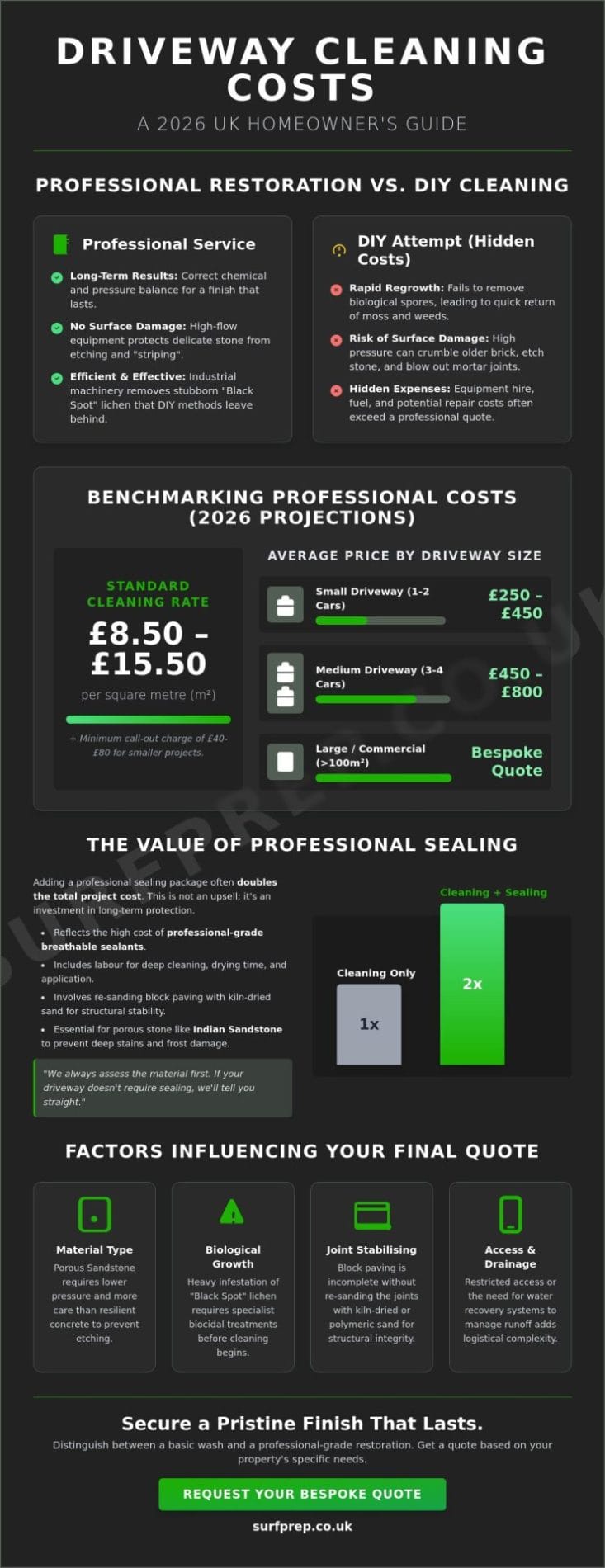
Understanding the driveway pressure washing cost UK 2026 requires looking past simple hourly rates. Currently, standard market rates for professional cleaning typically sit between £8.50 and £15.50 per square metre. Whilst it’s tempting to focus solely on the bottom line, it’s vital to understand what is pressure washing in a professional context. It isn’t just about high-pressure water; it’s about the volume of flow and the precision of the equipment used to prevent surface scarring. You aren’t just paying for a wash, you’re paying for the technical expertise to handle your specific substrate safely.
Small projects often face a minimum call-out charge, which typically ranges from £40 to £80 across the UK. This ensures the specialist can cover the logistical costs of transport, fuel, and equipment setup. Consequently, a compact driveway might carry a higher per-metre rate than a sprawling commercial forecourt. When you see quotes that seem unusually low, they often bypass the necessary preparation steps that ensure a long-lasting finish.
Average Price Breakdown by Driveway Size
Driveway dimensions dictate the baseline of your quote. Based on current 2026 market projections, here is what you should expect for standard cleaning:
- Small driveways (1-2 cars): Estimated ranges fall between £250 and £450.
- Medium driveways (3-4 cars): Professional rates often sit between £450 and £800.
- Large/Commercial expanses: Areas exceeding 100m² usually require bespoke quotes to account for water access and complex logistical requirements.
If your property requires superheated steam (DOFF) cleaning, expect a slight premium. This method uses high heat rather than raw force, making it the preferred choice for delicate heritage stone cleaning or older brickwork where traditional pressure might cause crumbling.
The Cost of Professional Sealing
Adding a sealing package often doubles the total driveway pressure washing cost UK 2026. This isn’t a simple upsell; it reflects the high price of professional-grade breathable sealants and the labour-intensive application process. Cheap "dust-binders" might look acceptable for a week, but they often trap moisture and cause long-term damage to the stone. A professional application involves deep cleaning, drying time, and often re-sanding with kiln-dried sand or polymeric compounds to ensure structural stability.
Expert admission: Sealing isn’t a universal requirement for every home. Whilst it’s essential for porous materials like Indian Sandstone to prevent deep-set staining, some dense, high-quality granites might not strictly need it. We always assess the material first. If your driveway doesn’t require sealing, we’ll tell you straight, rather than charging you for an unnecessary service.
Factors That Influence Your Quote: Beyond Square Metres
Dimensions provide the baseline, but they don’t tell the whole story. Your specific material and the biological load on the surface are what truly drive the driveway pressure washing cost UK 2026. A standard concrete slab is resilient, but natural Indian Sandstone is far more delicate. If a contractor approaches sandstone with the same raw power used on a motorway bridge, they’ll likely "etch" the surface or blow out the mortar joints entirely (a costly mistake that requires a full repoint). We prefer to assess the stone’s integrity before suggesting a high-pressure approach.
Access and drainage also play a significant role in the final quote. In dense urban areas, managing runoff is a legal and practical necessity. Following UK government driveway regulations ensures that water doesn’t flood the public highway or overload local sewers. If your property lacks adequate natural drainage, we may need to implement water recovery systems, which adds a layer of logistical complexity but protects your home’s foundation from water ingress.
Material Specificity and Restoration Methods
Block paving requires joint stabilising. After cleaning, the sand between blocks is often displaced; replacing this with kiln-dried sand is non-negotiable for structural stability. For natural materials, specialist stone cleaning uses lower pressure and higher water volume to prevent "pitting" or surface scarring. Pattern imprinted concrete often requires specific re-tinting and high-gloss sealing to restore its original aesthetic and prevent the colour from fading.
Biological Growth and Specialist Treatments
Biological growth like "Black Spot" lichen is notoriously difficult to shift. These organisms anchor themselves into the pores of the stone, meaning raw pressure often damages the substrate before it removes the lichen. Using superheated steam allows us to kill the spores at the root. This is a crucial factor in the driveway pressure washing cost UK 2026, as it prevents the immediate return of growth. Biocidal washes are often more effective than high pressure for long-term moss prevention.
If you’re unsure about the current condition of your driveway’s sub-base or material type, you can request a professional site survey to ensure you get an accurate, fixed-price quote.
Professional Restoration vs DIY: Calculating the Long-Term Value
Whilst hiring a domestic unit for £20 to £100 per day might seem like a savvy way to manage your driveway pressure washing cost UK 2026, the hidden expenses often mount up. Domestic machines typically lack the water flow rate required for a deep clean (often operating at under 10 litres per minute), which leads to "striping" where uneven pressure leaves permanent wand marks across your stone. Professional restoration is about more than just raw power. At Surfprep, we utilise superheated steam technology to lift grime at temperatures up to 150°C. This superheated method allows us to achieve a sterile, "like-new" finish without saturating the sub-base, which is a critical consideration for maintaining the structural integrity described in the UK government guidance on driveway surfacing.
Professional liability insurance also provides a safety net that DIY simply cannot offer. If a domestic pressure washer inadvertently blows a hole in a damp-proof course or shatters a delicate stone edge, the repair bills will quickly eclipse any initial savings. Choosing a specialist means you’re paying for calibrated equipment that delivers 1000+ PSI with precision, ensuring the job is done once and done correctly.
Avoiding Common Pressure Washing Mistakes
The most frequent error we see is "over-washing," where excessive pressure is used to compensate for a lack of heat. This can permanently degrade brickwork and erode the protective "face" of the material. Furthermore, "cheap" quotes often skip the essential 24 to 48-hour drying window required before applying sealants. If moisture is trapped beneath a sealer, it creates a milky, clouded finish that is incredibly difficult to rectify. Always ask a contractor for their technical methodology; if they don’t mention drying times or joint stabilisation, they’re likely cutting corners.
Next Steps: Getting an Accurate Quote
To ensure your driveway pressure washing cost UK 2026 remains transparent, we recommend providing clear photos and accurate dimensions when contacting a specialist for an estimate. A professional written quote should always include a clear breakdown of materials (such as kiln-dried sand or specific biocides), labour, and the removal of any biological waste. Expert admission: whilst the initial outlay is higher than a DIY weekend, a professionally maintained entrance can significantly boost kerb appeal, with some industry reports suggesting it adds between 5% and 10% to a property’s perceived value.
Investing in Professional Surface Restoration
Navigating the driveway pressure washing cost UK 2026 requires a shift in perspective from simple cleaning to comprehensive restoration. As we have explored, the true value lies in matching the technical method to your specific material, whether that involves joint stabilisation for block paving or the low-pressure care required for delicate natural stone. Avoiding the common pitfalls of DIY "striping" and surface etching ensures that your home’s kerb appeal remains a genuine asset rather than a recurring maintenance liability.
We pride ourselves on being honest specialists who prioritise the structural health of your property over a quick sale. With our national UK coverage and deep expertise in heritage stone and brick restoration, we use advanced superheated steam cleaning to deliver results that cold-water domestic units simply cannot match. If you’re ready to move beyond basic washing and invest in a professional finish that stands the test of time, our team is ready to assist. You can get a professional driveway restoration quote from Surfprep today. Let’s restore your property’s entrance to its original standard with the precision it deserves.
Frequently Asked Questions
Is it worth sealing a driveway after pressure washing?
Sealing is often the difference between a temporary clean and a long-term restoration. Whilst it increases the initial driveway pressure washing cost UK 2026, it provides a vital barrier against oil stains and significantly inhibits weed growth. For porous materials like Indian Sandstone, it’s essential for preventing deep-set grime. However, if your surface is a non-porous, high-density granite, we might admit that sealing is an unnecessary expense for your specific property.
How long does professional driveway cleaning take?
A typical medium-sized driveway, roughly 60 square metres, usually takes between 6 and 7 hours to clean thoroughly. Smaller 1-2 car spaces might be finished in 3 to 4 hours, whereas larger commercial projects require a full day or more. The duration depends heavily on the level of moss coverage and whether we’re using superheated steam to treat stubborn biological growth like "Black Spot" lichen.
Can pressure washing damage my block paving joints?
Standard high-pressure washing will inevitably displace the kiln-dried sand within block paving joints. This isn’t damage if the sand is professionally replaced once the surface is completely dry, but it can become a problem if the joints are left empty. The real risk comes from using excessive force at a sharp angle, which can undermine the sub-base. We use flat-surface cleaners to distribute pressure evenly and protect the structural integrity of your paving.
What is the best time of year to have my driveway cleaned and sealed in the UK?
The window between April and September offers the most reliable conditions for a full restoration project. Whilst we can perform basic cleaning year-round, sealing requires at least 24 hours of dry weather and a surface temperature above 10°C to cure correctly. Attempting to seal a damp driveway in the depths of winter often leads to a failed, milky finish that is difficult to rectify. We always monitor local forecasts to ensure the sealant bonds perfectly.
How much does it cost to remove oil stains from a driveway?
Oil stain removal is typically treated as a specialist pre-treatment rather than a standard wash. Because it requires industrial-grade degreasing chemicals and longer dwell times, it usually appears as a separate line item on your estimate. Success depends on how long the oil has been saturating the stone and the material’s porosity. We apply surfactants to break down the hydrocarbons before the main pressure washing begins to ensure the highest possible extraction rate.
Do I need to be at home whilst the driveway cleaning is being carried out?
You don’t need to be present as long as we have clear access to the driveway and a functional external water tap. We simply ask that all vehicles are moved off the drive and any side gates are left unlocked before our arrival. We’ll complete the restoration to our usual professional standards and ensure the site is left tidy. We can provide a final walkthrough or send digital photos of the completed work if you’re away from the property.
