
That high-pressure jet wash you are eyeing might be the fastest way to turn your historic boundary into a pile of crumbling rubble. It is a harsh reality that many well-meaning homeowners accidentally destroy the very character they are trying to preserve by using aggressive methods on delicate masonry. You likely want to reclaim your garden from stubborn black lichen and slippery moss, yet you are rightly worried about “spalling” (where the stone face flakes off) or blowing out fragile lime mortar joints.
Learning **how to clean old stone garden walls** is less about brute force and more about understanding the specific chemistry of your masonry. We agree that a wall should look cared for, not brand new and stripped of its history. In this guide, we will show you how to identify your stone type, remove biological growth safely, and achieve a professional finish that retains a beautiful historic patina. We will walk through the specialist techniques used in the industry, from superheated steam applications to pH-neutral cleaners, so you can decide exactly when to tackle the job yourself and when it is time to call in a restoration specialist.
In this specialist restoration guide, you will discover:
- Stone Identification: Why knowing the difference between porous sandstone and harder gritstone is vital for choosing the correct cleaning pressure.
- Mortar Integrity: How to test if your wall uses traditional lime mortar and why aggressive cleaning can lead to immediate structural failure.
- Professional Methodology: The proven sequence for how to clean old stone garden walls, starting with manual dry brushing to protect the stone’s natural patina.
- Advanced Cleaning Tech: The benefits of using superheated steam (Doff) cleaning to sanitise masonry surfaces without the use of saturating water or harsh chemicals.
- Post-Clean Care: How to assess the condition of your joints once the biological growth is removed to determine if specialist repointing is required.
Assessing Your Old Stone Garden Walls Before Cleaning
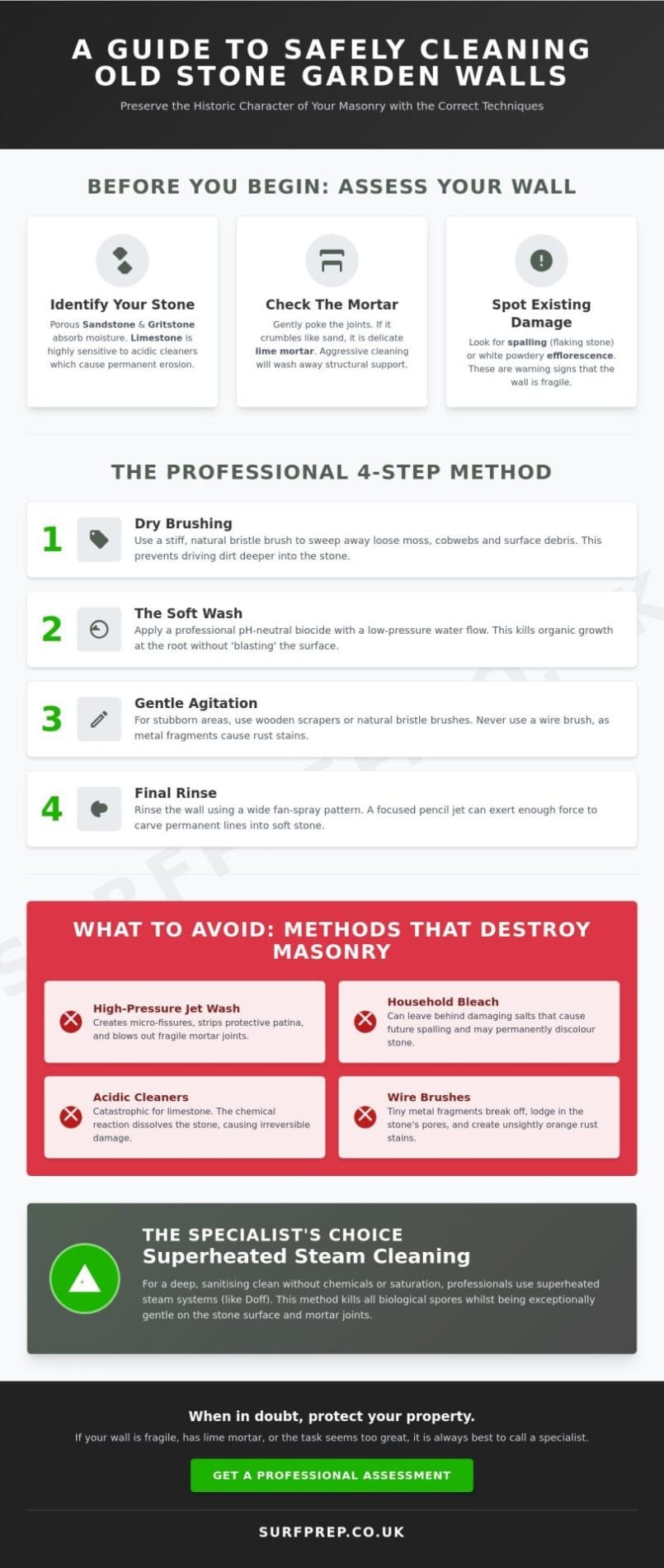
Before you begin researching how to clean old stone garden walls, you must understand the material under your hands. Stone walls across the UK vary wildly by region; what works for a granite boundary in Cornwall will likely ruin a limestone wall in the Cotswolds. You need to identify whether you are dealing with surface-level soot, green algae, or the stubborn “black spot” lichen that actually roots into the stone pores.
Your first task is a simple integrity test. Take a small tool and gently poke the mortar joints. If the material crumbles away like dry sand, you are looking at traditional lime mortar. This requires an incredibly delicate touch (and likely a specialist approach) to avoid washing the wall’s structural support away. If the mortar is hard and doesn’t shift, there is a significant chance it could be cement mortar – and the cause of your problems! Expert Admission: I’ll be honest; if your wall is already shedding large chunks of mortar or the stone feels soft to the touch, you shouldn’t clean it yet. You’ll need to organise professional stone cleaning and repointing as a combined restoration project rather than a simple DIY wash.
Identifying Common UK Stone Types
In the North, particularly around Leeds and York, limestone, sandstone and gritstones are the standard. These are durable but highly porous, meaning they act like sponges for moisture and biological growth. If you have limestone, you must avoid acidic cleaners at all costs. Acid causes limestone to “fizz,” which is a chemical reaction that dissolves the calcium carbonate. This leads to permanent surface erosion and a total loss of historic detail.
Spotting Damage: Efflorescence and Spalling
Keep an eye out for white, powdery streaks known as efflorescence. These are salt deposits pushed to the surface by migrating moisture. Whilst they can be brushed off, they often signal that the wall is holding too much water; in such cases, consulting a specialist in property preservation like Smart Property Care Ltd can help identify the source of the damp. You should also check for “spalling,” where the face of the stone begins to flake or peel away. If the stone is already delaminating, any form of pressure washing will accelerate the damage, leaving the wall vulnerable to the next winter frost cycle. This can be caused by using cement mortar rather than a lime based one..
Safe Methods for Cleaning Stone Walls: A Step-by-Step Guide
When considering how to clean old stone garden walls, the most effective approach is often the most patient one. We recommend a methodical four-step process that prioritises the long-term health of the masonry over immediate, aggressive results. Speed is rarely your friend when dealing with heritage materials.
Step 1: Dry Brushing. Start by using a stiff, natural bristle brush to sweep away loose moss, cobwebs, and dried mud. This removes the bulk of the debris without introducing moisture that could drive dirt deeper into the stone pores. Step 2: The Soft Wash. Apply a low-pressure water flow combined with a specialist biocide. This isn’t about “blasting” the wall; it’s about saturating the organic growth to kill spores at the root. Step 3: Agitation. For stubborn areas, use wooden scrapers or natural bristle brushes. Never use wire brushes; metal fragments can lodge in the stone and cause unsightly orange rust staining later. Step 4: Rinsing. Use a wide fan-spray pattern for the final rinse. A focused pencil jet can exert enough pressure to carve permanent lines into softer sandstone or gritstone.
The Dangers of High-Pressure Washing
It is tempting to use a standard domestic pressure washer to “blast” a wall clean, but this usually creates micro-fissures on the stone’s surface. These tiny cracks actually provide a perfect habitat for algae and moss to return even faster than before. High pressure also strips away the natural patina that protects the stone from the British weather. In many cases, aggressive washing will simply “blow out” historic lime mortar joints, leading to a much larger repair bill than you originally anticipated.
Choosing the Right Cleaning Solutions
Expert Admission: Whilst many online forums suggest using household bleach for a quick fix, we strongly advise against it. Bleach can leave behind residual salts that lead to future spalling and may permanently discolour certain stone types. Instead, look for pH-neutral, professional-grade biocides. For a truly deep clean that avoids chemical residue entirely, we often recommend superheated steam. If you feel hesitant about the condition of your masonry, looking into Surfprep’s stone cleaning services can ensure the work is carried out without risk of damage. Proper Assessing Cleaning and Water-Repellent Treatments is the only way to guarantee your heritage wall remains standing for another century.
Restoring and Protecting Your Stone Wall for the Long Term
Once the layers of biological growth and environmental soot are removed, the true condition of your masonry finally becomes visible. This is the critical moment to evaluate the structural health of the boundary. You may find that the moss was actually holding loose stones in place or hiding deep voids where mortar has washed away over decades. Understanding how to clean old stone garden walls is only the first step; the goal of any specialist restoration is to ensure the wall remains standing for the next century.
In damp Northern climates, particularly across Yorkshire and Lancashire, a wall that has been deep-cleaned is a blank canvas for new spores. Without a proactive maintenance schedule, you will likely see green algae returning within twelve to eighteen months. We recommend a light annual inspection to catch small patches of growth before they establish deep root systems. If the wall is large-scale or part of a heritage estate, organising a professional maintenance contract is often more cost-effective than a full-scale restoration every decade.
Professional Superheated Steam
For heritage properties, we rarely recommend chemical interventions or even low-pressure cold washing. Instead, we utilise superheated steam (we use a Thermatec machine – although this is often specified as DOFF). This technology uses superheated steam at temperatures up to 150°C. The heat kills biological spores instantly on contact, which means the “clean” look lasts significantly longer than traditional washing. Because the system relies on heat rather than high pressure, it doesn’t saturate the stone or damage fragile surfaces. This is why it remains the preferred method for English Heritage and listed property restoration. You can learn more about our specific approach to Surfprep’s superheated steam cleaning expertise to see how it protects delicate masonry.
Post-Clean Maintenance Tips
Improving the environment around the base of your wall is the best way to prevent future decay. Ensure that soil levels haven’t risen above the original footing and check that nearby gutters aren’t splashing directly onto the stone face. Expert Admission: I’ll be honest about stone sealants; most “waterproof” coatings found in DIY shops are a disaster for old stone. They trap moisture inside the masonry, leading to catastrophic spalling during the first hard frost. If you must use a protector, it must be 100% vapour-permeable to allow the stone to “breathe.”
If you are unsure about the stability of your mortar or the best way to handle a heritage boundary, it is always safer to seek a specialist opinion. You can contact Surfprep for a professional site assessment in Leeds, York, or Manchester to ensure your restoration project is handled with the appropriate tools and precision it deserves.
Restoring Your Property’s Historic Character Safely
Mastering how to clean old stone garden walls is ultimately a balancing act between removing harmful biological growth and protecting the delicate masonry underneath. As we have discussed, the process begins with a thorough assessment of your stone type and mortar integrity. Whether you choose to proceed with manual dry brushing or opt for the specialist precision of superheated steam, the goal is always to preserve the stone’s natural patina whilst preventing future structural damage.
If you find the task of managing heritage stone daunting, we are here to help. At Surfprep, we have been serving Leeds, York, and the wider North since 2000. As specialists, we bring the same level of expertise to domestic garden walls as we do to our large-scale industrial surface preparation projects. We don’t believe in quick fixes that cause long-term harm; we focus on delivering results that stand the test of time. You can request a professional stone cleaning quote from Surfprep today to ensure your masonry receives the expert care it deserves. With the right approach, your garden wall will remain a proud, historic feature of your property for generations to come.
Frequently Asked Questions
Can I use a pressure washer on my old stone garden wall?
You should generally avoid using a standard domestic pressure washer on heritage masonry. High-pressure jets can easily strip the protective “quarry sap” from the stone or blow out fragile lime mortar joints. Whilst some harder stones can withstand higher settings, it is far safer to use a low-pressure soft wash when researching how to clean old stone garden walls to preserve the structural integrity of the wall.
How do I remove black lichen from my stone wall safely?
Removing black spot lichen requires patience rather than brute force. These organisms root deeply into the stone pores; therefore, a professional-grade biocide or superheated steam treatment is the most effective way to kill the spores at the source. This ensures the lichen is removed without the need for aggressive scrubbing that might scar the surface of the masonry or cause permanent surface damage.
Is it safe to use bleach to clean garden ornaments and walls?
We strongly advise against using household bleach on natural stone or garden ornaments. Bleach contains salts that can lead to efflorescence and future surface flaking, particularly on porous materials like sandstone or limestone. It can also cause permanent discolouration; this leaves your garden features looking patchy and chemically damaged rather than properly restored. Always opt for pH-neutral cleaners specifically formulated for masonry.
How do I know if my stone wall needs repointing after cleaning?
You will know your wall needs repointing if you see deep voids, loose stones, or mortar that crumbles when touched after the cleaning process is finished. Moss often hides significant structural decay; consequently, once the biological growth is cleared, any missing or recessed joints will become obvious. If you are unsure about how to clean old stone garden walls safely, a professional assessment can help identify if repointing is required before any further water is applied.
