
Table of Contents
The Dilemma of Removing Old Floor Paint from Concrete Surfaces
Case Study: Professional Floor Preparation for a Nottingham Industrial Facility
Achieving the Correct Concrete Surface Profile (CSP): The Secret to Long-Lasting Floor Coatings
The Dilemma of Removing Old Floor Paint from Concrete Surfaces
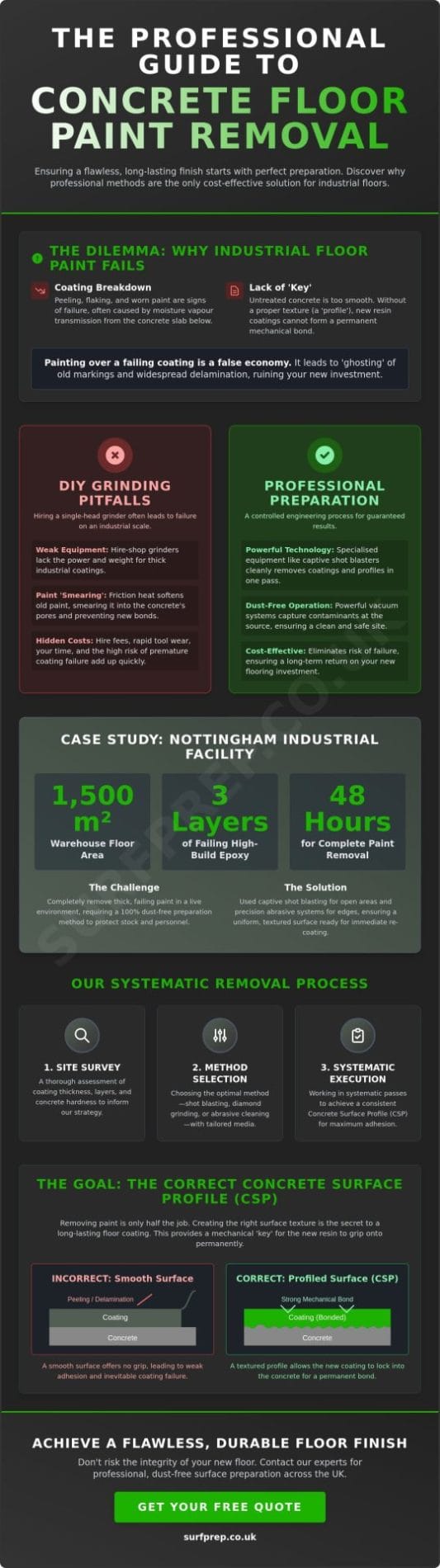
For any facilities manager, the sight of peeling, flaking, or worn industrial floor paint is more than just an aesthetic issue; it’s a sign of impending failure. Often, this breakdown is caused by underlying problems such as moisture vapour transmission from the concrete slab or, more commonly, a lack of an adequate surface profile when the original coating was applied. The smooth, non-porous surface of untreated concrete simply doesn’t provide the "key" needed for high-performance resins to form a permanent mechanical bond.
Why industrial floor paint fails: Common culprits include moisture vapour transmission and, crucially, the lack of an initial surface profile for the paint to grip onto.
The "Expert Admission": Whilst chemical strippers might seem effective for small domestic patches, they are often entirely unsuitable for large-scale commercial projects, especially in active facilities. They can leave a residue that actively prevents new coatings from adhering correctly.
Defining mechanical surface preparation: This isn’t just about cleaning. It is a controlled engineering process of removing old coatings and contaminants whilst simultaneously roughening the concrete to create a specific, textured finish.
The risks of ignoring old paint: Simply painting over a failing coating is a false economy. Issues like "ghosting" (where old line markings show through) and widespread delamination can ruin a significant new investment in epoxy or polyurethane systems.
Why DIY Grinding Often Falls Short
Faced with a failing floor, many consider hiring a single-head floor grinder. Unfortunately, this approach is rarely successful on an industrial scale. The limitations quickly become apparent when dealing with stubborn, multi-layered, or high-build epoxy coatings that have been in place for years.
The limitation of hire-shop grinders: These machines often lack the power and weight required to effectively remove thick industrial coatings, leading to an inconsistent finish and long, frustrating hours of work.
The "smearing" effect: The heat generated by the friction of a single grinding head can soften old paint, smearing it into the concrete’s pores rather than cleanly removing it. This contamination can jeopardise the bond of any new coating.
The hidden costs of DIY: The initial hire cost is just the beginning. Factoring in the rapid wear of diamond tooling, your time, and the extremely high risk of a premature coating failure makes professional preparation a far more cost-effective solution.
Case Study: Professional Floor Preparation for a Nottingham Industrial Facility
To illustrate the difference a professional approach makes, consider a recent project we undertook for a client in Nottingham. The challenge was to prepare a large warehouse floor for a new, modern resin system, requiring a methodical and efficient solution.
Project Overview: A 1,500m² warehouse floor in Nottingham with three layers of failing high-build epoxy paint that needed complete removal.
The Challenge: The primary task was removing the thick, failing paint whilst operating in a live environment, demanding a dust-free surface preparation method to protect adjacent stock and personnel.
The Solution: We implemented a multi-stage mechanical preparation system. For the large, open areas, a captive shot blasting machine was used, which fires steel shot at the surface and immediately recovers it, stripping the paint and profiling the concrete in one pass. For edges and difficult-to-reach areas, we used precision abrasive systems with full vacuum recovery.
Outcome: Complete removal of all three paint layers was achieved within 48 hours, leaving a uniform, textured surface ready for the immediate application of a new coating system.
The Professional Removal Process
A successful outcome is not accidental; it is the result of a planned, systematic process that accounts for the unique conditions of every concrete floor. Our approach is built on precision and technical understanding.
Initial Site Survey: We begin with a thorough site survey to assess the existing coating’s thickness, identify the number of layers, and test the hardness of the underlying concrete. This informs our entire strategy.
Selection of Method and Abrasive: Based on the survey, we select the optimal mechanical method. This may be captive shot blasting for large expanses, diamond grinding for levelling, or specialised abrasive cleaning for detailed areas. The abrasive media is tailored to the specific coating type to ensure efficient removal without damaging the substrate.
Systematic Execution: Our team works in systematic passes across the floor to achieve the specified Concrete Surface Profile (CSP), ensuring a consistent texture that is essential for the new coating’s performance.
Managing Dust and Disruption
In a commercial or industrial setting, controlling dust is not just a matter of cleanliness—it’s a critical health and safety requirement. We prioritise creating a safe, low-disruption work environment for clients in cities like Manchester, Leeds, and across the North.
Vacuum-Shrouded Systems: All our primary preparation equipment, from floor blasters to hand-held grinders, is fitted with powerful, vacuum-shrouded heads that capture dust and debris at the source, preventing airborne particulates.
Working Around Fixed Machinery: For areas inaccessible to larger machines, the precision of systems like our sand jet cleaning equipment allows us to work carefully around fixed machinery and up to finished edges.
Site Safety Protocols: We adhere strictly to the UK’s Health and Safety Executive (HSE) guidelines for managing airborne contaminants, including crystalline silica dust, ensuring full compliance and site safety.
Achieving the Correct Concrete Surface Profile (CSP): The Secret to Long-Lasting Floor Coatings
Simply removing the paint is only half the job. The real secret to a floor coating that lasts for decades is achieving the correct Concrete Surface Profile (CSP). This is a standardised measure, defined by the International Concrete Repair Institute (ICRI), that grades the roughness of the concrete from very smooth (CSP 1) to extremely rough (CSP 9).
Understanding CSP: Different coatings require different profiles. A thin sealer might only need a light etch (CSP 2), whereas a thick, 3mm self-smoothing epoxy system requires a much more aggressive profile (CSP 4-5) to anchor itself securely.
The Role of "Surface Profile" in Mechanical Bonding: The profile creates a vastly increased surface area for the new coating to bond with. A properly prepared floor should feel similar to 60-grit sandpaper, providing the mechanical "key" that is essential for long-term adhesion.
Why Quality Control is Non-Negotiable: A specialist contractor will work to achieve a specific CSP target, ensuring the preparation is perfectly matched to the resin system being installed. This is the difference between a floor that lasts and one that fails.
Final Inspection: Before any primer is applied, the floor must be checked for "laitance" (a weak, dusty layer on the surface of new concrete) and other contaminants to ensure the substrate is sound, clean, and ready for coating.
British Standards and Compliance
In the UK, professional surface preparation is guided by established standards that ensure quality and reliability. Adhering to these provides peace of mind for both the client and the coating applicator.
Adhering to BS 8204: This is the British Standard for screeds, bases, and in-situ floorings. It provides detailed guidance on the requirements for substrates to receive resilient, textile, and laminate floor coverings, including the importance of proper preparation.
Why Commercial Insurers Take Notice: In the event of a large-scale floor coating failure, commercial insurers may investigate whether the surface was prepared to the manufacturer’s specification and relevant British Standards.
The Value of a Specialist Contractor: A professional surface preparation company can provide a "preparedness certificate" or a detailed report, offering documented proof that the substrate is sound and ready for the next stage, protecting your investment.
