
Your building’s facade is the first thing a client sees, yet an aggressive “quick fix” with a high-pressure jet wash could be the most expensive mistake you ever make. We’ve seen too many delicate plastic coatings stripped and masonry scarred by contractors who lack the right equipment for professional commercial building facade cleaning. It’s a common worry for property managers; you want to remove unsightly algae and carbon build-up, but you’re terrified of causing permanent structural damage or facing the logistical nightmare of a city-centre site.
We agree that maintaining a professional image shouldn’t come at the cost of your building’s lifespan. Since we established our business in November 2000, we’ve focused on specialist restoration that balances aesthetic results with technical precision. This guide explains how to restore your property’s exterior using Thermatech superheated steam, often referred to as DOFF, and our specialist gentle sand jet system. We’ll outline the exact methods used to ensure compliance with UK health and safety standards, providing a clear path to a restored facade with minimal disruption to your daily business operations.
Key Takeaways
- Understand the technical requirements of commercial building facade cleaning to safely remove organic growth and carbon pollutants from diverse substrates like Kingspan panels and architectural stone.
- Discover why Thermatech (also known as DOFF) superheated steam at 150°C provides the most effective, low-pressure solution for sterilising biological matter on masonry.
- Learn about our gentle sand jet machine, which serves as a precise alternative to aggressive sandblasting for clearing stubborn oxidation and carbon crusting.
- Explore the logistics of high-level restoration, including the use of lorry-mounted cherry pickers and the necessity of pre-start site surveys in busy city centres.
- Learn how we ensure compliance with UK health and safety standards whilst minimising disruption to your daily business operations.
Assessing Commercial Facades: Material Risks and Contaminants
Technical commercial building facade cleaning involves much more than a simple wash down; it’s the precise removal of organic growth, carbon pollutants, and oxidation from the building envelope. Since we began our work in November 2000, we’ve seen how the diverse architecture across the North and Midlands requires a specialist touch. Whether your property features architectural stone in the centre of York or traditional brick facades in industrial Manchester, the cleaning method must match the substrate’s specific chemistry.
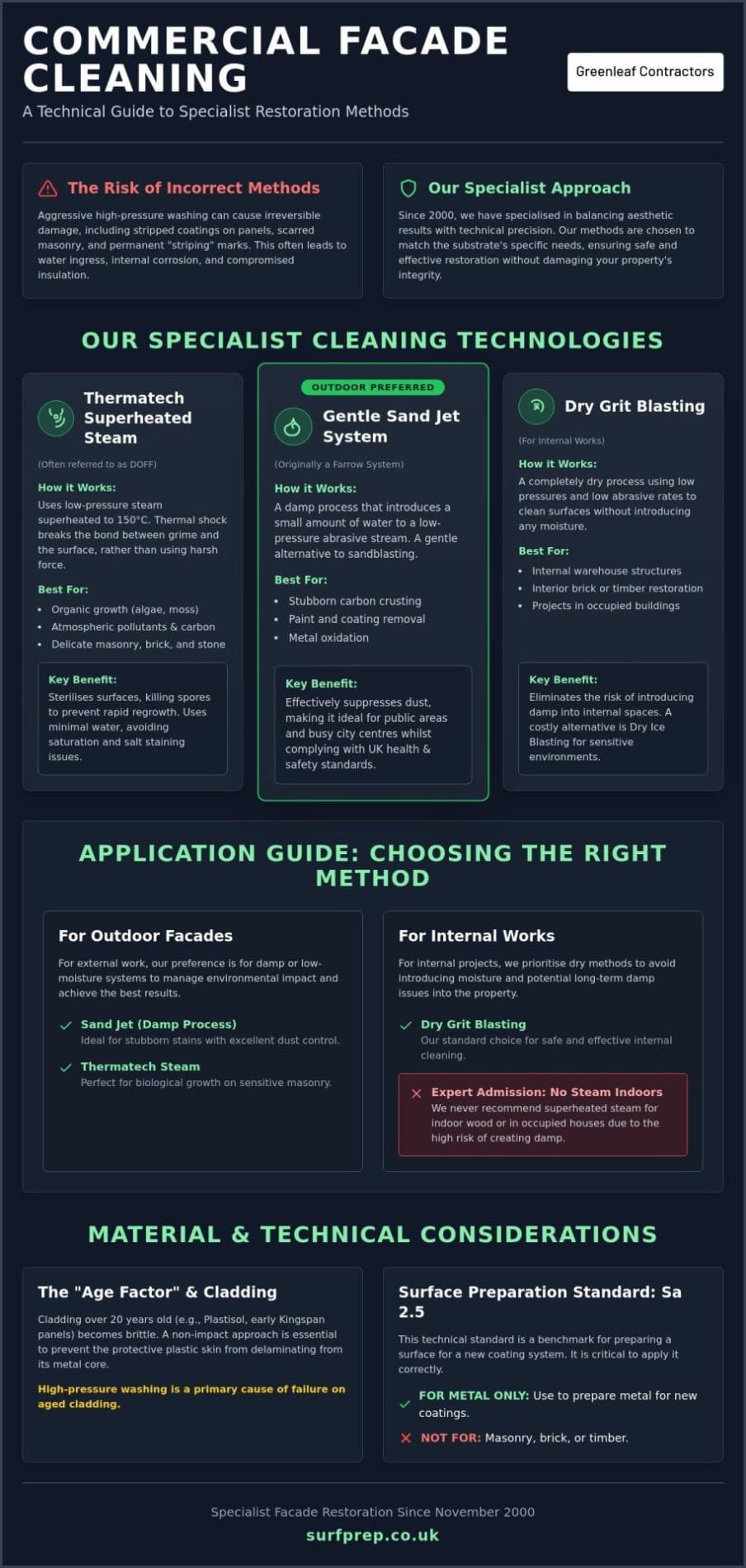
The “Age Factor” is perhaps the most overlooked risk in our industry. Cladding that has been in place for over 20 years, such as older Plastisol-coated steel or early Kingspan panels, requires a strictly non-impact approach. At this stage in its lifecycle, the plastic skin can become brittle. Using aggressive methods can cause this protective layer to delaminate from the metal core, leading to a total failure of the panel’s aesthetic and structural integrity. Regional environment also dictates our strategy; we tackle heavy industrial soot in Leeds and Manchester, whilst coastal sites in Hull or Scarborough require the removal of salt spray that otherwise accelerates metal oxidation.
The Dangers of High-Pressure Water Ingress
We often advise clients against standard high-impact pressure washing techniques for modern building envelopes. Excessive PSI can force water directly into panel joints and behind flashings. This leads to internal corrosion and can compromise the insulation within. Furthermore, high-pressure streams often leave permanent “striping” marks on the UV-protective layer of coloured metal panels, which is impossible to reverse without a full respray.
Technical Standards for Metal Facades
When we move beyond simple cleaning into full restoration, we reference Sa 2.5 standards for metal cladding preparation. This technical benchmark is essential when a facade needs to be prepared for a new coating system. It’s an expert admission on our part, however, that these standards are strictly for metal. We never apply Sa 2.5 metrics to masonry, brick, or timber, as these materials require an entirely different set of preservation protocols to maintain their integrity.
Specialist Cleaning Technologies: Thermatech Steam and the Sand Jet System
Effective commercial building facade cleaning relies on choosing the right tool for the specific contaminant. We’ve found that for most biological growth and atmospheric staining on masonry, heat is a far more effective solvent than raw pressure. Our Thermatech system, often recognised across the industry as a DOFF-style cleaner, produces superheated water at temperatures up to 150°C. This isn’t just about melting away grime; the low-pressure delivery ensures the underlying material remains intact whilst the high heat sterilises the surface, killing off algae spores at the root to prevent rapid regrowth.
For more stubborn carbon crusting or oxidation, we utilise our specialist sand jet machine. Originally acquired as a Farrow System in November 2000, this technology represents a gentle alternative to traditional sandblasting. In outdoor environments, we always prefer the “damp process.” By introducing a small amount of water into the abrasive stream, we suppress dust effectively, which is vital for protecting the public and neighbouring properties in busy city centres. Adhering to stringent UK health and safety regulations and industry best practices for safety and methodology, the controlled nature of these systems becomes even more critical for high-level restoration.
Thermatech vs Traditional Pressure Washing
The primary advantage of superheated steam is thermal shock. Instead of using mechanical force to “blast” dirt away, the heat breaks the chemical bond between the grime and the building. It’s a much kinder process for fragile stone and brick. Because the system uses very little water, we avoid the saturation issues that often lead to efflorescence or salt staining later in the project’s life.
Managing Internal Restoration Projects
Our “Expert Admission” is simple: we never recommend superheated steam for indoor wood or occupied houses. Introducing moisture into a confined, internal space is a recipe for long-term damp issues. For warehouse interiors or structural steels, we pivot to dry grit blasting at low pressures. This allows us to achieve a clean, prepared finish without the risk of water damage to internal fixtures or stock. If you’re unsure which method fits your property, we’re always happy to discuss your specific site requirements and provide a technical recommendation.
Executing the Project: Logistics, Access, and Safety
Successful commercial building facade cleaning relies as much on logistical precision as it does on technical equipment. When we operate in tight city-centre sites like York or Leeds, we typically utilise lorry-mounted cherry pickers or Mobile Elevated Work Platforms (MEWPs). These allow our teams to reach high-level elevations without the intrusive presence of scaffolding. This approach keeps your site secure and maintains a professional appearance throughout the restoration process.
We believe a pre-start site survey is non-negotiable. During this visit, we identify drainage requirements and locate any delicate architectural features that require specific protection. It’s during this phase that we ensure our methods align with historic masonry cleaning guidelines; we’re focused on preservation, not just a quick aesthetic fix. We also manage all environmental compliance, ensuring that run-off is handled according to local water authority regulations in the North and Midlands.
Navigating Local Logistics in the North
Operating in pedestrianised zones in Manchester, Nottingham, or Newcastle requires careful permit management. We handle these administrative hurdles to ensure your project stays on track. We’ve seen first-hand how improving business curb appeal through professional cleaning directly impacts tenant retention and property value. To support this, we offer out-of-hours and weekend scheduling for retail parks and office blocks to ensure minimal disruption to your daily operations.
Health, Safety, and Transparency
Safety is our primary concern. We provide bespoke RAMS (Risk Assessments and Method Statements) for every commercial building facade cleaning project we undertake. As an “Honest Specialist,” we take pride in our transparency. If our survey reveals that a specific cleaning method might compromise the building’s structural health, we’ll advise against it. We’d rather lose a sale than damage a client’s property; we always prioritise the long-term integrity of the substrate over a temporary shine.
Protecting Your Building Investment Through Specialist Restoration
Professional commercial building facade cleaning is about more than just aesthetics; it’s a critical maintenance task that preserves the lifespan of your property’s envelope. By choosing the right technology, such as the sterilising power of Thermatech superheated steam or the gentle abrasive action of our sand jet system, you avoid the delamination and water ingress risks associated with standard high-pressure methods. We’ve explored how a technical approach prevents the costly mistakes that often follow “quick fix” solutions.
We’ve spent over 25 years refining our approach to industrial surface preparation. Since November 2000, we’ve provided dependable, technical solutions for businesses across Leeds, Manchester, Hull, and the wider North. Our team prioritises transparency and material integrity, ensuring your restoration project meets strict safety standards whilst causing minimal disruption to your daily operations. We’re proud of our history as honest specialists who put the health of your building first.
Ready to restore your property to its best? Contact our specialist team for a free site survey and bespoke cladding cleaning quote. We look forward to helping you maintain a professional, high-standard exterior that reflects the quality of your business.
Frequently Asked Questions
How much does commercial cladding cleaning cost per square metre?
The total investment for commercial building facade cleaning varies based on the building’s height, the specific access equipment required, and the level of atmospheric soiling. A project in a busy city centre requiring lorry-mounted cherry pickers and pedestrian management permits will involve different logistical costs than a ground-level industrial unit. We provide bespoke quotes following a thorough site survey to ensure our technical solution matches your specific environment and budget requirements.
Will professional steam cleaning damage the plastic coating on my building facade?
Thermatech superheated steam is one of the safest methods available because it relies on thermal shock rather than mechanical pressure to remove grime. It’s designed to protect the integrity of delicate architectural coatings. However, we always assess the age of the cladding first; if a plastic skin is over 20 years old and showing signs of brittleness, we’ll adapt our technique to ensure the surface doesn’t delaminate during the process.
How often should commercial building facades be cleaned to maintain the warranty?
Most major cladding manufacturers, such as Kingspan, recommend a formal cleaning and inspection cycle every one to five years to keep material warranties valid. The exact frequency depends on your location. Buildings in high-corrosion environments, such as coastal sites near Hull or industrial zones in Manchester, require more regular attention to prevent salts and carbon pollutants from causing permanent oxidation to the metal substrate.
Can you clean commercial cladding during business hours without disrupting customers?
We can operate during the day, but we often suggest out-of-hours or weekend scheduling for retail parks and busy office blocks to ensure zero disruption to your clients. By utilising MEWPs instead of fixed scaffolding, we maintain a small operational footprint and keep entrances clear. Our teams also manage all water run-off and use the damp process on our sand jet machines to suppress dust, keeping the site safe for everyone.
