
That thick layer of masonry paint isn’t just an eyesore; it could be actively suffocating your property’s ability to breathe. Many homeowners and developers across the country are searching for how to remove paint from brickwork UK to restore the natural character of their buildings, yet they often stall when faced with the risk of permanent scarring. It’s completely understandable to feel hesitant. You’ve likely heard horror stories of aggressive sandblasting that strips away the “fire skin” (the hard, protective outer layer of the brick), leaving the soft core exposed to the British weather.
Our guide, backed by over 25 years of specialist restoration experience since we established in November 2000, reveals the professional methods that prioritise masonry health over a quick, destructive fix. We’ll explore the precision of Thermatech superheated steam and the gentle touch of the sand jet (originally the Farrow System), whilst navigating the latest 2026 UK REACH chemical regulations and lead-based paint safety standards. From preserving historic facades to meeting the NHBC Standards 2026 for newer builds, you’ll discover how to achieve a clean, original finish without compromising the structural integrity of your masonry.
Key Takeaways
- Protect your property’s structural integrity by learning why the brick’s “fire skin” is its most important defence against the British weather.
- Discover how to remove paint from brickwork UK using Thermatech superheated steam, which melts away multiple layers of masonry paint without the need for high-pressure impact.
- Explore the advantages of the sand jet (originally the Farrow System) as a gentle, damp abrasive alternative to traditional sandblasting for external restoration projects.
- Identify the crucial distinctions between internal and external methods, including why dry ice blasting or low-pressure grit blasting are preferred for delicate indoor spaces.
- Navigate the logistical side of restoration, from the necessity of professional site trials to securing Listed Building consent for heritage properties in cities like York and Lincoln.
Understanding Your Masonry: Why “How to Remove Paint from Brickwork UK” is a Complex Question
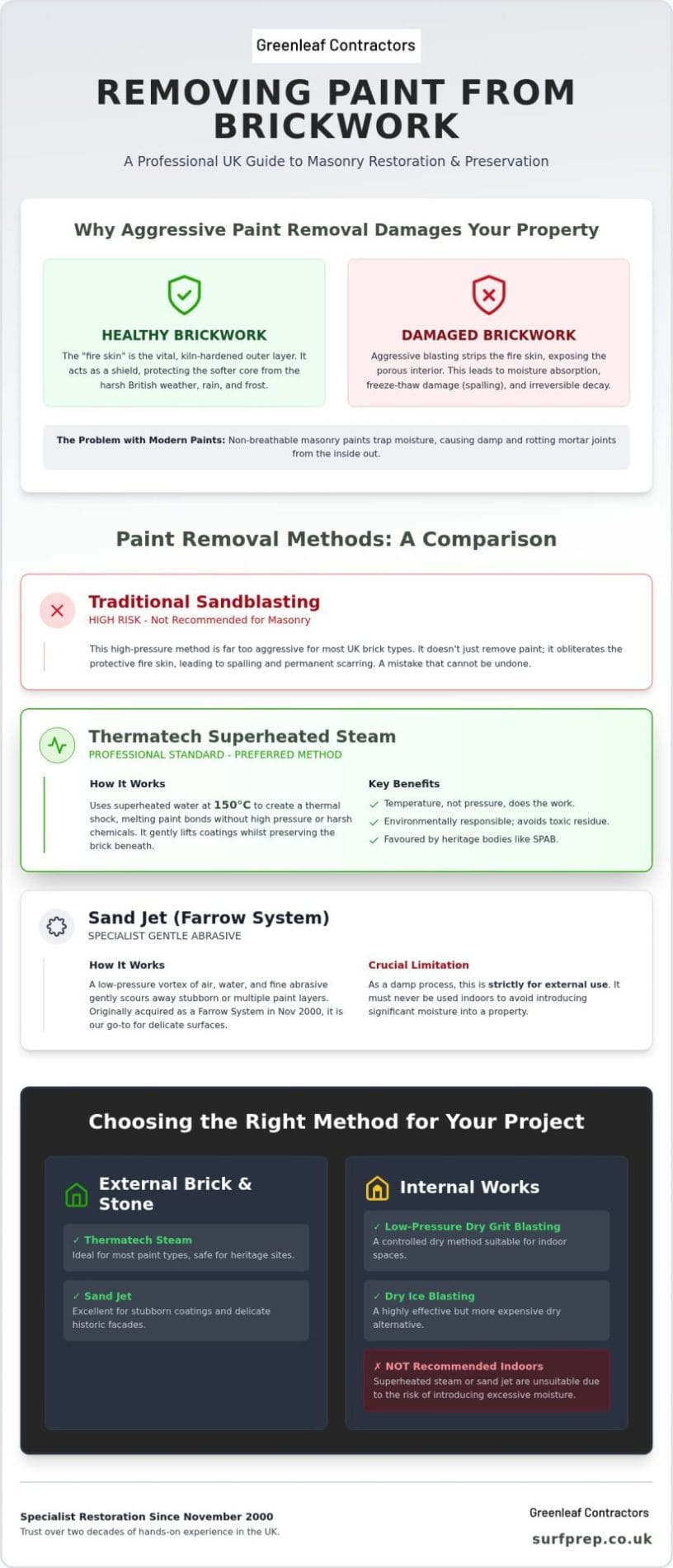
Removing paint from a building isn’t just about aesthetics; it’s a matter of structural preservation. If you’re asking how to remove paint from brickwork UK, you must first understand the “fire skin”. This is the kiln-hardened outer surface that acts as a brick’s primary shield against rain and frost. Once this layer is breached, the softer, more porous interior is exposed, leading to rapid deterioration and moisture absorption.
We’ve encountered almost every coating imaginable since we established our business in November 2000. Historic properties often feature breathable limewash, whilst mid-century homes might be coated in modern, rubberised masonry paints. These modern coatings are particularly troublesome because they trap moisture behind the paint film, causing the brickwork to stay damp and eventually rot the mortar joints from the inside out.
Whilst off-the-shelf chemical paint removers are widely available, they often require exhausting multiple applications and can leave unsightly staining amongst different regional brick types. Worse still, DIY attempts with wire brushes or high-pressure domestic washers often cause irreversible pitting. This damage triggers efflorescence, where salts are drawn to the surface, creating a white, powdery residue that is notoriously difficult to manage once the brick’s face is compromised.
The Risk of Traditional Sandblasting
Standard grit blasting is frequently far too aggressive for the UK’s architectural heritage. When high-pressure abrasives hit soft red bricks, they don’t just take the paint; they take the face of the brick with it. This leads to “spalling”, a process where the brick surface crumbles away during winter freeze-thaw cycles because the protective skin has been obliterated. It’s a mistake that can’t be undone.
Identifying Your Brick Type
Every project requires a bespoke approach. There is a vast difference between cleaning hard-engineered bricks and the porous, handmade period bricks found across York, Leeds, and Hull. We always recommend a professional survey of your brick cleaning requirements before any work begins. Understanding the specific substrate ensures we choose the right specialist equipment rather than a one-size-fits-all solution that could cause lasting harm.
Specialist Methods: The Thermatech and Sand Jet Advantage
When you’re researching how to remove paint from brickwork UK, you’ll quickly realise that the industry is divided between aggressive mechanical methods and slow chemical stripping. We bridge that gap using two primary technologies: Thermatech superheated steam and the sand jet. These systems allow us to work with surgical precision, ensuring that the paint is lifted whilst the underlying masonry remains untouched.
Thermatech vs. Generic Steam Cleaning
Temperature is far more important than pressure when it comes to stubborn masonry coatings. The Thermatech system produces superheated water at 150°C, which acts as a thermal shock to the paint bonds. Unlike a standard pressure washer that relies on kinetic force (often causing the pitting mentioned in the previous section), Thermatech melts the paint. This approach is highly favoured by the Society for the Protection of Ancient Buildings (SPAB) because it avoids the use of harsh alkaline chemicals that can leach into the brickwork. It’s an environmentally responsible choice that delivers a clean finish without saturating the substrate with toxic residues.
The Sand Jet: Precision Abrasive Cleaning
For more resilient coatings or multiple layers of lead-based paint, we utilise the sand jet. This system, which we originally acquired as a Farrow System in November 2000, is a damp abrasive process. It’s incredibly gentle, allowing us to clean delicate surfaces that would be destroyed by traditional sandblasting. Because it uses a low-pressure vortex of air, water, and fine abrasive, it’s the preferred method for stone cleaning and historic facades. If you’re unsure which method fits your project, you can see the results of this technology on our sand jet cleaning page.
Expert Admission: Whilst the damp sand jet is perfect for external walls, we never recommend it for internal works. Introducing water into an occupied property or a confined indoor space can lead to long-term damp issues and secondary damage. For internal paint removal, we pivot to traditional dry grit blasting at very low pressures or dry ice blasting. Dry ice is an exceptional, mess-free option, though it is a significantly more expensive choice due to the logistics of the CO2 pellets. We also apply this same caution to wooden beam cleaning; superheated steam should stay outside to protect the timber from moisture-related movement.
If you’re dealing with a particularly complex heritage property, it’s always worth speaking with a specialist to ensure the method matches the material.
Organising Your Restoration: What to Expect from a Professional Service
Once you’ve decided on the right methodology, the focus shifts to the logistical reality of the project. Understanding how to remove paint from brickwork UK effectively requires more than just high-end machinery; it demands a methodical approach to site management and property protection. We never start a full-scale project without conducting a site trial on a small, inconspicuous area. This test allows us to observe exactly how the specific brick substrate and paint layers react to our equipment, ensuring the final result is uniform and damage-free across the entire facade.
For those owning heritage properties in cities such as York, Lincoln, or Durham, navigating Listed Building consent is a critical step. Conservation Officers often require proof that the chosen technique won’t harm the historic fabric of the building. Since we established Surfprep in November 2000, we’ve regularly worked alongside local authorities to demonstrate the safety of our specialist methods for paint removal. Our long history in the North means we understand the regional stone and brick variations, from the soot-stained industrial terraces of Manchester to the handmade bricks found amongst East Yorkshire villages.
Choosing a Contractor in Northern England
Local knowledge is indispensable when selecting a restoration partner. Property styles in Leeds, Manchester, and Hull vary significantly; a contractor must be able to adjust their abrasive rates and temperatures to suit the local material. Always ask potential firms if they utilise dedicated restoration equipment like the Thermatech system. If they plan to use a standard domestic power washer, they aren’t the right fit for professional brick cleaning. A specialist will also have a clear plan for protecting your windows, doors, and neighbouring properties from debris whilst the work is underway.
Aftercare and Maintenance
Once the paint is gone, your brickwork needs to breathe. We generally advise against applying non-breathable sealants, as these can recreate the moisture-trapping issues of the original masonry paint. Leaving the brickwork natural is often the best course of action for the building’s longevity. If a protective coating is necessary for weatherproofing, it must be a high-quality, vapour-permeable product. This ensures that moisture can escape from the masonry, preventing the peeling and damp issues that likely led you to seek restoration in the first place.
Restoring the Original Character of Your Masonry
Restoration is a delicate balance between aesthetic renewal and structural preservation. By choosing a method that respects the brick’s “fire skin” and addresses the specific type of coating, you ensure your property remains weather-proof for decades to come. Mastering how to remove paint from brickwork UK involves more than just equipment; it requires the seasoned judgement that only comes from decades of hands-on experience in the field.
Since November 2000, we’ve helped property owners across Leeds, York, Hull, and the wider North uncover the hidden beauty of their buildings. Our commitment to using precision technology like Thermatech and the sand jet ensures that even the most stubborn masonry paint is lifted without the risk of pitting or scarring. We pride ourselves on being honest specialists who prioritise the right technical solution for every unique stone or brick type.
If you’re ready to move forward with a restoration that adds value and integrity to your property, we’re here to help. Request a Professional Brickwork Survey from Surfprep to get expert advice on the safest path for your project. Your building deserves a finish that stands the test of time.
Frequently Asked Questions
Is it safe to remove paint from old bricks myself?
DIY removal is generally unsafe for the building’s longevity because it risks obliterating the protective “fire skin”. We’ve seen many properties where wire brushes or domestic pressure washers have caused irreversible pitting; this damage allows moisture to penetrate the soft core of the brick. Professional intervention ensures the right balance of temperature and pressure is maintained to protect the masonry for the long term.
How much does professional brick paint removal cost in the UK?
The cost of professional restoration varies based on the property’s size, the number of paint layers, and the specific method required. Factors like scaffolding access and regional location also play a significant role in the final quote. Investing in specialist methods avoids the high future costs of repairing masonry that has been damaged by cheaper, more aggressive alternatives.
Will removing paint damage the mortar joints between my bricks?
Specialist systems like Thermatech or our sand jet are designed to lift paint without eroding the underlying mortar. Traditional sandblasting is often too abrasive, but our gentle abrasive sand jet (originally the Farrow System) uses a low-pressure vortex that respects the joints. If your mortar is already failing, we can advise on repointing once the paint is removed to ensure the wall is fully restored.
What is the best method for removing paint from a Listed Building?
Thermatech superheated steam is widely considered the best approach for Listed Buildings and heritage masonry. It’s a non-destructive process that avoids harsh chemicals, making it a favourite amongst Conservation Officers in cities like York and Lincoln. This method effectively lifts multiple layers of old masonry paint whilst preserving the historic fabric of the building; a crucial factor for how to remove paint from brickwork UK in sensitive contexts.
How long does it take to clean a standard house facade?
A standard house facade usually takes between two to five days to complete, though this depends on the complexity of the job. Dealing with multiple layers of rubberised masonry paint or old lead-based variants can extend the timeline. We always recommend a site trial first, as this helps us provide a more accurate estimate of the time required for a thorough and safe clean.
Can you remove graffiti as well as old masonry paint?
We certainly can; graffiti removal is a core part of our restoration service. We utilise the same precision technology to lift spray paint and ink from brick or stone without leaving unsightly “ghost” marks behind. Whether you’re dealing with modern vandalism or decades of old paint, our systems are versatile enough to handle various contaminants. This is a key part of how to remove paint from brickwork UK for both domestic and commercial clients.
