
The real damage of a fire doesn’t end when the flames are extinguished; it’s the invisible, corrosive soot that begins eating away at your property’s history the moment smoke clears. You’re likely worried that aggressive cleaning will leave permanent scars on delicate stonework or that smoke odours will remain trapped in structural timbers forever. It’s a stressful position, especially when you’re trying to protect the integrity of a Leeds landmark or a family home. Our team has provided specialist fire restoration since November 2000, and we’ve learnt that every surface requires a bespoke approach (what works for stone will often ruin wood). This article reveals how techniques like Thermatech superheated steam and sand jet can restore your property to its former glory. We’ll explore the best methods for cleaning external masonry and internal timbers, using dry grit blasting to achieve a soot-free finish without the risk of further damage.
Key Takeaways
- Understand the corrosive nature of soot and why rapid neutralisation is essential to prevent fire-hose water from driving contaminants deeper into porous brick and stone.
- Discover how Thermatech superheated steam and the sand jet system provide gentle yet effective cleaning for exterior masonry without the aggression of traditional sandblasting.
- Learn why professional fire restoration for internal timbers requires dry grit blasting or dry ice blasting to avoid the moisture risks associated with steam or damp processes.
- See how a detailed site survey and our “Expert Admission” approach ensure you receive honest, practical advice on which restoration techniques will truly work for your property.
The Science of Fire Damage: Why Specialist Cleaning is Essential for Restoration
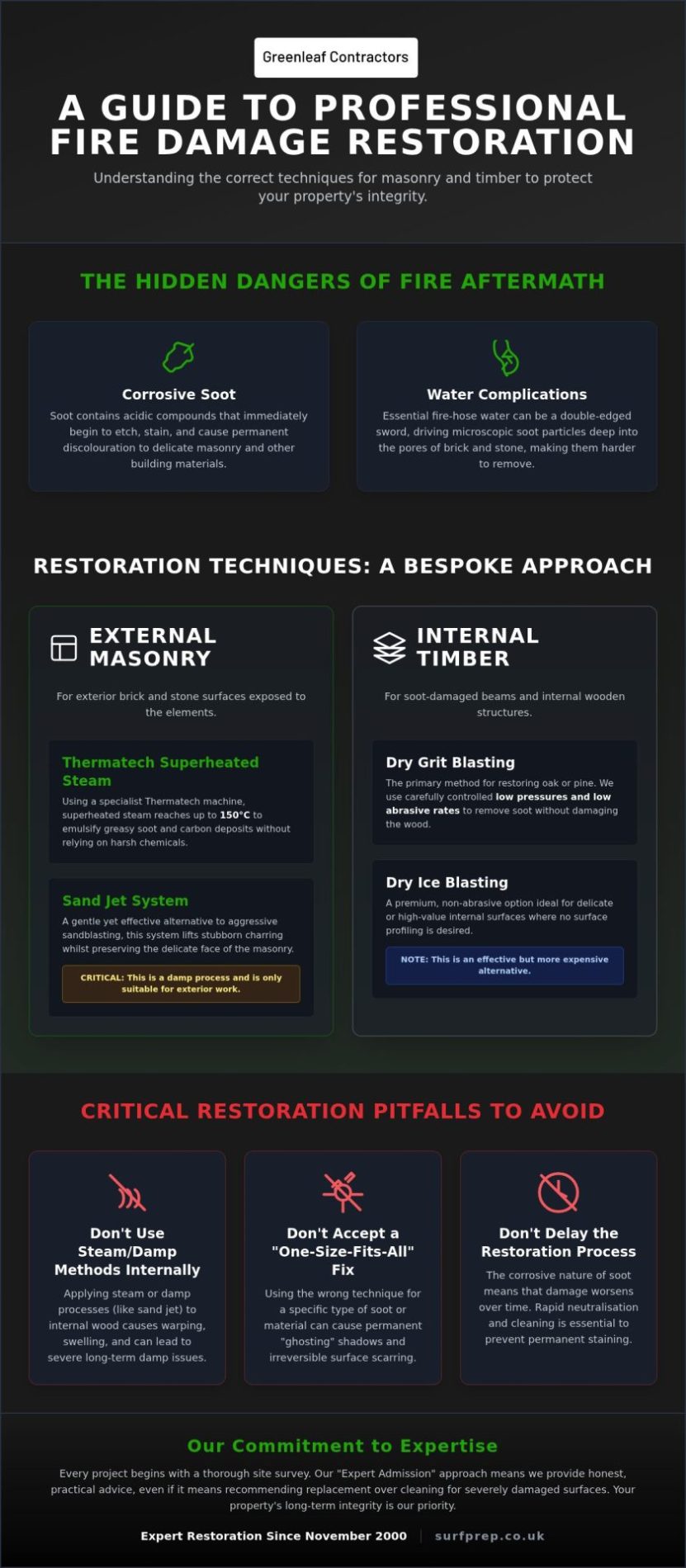
Fire damage doesn’t stop once the heat dies down. Soot is inherently corrosive; it contains acidic compounds that immediately begin to etch and stain building materials. Without rapid neutralisation, these deposits can cause permanent discolouration on delicate Leeds masonry. This is a critical stage in the broader disaster restoration process, where timing determines whether a facade can be saved or if it requires replacement.
There’s also a hidden complication: fire-hose water. Whilst essential for safety, high-pressure water often drives microscopic soot particles deep into the pores of brick and sandstone. Standard cleaning might remove surface grime, but professional fire restoration requires removing the carbonised layers that hold both the stain and the pungent odour. It’s a surgical process. We prioritise the material’s integrity, ensuring the building’s bones aren’t weakened by aggressive, ill-judged cleaning methods.
Understanding Soot and Smoke Deposits on Masonry
Not all smoke is the same. Greasy soot from burning plastics creates a smeary, stubborn film, whilst dry soot from wood is powdery. If you use the wrong technique, you risk “ghosting”, a permanent shadow of the smoke pattern that remains visible. Since November 2000, we’ve refined our methods to handle these variables. Whether we’re tackling brick cleaning or stone cleaning, we ensure the right solution is used for the specific contaminant.
Professional Restoration Techniques: Choosing the Right Method for Your Property
Selecting the correct methodology is the most important decision in any fire restoration project. For exterior surfaces, Thermatech superheated steam is the industry benchmark for cleaning brick and stone. It reaches temperatures up to 150°C, allowing us to emulsify greasy soot and carbon deposits without relying on harsh chemicals that might leach into the masonry. When the damage requires a slightly more tactile approach, we utilise the sand jet machine. Originally acquired as a Farrow System in November 2000, this system acts as a gentle alternative to traditional, aggressive sandblasting, preserving the delicate face of external masonry whilst lifting stubborn charring.
It’s vital to recognise the limitations of these tools. Because the sand jet is a damp process, it must be avoided for indoor fire restoration work to prevent moisture ingress that can lead to long-term damp issues. If you’re managing a project involving historic facades, our technical guide on brick cleaning offers deeper insights into substrate safety. For those facing complex recovery tasks, we are always happy to discuss your specific restoration requirements to ensure the right technology is deployed.
Restoring Fire-Damaged Internal Timber Beams Safely
Internal timbers require a completely different strategy. We strictly advise against using superheated steam cleaning for wood inside a property, especially in occupied houses. The moisture can cause beams to warp and swell, creating structural issues that are far harder to fix than the fire damage itself. Instead, we recommend traditional dry grit blasting at low pressures and low abrasive rates. This method is the primary way we restore soot-damaged oak or pine beams to a natural, clean finish. For delicate or high-value internal surfaces, dry ice blasting remains a premium, non-abrasive option, though it’s an expensive alternative due to the costs of the specialised media.
Planning Your Restoration Project: From Structural Assessment to Final Finish
Successful fire restoration relies on a thorough site survey before a single machine is turned on. We assess the porosity of the brick or stone across Leeds, York, and Manchester to ensure the chosen method won’t cause moisture traps or surface scarring. This stage includes our “Expert Admission” approach; we’ll be honest if a surface is too severely damaged for cleaning. It’s better to advise on replacement than to compromise a building’s safety for a quick sale.
For large-scale industrial facilities in Northern England, logistical planning is paramount. Our team manages the complexities of site access and material handling for expansive projects, ensuring minimal disruption to your operations. It’s why we encourage property owners to choose a contractor with deep roots in the craft. Our business was established in November 2000, giving us over two decades of practical experience in managing these high-stakes environments with quiet confidence.
Working with Heritage and Industrial Properties in Northern England
Listed buildings in York or Scarborough require a sensitive touch. We work alongside conservation officers who often mandate specific, low-impact methods like Thermatech or dry grit blasting to protect historical integrity. We avoid irrelevant industrial standards like Sa 2.5, which are designed for metal preparation and have no place in masonry or timber care. To ensure your property is handled with the precision it deserves, contact our specialist team for a professional assessment.
Moving Forward with Professional Restoration
Effective fire restoration is a balance of rapid action and technical restraint. Success lies in understanding how soot interacts with different materials; from the porous sandstone of a York heritage building to the structural oak beams of a Leeds home. By utilising specialised tools like Thermatech superheated steam or the gentle sand jet system for exteriors, and dry grit blasting for internal timbers, you can remove carbonised layers without risking moisture damage. Since November 2000, we’ve operated as honest specialists across the North, including Hull and Manchester, providing the “Expert Admission” required to protect your property’s long-term value. We prioritise the right solution over a quick fix, ensuring every surface is treated with precision. To get started, you can Request a Specialist Fire Restoration Assessment from Surfprep. Your property’s recovery is in safe, experienced hands.
Frequently Asked Questions
Can fire-damaged brickwork always be restored to its original colour?
Restoration depends on the heat intensity and the brick’s porosity. Whilst our Thermatech superheated steam and sand jet systems effectively remove carbonised layers, extreme heat can sometimes cause permanent vitrification in the clay itself. We always conduct site surveys across Leeds or York to manage expectations and determine the most realistic outcome for your specific masonry before starting any work.
Is it safe to use steam cleaning on wooden beams inside my house after a fire?
We strictly advise against using superheated steam cleaning on internal timbers, especially in occupied properties. Introducing moisture into fire-damaged wood can cause warping, swelling, and long-term damp issues. For internal fire restoration, we recommend dry grit blasting at low pressures or dry ice blasting. These methods safely remove soot from oak or pine beams without the structural risks associated with water or steam.
What is the difference between sandblasting and the gentle sand jet system for fire damage?
Traditional sandblasting is an aggressive process that often scars delicate brickwork. Our sand jet system, originally acquired as a Farrow System in November 2000, is a far gentler alternative. It uses lower pressures and a damp abrasive mix to lift fire damage without destroying the substrate’s face. Since it’s a damp process, it’s reserved for exterior masonry in areas like Hull or Scarborough to avoid internal moisture problems.
How much does professional fire restoration cost for a commercial property in the UK?
Costs for professional fire restoration vary significantly based on the building’s scale, the soot type, and the required cleaning methodology. Factors like whether we use Thermatech steam for the facade or specialised dry ice blasting for delicate interiors will influence the final quote. Every commercial project in Northern England requires a bespoke assessment to ensure we provide the most effective and honest solution for your facility.
