
The cheapest quote to blast paint off commercial masonry is almost always the most expensive mistake a building manager can make. When unexpected tagging defaces your premises, the immediate dread isn’t just the visual blight. It’s the entirely valid fear of permanent “ghosting” shadows, aggressive chemicals eroding historic stone, and unpredictable extra charges for specialist access.
Understanding the true commercial graffiti removal cost UK businesses face means looking beyond bottom-dollar rates to focus on substrate preservation. In this guide, you will discover the core variables that dictate project pricing, which methods protect delicate brickwork, and how to ensure compliance with British heritage standards. Here is everything you need to budget with confidence and restore your building safely.
Key Takeaways
- Substrate porosity dictates your restoration method, meaning ink extraction from historic sandstone requires far more delicate care than cleaning modern metal surfaces.
- Accurately evaluating commercial graffiti removal cost UK figures requires factoring in elevated access, city centre logistics, and specialist rig setups rather than simple surface area alone.
- Selecting between Thermatech superheated steam and gentle damp sand jetting ensures paint removal without scarring historic brickwork or causing persistent ghosting.
- Painting over defaced masonry traps moisture and accelerates structural decay, making professional extraction and breathable protective coatings the far more cost-effective investment.
Factors Influencing Commercial Graffiti Removal Costs in the UK
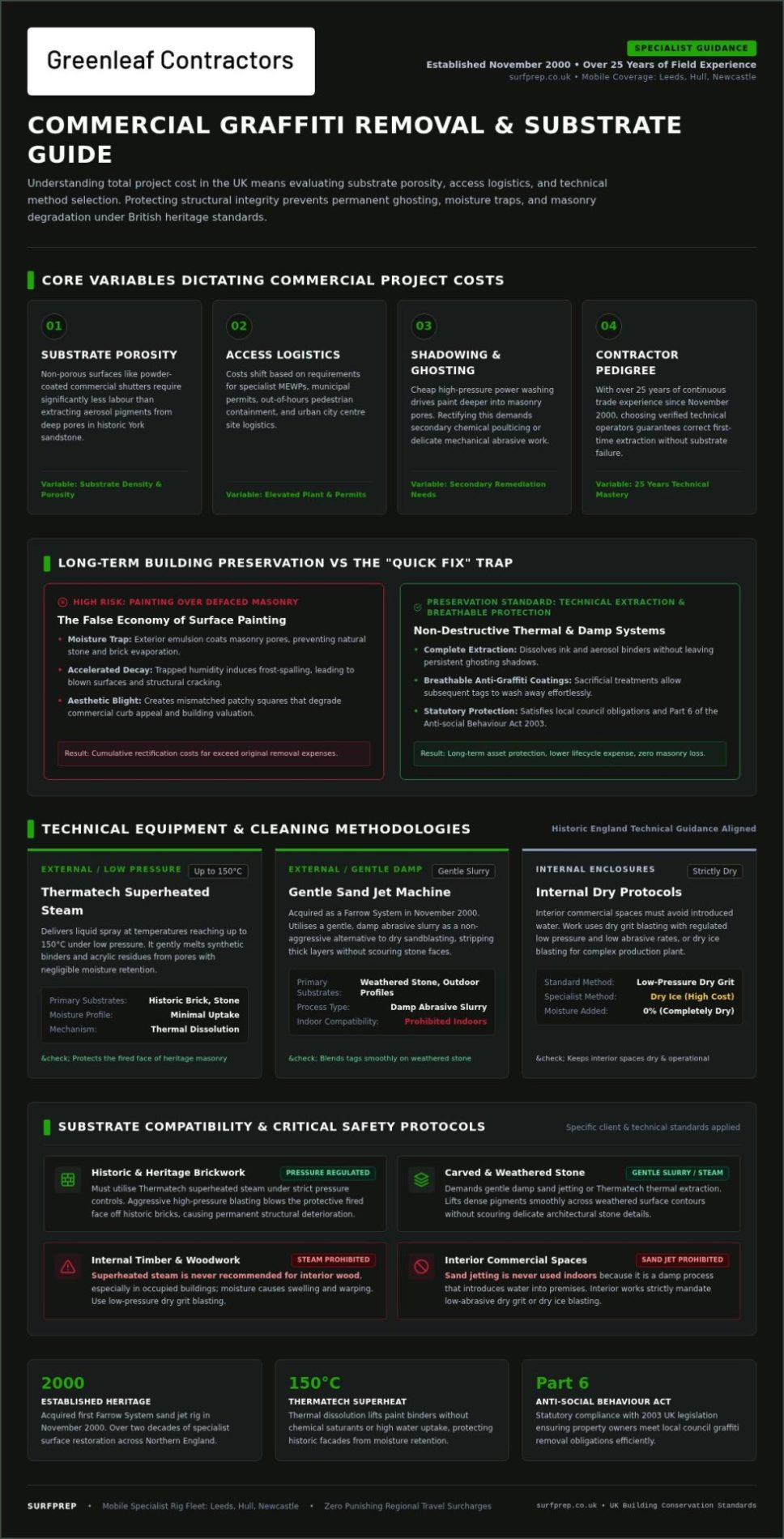
Generic price guides often fail commercial clients because they treat every wall the same. In reality, calculating an accurate commercial graffiti removal cost UK broad estimates can’t capture depends heavily on four operational factors:
- Substrate porosity: Cleaning spray paint off non-porous powder-coated shutters in Manchester requires far less labour than extracting aerosol pigments from soft, porous York sandstone.
- Access logistics: Work requiring specialist MEWPs, city centre permits, or out-of-hours pedestrian management shifts project costs quickly.
- Shadowing and ghosting: Cheap, high-pressure washing often drives paint deeper into masonry pores, demanding secondary chemical poulticing or delicate abrasive work to lift the remaining shadow.
- Contractor pedigree: Surfprep was established in November 2000. Over 25 years of field experience ensures the right methodology is specified first time, preventing catastrophic substrate damage.
The Cost of Material Integrity: Brick, Stone, and Wood
Delicate architectural surfaces cannot withstand aggressive blasting. Specialist brick cleaning requires strict pressure regulation to avoid blowing the protective fired face off historic brickwork, whilst heritage stone cleaning across northern cities demands neutral, non-destructive techniques to preserve carved details. Applying breathable anti-graffiti coatings afterwards can drastically cut future maintenance expenses. For internal timber or woodwork, superheated steam must be avoided because moisture causes swelling and warping; here, dry grit blasting at low pressures is the safe, controlled approach.
Specialist Methods: Thermatech vs Sand Jetting Costs
Selecting the appropriate technical system directly dictates your overall commercial graffiti removal cost UK balance. Rather than saturating walls with caustic chemical cocktails, professional restoration relies on precise thermal or mechanical dissolution to lift paint cleanly.
- Thermatech superheated steam: Thermatech operates as a low-pressure, high-temperature system delivering liquid spray at up to 150°C to melt acrylic and alkyd binders away from substrate pores with minimal moisture uptake.
- Gentle sand jetting: Originally acquired as a Farrow System in November 2000, our sand jet machine introduces a gentle, damp abrasive slurry. It provides a non-aggressive alternative to standard grit blasting, cleanly lifting thick layers on weathered outdoor stone without scouring the stone face.
- Internal space protocols: Because the sand jet is a damp process, we never use it indoors. For interior commercial spaces, dry grit blasting at low pressures and low abrasive volumes keeps rooms dry, whilst dry ice blasting offers a specialist, higher-cost option for complex production environments.
Choosing the Right Tool for the Substrate
Aligning with Historic England’s technical guidance on graffiti removal prevents irreversible surface degradation. Exterior masonry often demands sand jet cleaning to blend tagged sections smoothly across weathered, textured profiles. Here is an honest specialist admission: superheated steam is never recommended for cleaning wood inside a property, especially in occupied buildings, because the residual humidity risks warping load-bearing timbers and raising grain. For tailored guidance on your building substrate, you can always reach out to our team to discuss suitable methodologies.
Budgeting for Long-Term Property Restoration and ROI
Reaching for a tin of masonry paint is a tempting quick fix, but painting over tags is a costly misstep. Exterior emulsion traps moisture within porous brickwork, leading to spalling, blown surfaces, and unsightly mismatched patches that devalue commercial units. When evaluating the real commercial graffiti removal cost UK property managers face, professional extraction delivers superior long-term return on investment by protecting structural integrity and avoiding statutory penalties under Part 6 of the Anti-social Behaviour Act 2003.
- Preventative coatings: Incorporating breathable, sacrificial barrier treatments into your maintenance schedule ensures subsequent aerosol tags wash away easily, reducing future remediation bills.
- Northern regional logistics: Operating mobile rigs across Leeds, Hull, and Newcastle, Surfprep provides responsive regional coverage without punishing travel surcharges.
- Proven trade experience: Established in November 2000, our 25 years of specialist expertise guarantees first-time pigment extraction without substrate failure.
Maximising Business Curb Appeal in the North
First impressions directly influence tenant retention and retail footfall across commercial parks in Leeds and York. Focusing on improving business curb appeal through proactive facade care prevents that run-down appearance that deters high-value clients. Scheduled cyclical maintenance agreements further reduce the individual commercial graffiti removal cost UK facilities teams incur per call-out, ensuring rapid abatement before vandalism encourages repeat incidents.
Protect Your Commercial Facade with Specialist Restoration
Safeguarding your building against the lasting effects of vandalism requires a balanced approach to methodology and materials. Assessing the true commercial graffiti removal cost UK property owners encounter means prioritising substrate safety over aggressive, cheap quick fixes that lead to surface failure. Whether your premises require the low-pressure thermal precision of Thermatech superheated steam or the controlled outdoor capability of our gentle sand jet system, choosing the correct process preserves historic stone and modern brickwork alike.
Established in November 2000, Surfprep brings over 25 years of proven masonry restoration experience across Leeds, York, Hull, and the North. Don’t let unwanted paint compromise your property value or professional standing. Request a professional graffiti removal quote from Surfprep today to restore your commercial facade cleanly and permanently.
Frequently Asked Questions
How much does it cost to remove graffiti from a commercial building in the UK?
Total commercial graffiti removal cost UK estimates vary depending on substrate porosity, working height, and the chosen methodology. Porous stone requires delicate extraction to prevent shadowing, whilst elevated tags require specialist access platforms. Reputable contractors assess the specific wall fabric and location across regions like Leeds or Manchester to provide tailored, transparent quotations.
Is it cheaper to paint over graffiti or have it professionally removed?
Painting over graffiti appears cheaper initially, but it quickly becomes an expensive mistake. Standard paint traps residual moisture inside porous brickwork, accelerating freeze-thaw spalling and creating mismatched patches that harm building value. Professional extraction lifts pigments out entirely, restoring the natural surface and protecting the masonry from long-term structural decay and costly remedial repairs.
Can superheated steam cleaning be used on internal wooden beams?
No, superheated steam cleaning isn’t recommended for internal woodwork or beams inside occupied properties. Introducing high-temperature vapour into indoor spaces drives moisture deep into structural timber, creating serious risks of grain raising, surface swelling, and long-term warping. For interior beams, controlled low-pressure dry grit blasting or specialised dry ice blasting provides a safe, completely moisture-free restoration solution.
Does professional graffiti removal damage the underlying brick or stone?
Not when handled by an experienced contractor using substrate-matched equipment. Systems like Thermatech superheated steam melt aerosol binders using high temperature rather than destructive pressure, safeguarding the fired face of bricks. On exterior masonry, gentle sand jetting lifts pigment without scouring the stone face, ensuring your commercial graffiti removal cost UK investment delivers clean conservation without substrate damage.
