
The most expensive industrial floor coating isn’t the high-build resin; it’s the one that flakes away under heavy forklift traffic after six months. Getting warehouse concrete floor preparation right is the single most critical factor in preventing costly delamination, yet facility managers often face a tough compromise: halting active logistics programmes to prevent airborne dust contamination, or risking surface failure through rushed profiling.
You shouldn’t have to sacrifice operational uptime to secure a dependable mechanical key. In this 2026 buying guide, you’ll discover how to specify the precise surface profile required for durable coating adhesion, effectively handle contaminated slabs, and protect active stock. Drawing on our specialist industrial surface preparation experience established in November 2000, we examine the dry profiling methods that keep your facility compliant, clean, and operational.
Key Takeaways
- Learn how mechanical profiling strips weak surface laitance and tyre rubber to uncover sound aggregate for maximum coating adhesion.
- Discover why warehouse concrete floor preparation indoors demands controlled dry grit blasting instead of damp abrasive methods that trap moisture within the slab.
- Weigh the operational benefits of specialist residue-free methods like dry ice blasting against their higher project costs.
- Specify at-source extraction and sectional phasing in your tender to protect sensitive stock and maintain active distribution schedules.
Evaluating Substrate Conditions: Laitance, Contaminants, and Structural Soundness
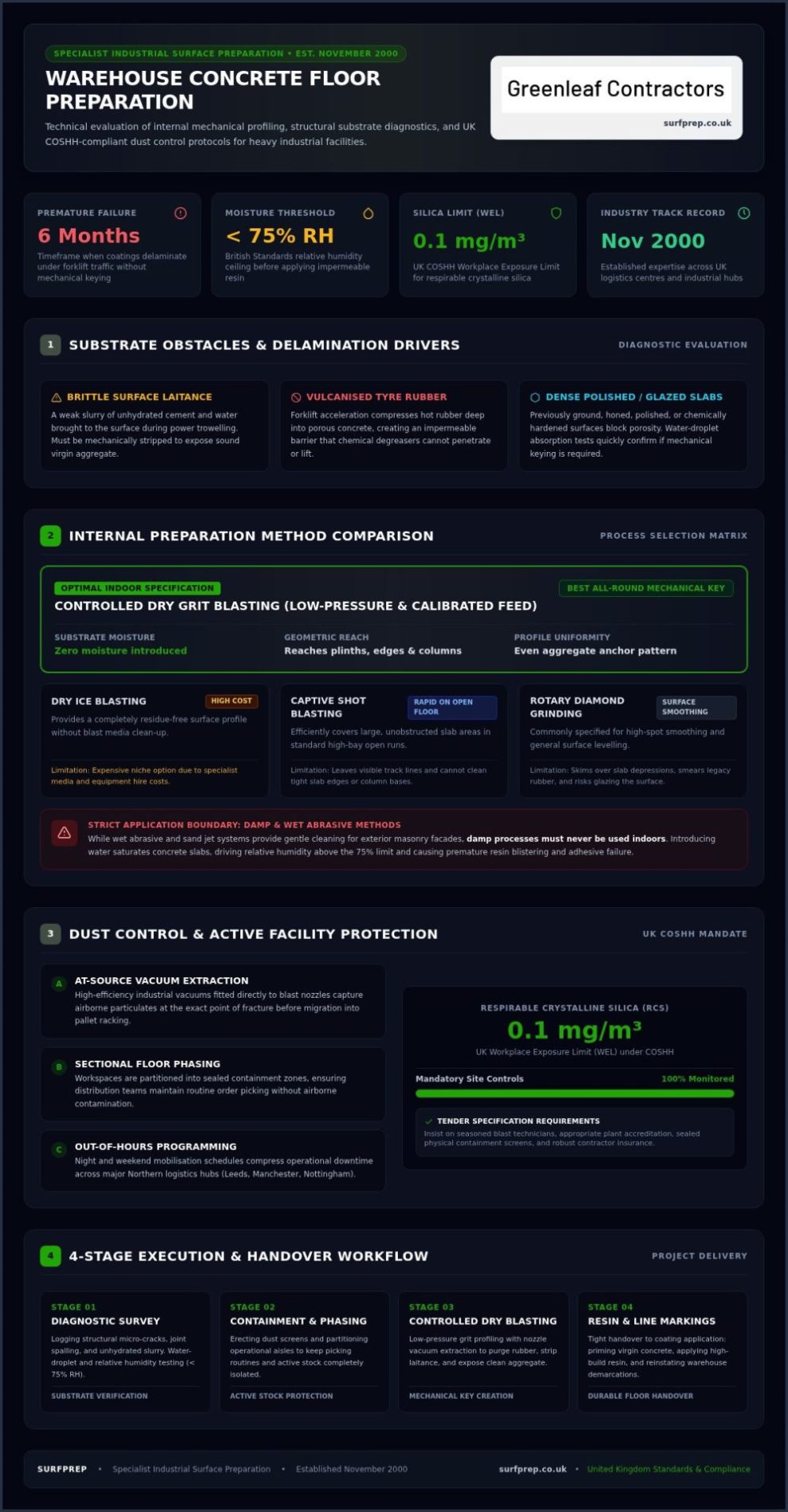
Applying a high-performance resin over an unprepared slab guarantees early failure. Weak surface laitance (the brittle slurry of cement and water brought to the surface during power trowelling) lacks structural integrity and must be mechanically stripped to expose sound aggregate. Equally problematic are industrial contaminants like hydraulic fluids and vulcanised forklift tyre rubber. Heavy forklift acceleration compresses hot rubber deep into concrete pores, creating an impermeable barrier that chemical degreasers simply cannot lift. Thorough warehouse concrete floor preparation demands mechanical removal to purge these residues alongside failed legacy coatings, ensuring primers bond directly to virgin concrete rather than surface debris.
Identifying Concrete Defects That Cause Premature Coating Delamination
Effective warehouse concrete floor preparation always begins with identifying latent substrate flaws before machinery arrives on site. Visual surveys must log structural micro-cracks, spalling around expansion joints, and unhydrated slurry. Furthermore, slabs that were previously mechanically ground, honed and polished or treated with chemical hardeners often present dense surfaces that resist mechanical keying. Simple water-droplet absorption tests quickly reveal whether legacy sealers block porosity. In older logistics units, moisture vapour transmission through uninsulated ground-bearing slabs presents a severe blistering risk; relative humidity testing ensures readings stay below the 75% threshold recommended by British Standards before applying impermeable resins.
Comparing Internal Floor Preparation Methods: Achieving the Correct Mechanical Key
Internal logistics facilities demand strict process control. While our sand jet system excels on exterior masonry, damp abrasive systems should never be used for internal warehouse concrete floor preparation, as moisture saturates the slab and jeopardises resin bonding schedules. Dry ice blasting provides an effective zero-residue profile, but high equipment hire and media costs keep it an expensive niche alternative. Instead, controlled dry grit blasting operating at low pressures and calibrated feed rates delivers an even, dependable anchor profile across high-traffic transit aisles without introducing liquid into the substrate.
Low-Pressure Dry Grit Blasting vs Captive Shot Blasting and Grinding
Captive shot blasting and rotary diamond grinding both present operational limitations. Diamond grinders often skim over slab depressions, smearing legacy tyre rubber or glazing the surface rather than opening the aggregate. Captive shot blasters cover wide open runs quickly, yet they leave noticeable track lines and cannot clean tight slab edges, column bases, or machinery plinths. Controlled dry grit blasting navigates these intricate floor layouts easily, producing the precise Concrete Surface Profile needed for heavy forklift traffic and seamless resin adhesion.
Aligning project specifications with recognized engineering standards for Dust Control, and Phasing protects sensitive stock and keeps airborne particulates contained. Choosing an experienced specialist for industrial surface preparation ensures thorough substrate profiling without compromising your day-to-day warehouse schedule.
Specifying Floor Preparation Contracts: Logistics, Dust Control, and Phasing
Procurement tenders for warehouse concrete floor preparation must mandate rigorous environmental controls. Under UK COSHH regulations, airborne respirable crystalline silica carries a strict workplace exposure limit of 0.1 mg/m³. Meeting this benchmark inside an operational facility requires high-efficiency industrial vacuum systems fitted directly to the blast nozzle, capturing abrasive particulates at the exact point of fracture before they migrate into pallet racking. Sectional floor phasing partitions the workspace into isolated zones, ensuring distribution teams maintain daily picking routines behind sealed containment screens. Facility managers should insist on seasoned blast technicians, appropriate plant accreditation, and robust contractor insurance before work commences on site.
Managing Operational Downtime in Active Logistics Hubs Across Northern England
Maintaining supply chain flow across northern logistics hubs in Leeds, Manchester, and Nottingham demands adaptable contractor programming. Mobilising teams for night shifts and weekend blasting schedules compresses overall downtime, keeping core transit routes accessible. Once dry preparation exposes an even aggregate profile, the slab is primed for industrial coatings alongside clear demarcations and line markings. Specifying tight handover intervals between dry profiling and primer application is vital; applying sealers promptly ensures ambient moisture or warehouse traffic won’t recontaminate the freshly exposed mechanical key.
Secure a Resilient Substrate for Your Warehouse Facility
A durable industrial floor starts with uncompromising mechanical profiling. Stripping weak surface laitance, eradicating compressed tyre rubber, and avoiding moisture-laden preparation methods indoors ensure your resin investment delivers years of heavy-duty performance. By specifying controlled dry profiling with at-source vacuum extraction, facility teams can protect sensitive stored inventory whilst keeping essential logistics programmes running smoothly.
Established in November 2000, Surfprep provides specialist low-pressure dry grit blasting teams throughout Northern England and the Midlands. Our contained, dust-controlled industrial plant delivers the precise mechanical key your warehouse concrete floor preparation demands without introducing liquid into the slab. Speak with our industrial surface specialists to prepare your warehouse floor and keep your operational traffic moving forward with complete confidence.
Frequently Asked Questions
Why can damp abrasive sand jetting not be used for warehouse concrete floors?
Damp abrasive sand jetting introduces water directly into the concrete matrix, which cannot evaporate easily inside an enclosed facility. Trapped moisture raises the slab’s relative humidity, causing blisters and bond failure once impermeable resins cure. Internal warehouse concrete floor preparation relies on controlled dry grit blasting instead, keeping the substrate completely dry and ready for immediate primer application.
How clean must warehouse concrete be before applying an epoxy resin coating?
The slab must be entirely free from weak surface laitance, vulcanised tyre rubber, oils, and previous failed finishes. Sweeping or chemical degreasing isn’t enough for heavy logistics use. Contractors must mechanically profile down to sound aggregate, opening the concrete pores so low-viscosity primers can penetrate deeply rather than adhering to surface contaminants.
What Concrete Surface Profile is required for heavy forklift traffic aisles?
Heavy forklift transit aisles generally require a Concrete Surface Profile (CSP) of 3 to 5, providing a medium sandpaper to light aggregate texture. This depth creates enough mechanical anchor for high-build epoxy or polyurethane screeds to withstand the severe shear stresses exerted by loaded forklift wheels, without causing the coating to thin over sharp aggregate peaks.
How do specialist contractors control dust inside an operational warehouse facility?
Specialist teams capture particulates directly at the blast nozzle using high-volume industrial vacuum recovery units fitted with HEPA filtration. Across sites in Manchester, Leeds, and Nottingham, contractors isolate working bays with floor-to-ceiling polythene containment sheeting. This sectional approach prevents airborne silica from drifting into adjacent picking aisles, ensuring compliance with UK COSHH limits and keeping inventory clean during warehouse concrete floor preparation.
