
The gentlest-sounding option isn’t automatically right for a historic building. Conservation officer approved cleaning methods depend on the building, the condition of its brick, stone or timber, and the work proposed. A method considered suitable for one property shouldn’t be assumed to have blanket approval elsewhere. It also matters whether an officer is commenting on a technique, a proposal or the work itself.
Choosing carefully means weighing the cleaning result against the risk of damaging historic surfaces or introducing moisture. This guide compares damp sand jetting, dry cleaning and Thermatech superheated steam, and explains what to prepare before discussing a project. Surfprep cleans brick, stone and wooden beams, using a method suited to the material and its condition. The company’s sand jet machine was originally acquired as a Farrow System in November 2000.
Key Takeaways
- There’s no blanket list of conservation officer approved cleaning methods. Suitability depends on the building, its materials and condition, and the proposed work.
- Compare options by surface and moisture risk. The damp sand jet is a gentle alternative to traditional sandblasting, but it isn’t suitable for indoor use. Read about sand jet cleaning.
- For internal cleaning, dry grit blasting at low pressure and low abrasive rates may be considered, as may dry ice blasting, which is expensive. Superheated steam is generally not recommended for interior timber, especially in occupied homes.
- Prepare details about the building fabric, soiling and proposed scope. A small trial can help assess the approach before wider work is considered.
What Does Conservation Officer Approval Mean for Historic Building Cleaning?
“Conservation officer approved” isn’t a universal endorsement of a cleaning technique. An officer may advise on a specific proposal, but that advice is distinct from any formal consent that may be required. The applicable requirements depend on the building’s status, the surface material and condition, its location, and the scope of the work. For a UK project, establish what applies to the specific property before cleaning begins, rather than assuming a method considered elsewhere will be acceptable.
No single cleaning method is universally approved for every historic building. Suitability depends on the fabric, the soiling and the work proposed. British guidance, including BS 8221-1:2012 for cleaning building surfaces, can inform decisions, but it doesn’t replace project-specific advice. The Institute of Historic Building Conservation (IHBC) is a professional body associated with conservation practice, not the authority that grants consent.
What information helps an officer assess a cleaning proposal?
Make the proposal specific. Describe whether the surface is brick, stone or timber, its visible condition and soiling, any known previous treatments, and the exact areas to be cleaned. Set out the proposed method and scope, including any expected moisture or abrasive action. For example, a proposal for damp sand jet cleaning should identify where it would be used and explain that it is not an indoor method.
Clear photographs show the surface and affected areas; a method statement explains how the work would be carried out. A small trial area can help show the likely result and reveal whether the approach is too aggressive before wider cleaning is considered. These details give an officer a more useful basis for commenting on the proposal. Check the relevant local planning authority’s project-specific guidance before work proceeds.
How Do Conservation Cleaning Methods Compare for Brick, Stone and Timber?
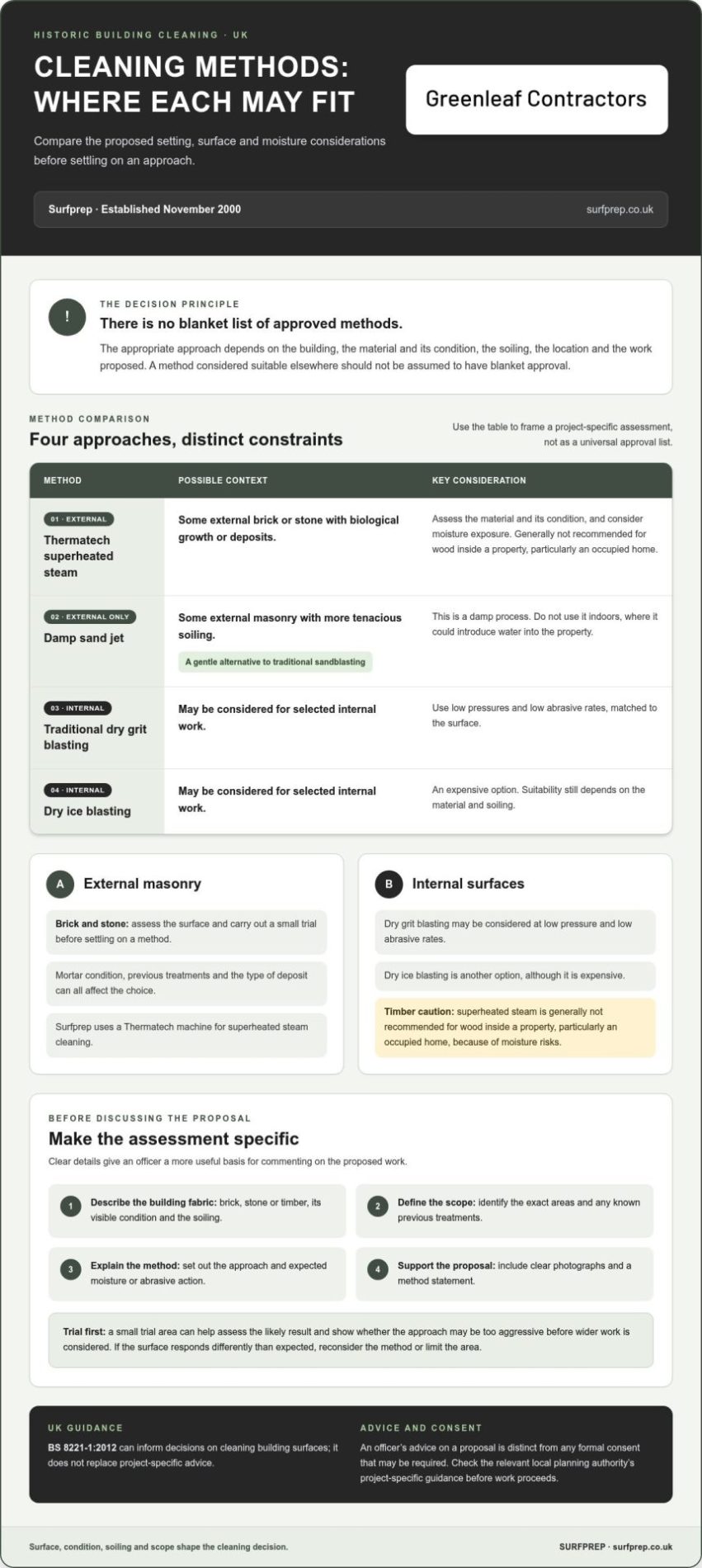
The right approach depends on the surface, the type and strength of the soiling, and whether cleaning could introduce moisture. The aim is to remove deposits only as far as needed, without stripping the surface or damaging its character. A sand jet is a gentle alternative to traditional sandblasting, not the same high-impact process.
| Method | Possible use | Key consideration |
|---|---|---|
| Thermatech superheated steam | Some external brick or stone with biological growth or deposits | Assess the material and condition, and consider moisture exposure, especially for timber. |
| Damp sand jet | Some external masonry with more tenacious soiling | It uses moisture, so don’t use it indoors. |
| Dry grit blasting | Selected internal work | Use low pressure and low abrasive rates, matched to the surface. |
| Dry ice blasting | Selected internal work | An expensive option; suitability still depends on the material and soiling. |
Which cleaning methods suit different building materials and locations?
For external brick and stone, assess the surface and carry out a small trial before settling on a method. Material alone doesn’t determine the right approach: mortar condition, previous treatments and the type of deposit all matter. Surfprep’s sand jet cleaning is a damp process, so it isn’t appropriate indoors, where it could introduce water into the property.
For interior cleaning, traditional dry grit blasting at low pressure and low abrasive rates may be considered. Dry ice blasting is another option, although it is expensive. Superheated steam is generally not recommended for wood inside a property, particularly an occupied home, because of moisture risks. For exterior masonry, Surfprep uses a Thermatech machine for superheated steam cleaning. DOFF is a widely recognised term people search for, but Thermatech is the equipment Surfprep uses. Explore Surfprep’s building-cleaning work for practical context when weighing up an approach.
How Surfprep Approaches Conservation-Led Cleaning Projects
A careful cleaning project starts with the building, not the equipment. Surfprep assesses the surface and its condition, considers the soiling, selects a proportionate method and reviews a trial before deciding whether the proposed scope remains suitable. The aim is to remove deposits without taking more of the historic surface than necessary. Surfprep’s specialist work includes brick and stone cleaning, wooden beam cleaning, superheated steam cleaning and damp sand jet cleaning.
This measured approach keeps discussions about conservation officer approved cleaning methods grounded in the particular building and proposal. A trial can inform the choice of method and scope, but it can’t guarantee a particular result or replace the relevant authority’s advice or any required consent.
What should a careful cleaning proposal explain?
Set out the material, exact area proposed for cleaning, objective and method under consideration. Include relevant risks, such as moisture exposure, and explain why the approach is proportionate to the soiling and condition. For timber, the location matters: moisture considerations differ between exposed exterior beams and wood inside an occupied property. Details about wooden beam cleaning can help frame that assessment.
Review the trial against the proposal before extending the work. If the surface responds differently than expected, reconsider the method or limit the area rather than assuming the same result across every elevation or material. This evidence-led sequence gives the owner and relevant authority a clearer basis for discussing the work, without presenting a cleaning assessment as formal approval.
If you’re planning a cleaning project, contact Surfprep to discuss a suitable approach for your building.
Take the Next Step with Confidence
Before cleaning begins, bring together the project details, photographs and proposed scope. This helps focus the discussion on the building’s needs, the intended result and any authority guidance still to resolve. A suitable technique isn’t automatically formal approval: conservation officer approved cleaning methods must be considered in the context of the specific property.
Surfprep cleans building surfaces across Leeds, York, Hull, Bradford, Nottingham, Manchester, Derby, Lincoln, Newcastle, Durham, Scarborough and Beverley. The right solution can vary across materials and locations, and a careful assessment includes recognising when a method isn’t suitable.
Discuss a careful cleaning approach for your building and take a considered first step towards protecting its historic fabric.
Frequently Asked Questions
Do conservation officers approve specific cleaning methods?
Not as a universal list. Conservation officer approved cleaning methods are considered in relation to a particular building and proposal. An officer may give conservation advice, but that advice shouldn’t be treated as proof that formal consent has been granted. If comments refer to conditions, limits or a consent route, establish the relevant local planning authority’s position before scheduling work.
Can sand jet cleaning be used on a listed building?
It may be considered for some listed-building projects, but listed status alone doesn’t establish that it’s suitable or permitted for a particular surface. Sand jetting is damp, so it’s generally an external option, not a choice for interiors. The proposal should account for the masonry’s condition and whether cleaning could affect its surface or character.
Is superheated steam suitable for cleaning historic wooden beams indoors?
Generally, it isn’t recommended for wood inside a property, particularly an occupied home, because the process introduces moisture. Before cleaning a beam, consider its condition, any existing coating and the indoor setting. A dry approach may be more appropriate for internal timber; the choice should reflect the surface and moisture risks, not just the desired appearance.
What should I prepare before discussing cleaning with a conservation officer?
Bring clear, dated photographs and mark the areas under consideration on a plan or image. Note any records of earlier cleaning or treatments, and describe the result you’re seeking without assuming every stain must be removed. These details can help focus discussions with the relevant authority, whether the property is in Leeds, York, Hull, Bradford, Nottingham, Manchester, Derby, Lincoln, Newcastle, Durham, Scarborough or Beverley.
