
What if the very products you’re using to “save” your garden are actually poisoning the soil and permanently etching your expensive masonry? Most homeowners we speak with are tired of the annual battle against slippery algae and those stubborn black spot lichens that supermarket detergents simply can’t touch. We agree that the traditional reliance on harsh acids is a losing game that risks both your plants and your stone’s finish. Finding the best way to clean stone patio without chemicals is about more than just environmental ethics; it’s about using the right technical approach to preserve your home’s value.
Since we started our specialist cleaning journey in November 2000, we’ve focused on mechanical excellence over chemical shortcuts. This guide reveals how professional systems like Thermatech, also known as DOFF, and our gentle sand jet machine can restore natural colour and slip resistance without toxic runoff. We’ll walk you through the specialist methods used to safely lift years of grime and biological growth, providing you with the clarity to choose between a simple DIY scrub and a professional restoration that protects your masonry for the long term.
Key Takeaways
- Understand why “natural” household acids can cause irreversible etching on limestone and marble patios, requiring careful professional intervention.
- Discover how Thermatech (DOFF) technology uses 150°C superheated steam to kill biological spores at the root without harming your garden’s biodiversity.
- Learn why our damp sand jet process is the best way to clean stone patio without chemicals, especially when tackling deep-seated staining on porous sandstone.
- Identify how to match the correct cleaning methodology to your specific masonry type to ensure a safe, slip-resistant finish that preserves the stone’s original colour.
- Gain professional insight into the technical differences between high-pressure washing and specialist restoration to help you decide when to call in the experts.
Why Chemical-Free Patio Cleaning is Essential for Your Masonry
Many homeowners assume that once a cleaning solution is rinsed off, its job is done. In reality, the runoff from harsh detergents and biocides often ends up in garden borders, where it can linger in the soil for years. According to a 2025 survey, 68% of UK adults are now worried about the environmental impact of synthetic chemicals in their household products. This concern is well-founded; traditional patio cleaners can disrupt the delicate pH balance of your soil and harm local biodiversity. We believe the best way to clean stone patio without chemicals is to avoid these risks entirely by using mechanical and thermal methods that leave no toxic footprint.
A common mistake we see involves using “natural” alternatives like white vinegar. Whilst it seems harmless, vinegar is acetic acid. When applied to calciferous stones such as limestone or marble, it triggers a chemical reaction that dissolves the calcium carbonate. This leads to permanent etching, where the stone’s surface becomes dull, pitted, and rough. Similarly, household bleach is a salt-based oxidant. It doesn’t just kill algae; it can crystallise within the stone’s pores, causing internal pressure that leads to “spalling” or surface crumbling. This process often triggers efflorescence, where salts migrate to the surface and leave unsightly white staining that is difficult to remove without specialist stone cleaning.
The Risks of DIY “Eco-Friendly” Acids
On the pH scale, most masonry thrives in a neutral environment. Any solution moving toward the acidic end (pH 0 to 6) poses a threat to the structural integrity of the stone binders. Before you apply any “eco” solution, we recommend a simple patch test in an inconspicuous corner. If the stone fizzes or loses its sheen, it is acid-sensitive. In these cases, a Soft washing method using only water and low pressure is far safer than gambling with acidic reagents.
Manual Agitation: The Power of the Stiff Broom
Sometimes, the most effective tool is the simplest one. Mechanical action remains a cornerstone of professional restoration. A high-quality stiff broom can break the bond of surface grime and early-stage algae without the need for chemicals. For riven sandstone, a heavy-duty polypropylene bristle is ideal. However, if you are cleaning polished marble or smooth limestone, you must choose a softer natural bristle to avoid micro-scratching the finish. This manual preparation often makes the subsequent use of our sand jet machine even more efficient.
Professional Non-Chemical Methods: Thermatech and Sand Jetting
Whilst manual scrubbing is a start, the best way to clean stone patio without chemicals on a professional scale involves manipulating temperature and controlled abrasives rather than relying on sheer water volume. We’ve spent over two decades refining these processes to ensure they’re as kind to the masonry as they are to the environment. Unlike standard cold-water pressure washers that can strip the “face” off delicate stone, we utilise the Thermatech system to deliver superheated water at temperatures reaching 150°C.
This intense heat is the secret to tackling deep-seated biological growth. Many chemical treatments only bleach the surface of algae, leaving dormant spores behind in the stone’s pores. Thermatech, or DOFF as it’s widely recognised amongst heritage professionals, kills these spores instantly. Because the pressure remains low, there’s no risk of saturating the stone substrate or damaging the surrounding pointing. It leaves a sterile finish that significantly delays the return of moss and lichen, providing a long-term solution that protects your garden’s biodiversity.
Thermatech (DOFF) Superheated Steam
The primary advantage of the Thermatech system is its ability to clean without saturation. By using superheated steam at low pressure, we can remove years of grime and organic matter whilst using very little water. This prevents the stone from becoming waterlogged, which is particularly important for preventing deep-seated staining or frost damage in the winter months. It’s a methodical process that respects the natural integrity of the material.
The Sand Jet Machine: A Gentle Alternative to Sandblasting
For patios suffering from stubborn carbon soiling or old paint spills, steam alone might not suffice. This is where we employ our sand jet machine. Originally acquired as a Farrow System when we established the business in November 2000, this machinery represents a major leap forward from traditional, aggressive sandblasting. It’s a damp abrasive process that uses soft media at incredibly low pressures to gently lift contaminants.
We’ll be the first to admit that abrasive cleaning isn’t always the right fit; if steam can achieve the desired result, we’ll recommend that first to keep costs and impact low. However, for heavily weathered York stone or gritstone, the sand jet provides a level of precision that other methods lack. By using a damp process for outdoor patios, we effectively control dust and prevent it from drifting into your home or onto your neighbours’ property. If you’re unsure which method suits your garden, you can view our stone cleaning services to see the results these systems achieve on different masonry types.
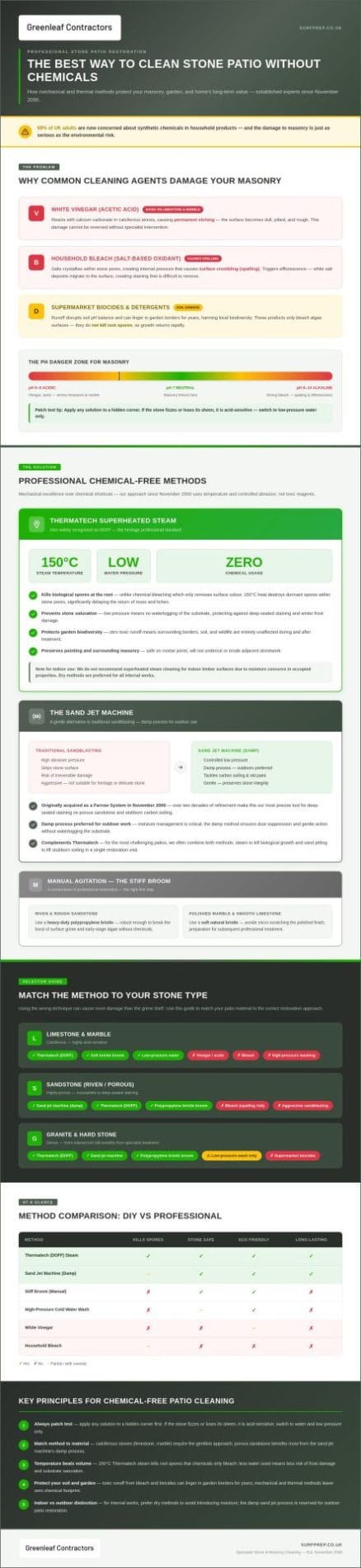
Selecting the Right Method for Your Stone Type
The best way to clean stone patio without chemicals depends entirely on the mineral composition of your paving. A “one size fits all” approach often leads to disappointing results or, worse, permanent damage. Sandstone, for instance, is highly porous. If you use excessive water pressure without the right thermal control, you risk driving dirt deeper into the stone or causing water staining that takes months to dry out. We find that the gentle, damp abrasive action of our sand jet machine is often superior here, as it lifts surface contaminants without saturating the core.
Limestone and marble require an even more cautious touch. These are calciferous stones, meaning they are chemically sensitive. Whilst we’ve already discussed the dangers of acids, even high-pressure cold water can be too aggressive for their softer surfaces. For these materials, we almost exclusively recommend Thermatech (DOFF) superheated steam. It provides a deep clean that respects the stone’s delicate structure. Similarly, when we work with historic York stone, our goal is to restore the stone’s natural colour whilst preserving the “patina” that gives aged Yorkshire paving its character. We don’t want the stone to look brand new and plastic; we want it to look well-maintained and historic.
This philosophy of careful restoration applies to all stone features in a garden. If you are also maintaining a swimming pool and want to understand how its surfaces can be professionally restored, you can check out Rod Cameron Pools for expert insights into the resurfacing process.
Concrete and block paving present a different challenge, primarily due to the sand-filled joints. Aggressive jet washing often blasts this sand away, destabilising the blocks and encouraging rapid weed regrowth. Our low-pressure thermal methods allow us to clean the surface of the blocks whilst leaving the structural jointing sand intact.
Beyond surface cleaning, it is important to monitor the structural stability of your masonry. If you encounter issues with sinking paths or uneven stairs, professional levelling services like those provided by Airlift Concrete Experts can restore safety and functionality to your brick steps and concrete walkways.
Heritage Stone Conservation in the UK
Working in historic centres like York and Durham requires a specialist understanding of heritage requirements. When dealing with listed buildings, we often employ what we call an “Expert Admission.” This means we’ll occasionally advise that a certain level of staining be left alone if the alternative risks damaging a fragile, centuries-old surface. Our priority is the long-term conservation of the masonry, not just a temporary aesthetic fix.
When to Call the Professionals
A bucket and a stiff brush are fine for a small, lightly soiled area. However, on a larger scale, DIY efforts often result in “striping,” where the narrow wand of a domestic jet wash leaves permanent zig-zag patterns across the patio. Professional equipment provides a uniform, streak-free finish that is impossible to achieve with consumer-grade tools. If your patio has reached a point where manual scrubbing no longer works, our stone cleaning services offer a safe, effective, and entirely chemical-free restoration. We can help you assess the condition of your masonry and determine the most appropriate technical solution for your specific garden environment.
Restore Your Garden’s Natural Beauty Safely
Choosing the best way to clean stone patio without chemicals is a decision that protects both your garden’s biodiversity and the structural integrity of your masonry. We’ve explored how avoiding harsh acids and “natural” vinegar prevents permanent etching, whilst professional systems like Thermatech (DOFF) and our sand jet machine kill biological spores at the root. By matching the right thermal or mechanical process to your specific stone type, you ensure a clean, slip-resistant finish that lasts far longer than a standard jet wash.
Since establishing our business in November 2000, we’ve focused on providing honest, specialist advice to clients across Leeds, York, Hull, and the wider North of England. Our two decades of experience with superheated steam and gentle abrasive systems mean we know exactly when a surface requires a delicate touch or a more robust mechanical approach. If you’re ready to restore your patio’s original colour and character, contact our specialist team for a chemical-free patio restoration quote. We look forward to helping you breathe new life into your outdoor space.
Frequently Asked Questions
Is it safe to clean my patio with just boiling water?
Boiling water is safe for all stone types, but it rarely provides a deep, restorative finish on its own. Whilst it can kill surface weeds or small patches of green algae, it lacks the sustained 150°C temperature and controlled pressure of a professional Thermatech system. It’s a useful DIY tactic for minor spot cleaning, but it won’t reach the dormant spores embedded deep within the stone’s pores to prevent rapid regrowth.
Will a pressure washer damage my natural stone patio slabs?
High-pressure domestic jet washes frequently cause irreversible damage to natural stone by stripping the “quarry skin” or protective surface. This aggressive action leaves the stone more porous and susceptible to future staining. It also tends to blast out the structural jointing sand between slabs. We prefer using low-pressure, high-heat methods that clean by temperature rather than brute force, ensuring your patio remains structurally sound.
How do I remove black spots from my patio without using patio milk or bleach?
The best way to clean stone patio without chemicals when dealing with stubborn black spot lichen is through superheated steam. These lichens anchor themselves into the masonry, and whilst bleach only discolours the surface, 150°C steam kills the organism’s root entirely. For particularly weathered York stone, we may also employ our sand jet machine to gently lift the physical remains of the lichen without the need for toxic biocides.
How often should I clean my stone patio to keep it slip-resistant?
We recommend a professional deep clean every two to three years to maintain optimum slip resistance and aesthetic appeal. In the damp UK climate, biofilm and algae can accumulate quickly, especially in shaded or north-facing garden sections. Regular seasonal sweeping to remove organic debris will help, but a periodic specialist restoration ensures the stone’s natural texture remains exposed and safe for walking during wet winter months.
