
That persistent black spotting on your patio isn’t actually dirt or a surface stain; it’s a living organism that has physically anchored itself into the pores of your stone. If you’ve spent an entire weekend with a domestic pressure washer only to see the marks remain, you aren’t alone. Achieving successful black spot removal from Indian sandstone requires more than just high pressure; it requires an understanding of the stone’s biology. It’s incredibly frustrating to invest in premium paving only for it to look weathered and dull, yet you’re likely hesitant to reach for heavy chemicals that might bleach the natural, vibrant colour out of the stone or harm your garden borders.
We understand the delicate balance required between effective cleaning and stone preservation. This guide provides a professional roadmap for restoration, focusing on methods that prioritise the stone’s health over brute force. You’ll discover why these lichen colonies are so resilient and learn about the safest, most effective removal techniques, including specialist chemical applications and superheated steam. We’ll also outline a long-term prevention strategy to ensure your stone’s original multi-tonal beauty remains the focal point of your garden for years to come.
Key Takeaways
- Identify the true nature of black spot as Lichen crustosus (a complex organism rather than a simple stain) and understand why its protective pigments make it so resistant to standard pressure washing.
- Evaluate the most effective professional techniques for black spot removal from Indian sandstone, contrasting targeted biocide treatments with heritage-standard superheated steam cleaning.
- Discover how to successfully restore the stone’s original multi-tonal palette whilst avoiding the common pitfalls of aggressive bleaching or high-pressure surface damage.
- Implement a robust long-term maintenance strategy by managing stone porosity and site drainage to eliminate the damp conditions that allow lichen to thrive.
What is Black Spot and Why Does it Target Indian Sandstone?
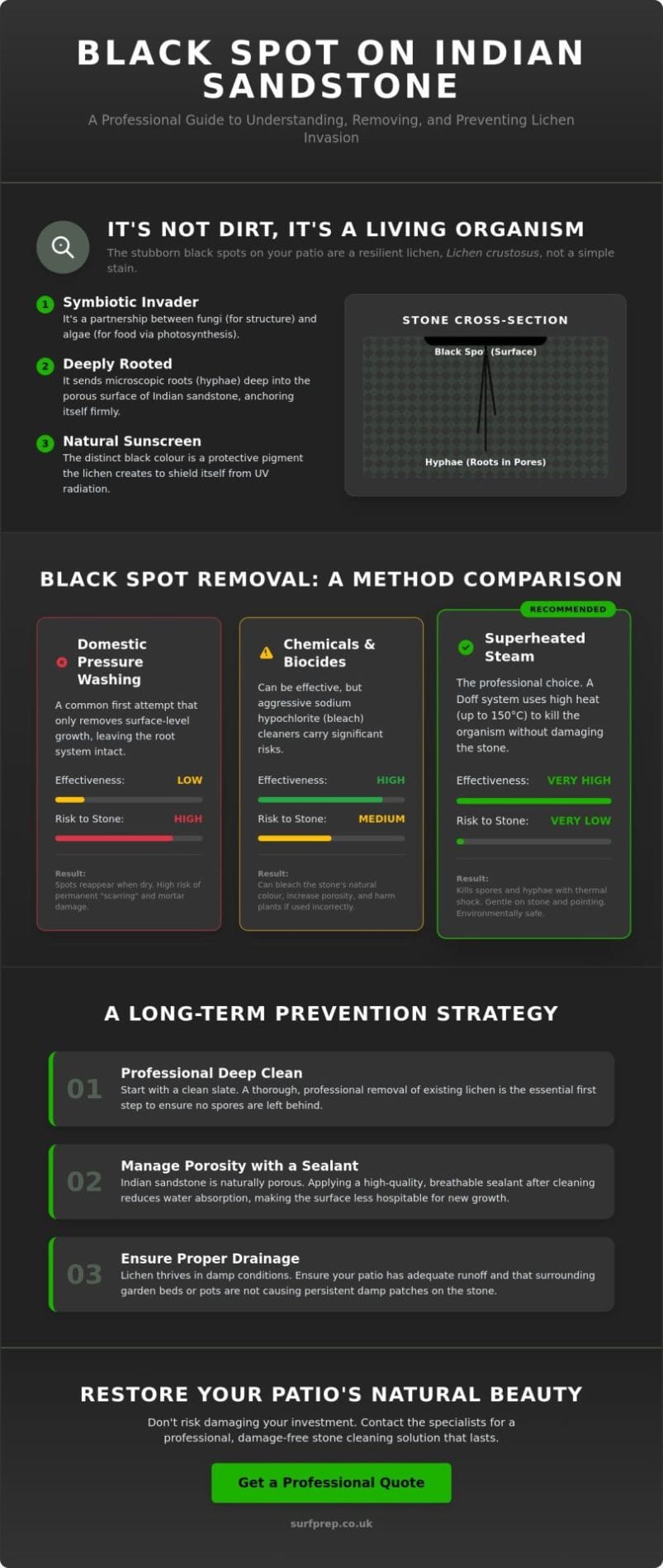
The ink-like splats that plague many UK patios aren’t actually stains from a spilt drink or falling leaves. They are a complex biological organism known as Lichen crustosus. This species is particularly fond of Indian sandstone because of the stone’s high porosity. The black colour you see is a protective pigment the lichen produces to shield itself from UV rays; it’s essentially a biological sunscreen. For homeowners in damp Northern cities like Leeds and York, the mild winters provide the perfect incubator for these spores to settle and multiply. Effective black spot removal from Indian sandstone begins with acknowledging that you are dealing with a living inhabitant, not just a dirty surface.
The Biological Reality: Lichen Crustosus
To understand what is lichen in this context, you have to look at its structure. It’s a symbiotic partnership between fungi and algae. The fungi provide the structure and anchor, while the algae produce food through photosynthesis. This lichen feeds on the minerals within the sandstone, sending microscopic roots, called hyphae, deep into the stone’s capillaries. It’s a physical integration that makes surface-level cleaning ineffective.
Why Standard Pressure Washing Often Fails
A high-powered jet wash is often the first tool homeowners reach for, but it rarely solves the problem. Brute force might blast away the surface-level pigment, making the stone look clean whilst it’s wet, but the hyphae remain safely tucked away in the pores. As soon as the stone dries, those black spots reappear because they never actually left. Over-compensating with pressure can also lead to “scarring”, which are permanent etch marks on the stone, or blowing out the mortar pointing. Successful black spot removal from Indian sandstone requires a more sophisticated approach that targets the root system without damaging the substrate.
While high-pressure methods are unsuitable for delicate lichen removal, they remain a staple for other exterior maintenance tasks. For instance, you can learn more about driveway cleaning to see how professional specialists like Balo Jetwash maintain various hardstanding surfaces using commercial-grade equipment.
How to Remove Black Spots Safely: A Method Comparison
Once you’ve identified that the black spotting is a living organism, the next step is choosing a removal method that won’t compromise the stone’s integrity. Most homeowners are caught between the convenience of chemical cleaners and the perceived power of a jet wash. However, professional restoration requires a more nuanced approach. We often see patios where the “quick fix” has caused more long-term harm than the lichen itself. Achieving successful black spot removal from Indian sandstone involves balancing efficacy with the preservation of the stone’s natural mineral hues.
The Chemical Route: Biocides vs. Bleach
The chemical approach typically involves sodium hypochlorite-based cleaners or specialised biocides. Whilst these are undeniably effective at killing surface lichen, here is an Expert Admission: aggressive, high-concentration chlorine mixes can be a double-edged sword. If used incorrectly, they risk bleaching the iron oxides that provide Indian sandstone its vibrant, multi-tonal colour. Repeated use can also increase the stone’s porosity, effectively creating more “pockets” for future spores to inhabit. If you do use chemicals, you must ensure they are thoroughly neutralised; failure to do so can lead to salt crystallisation, which causes the stone surface to flake over time.
Doff Steam: The Heritage-Safe Alternative
For high-end residential patios or listed properties, superheated steam is the superior choice. The Doff system is a specialised cleaning technology that kills spores and lichen hyphae with intense heat (up to 150°C) rather than abrasive force. This thermal shock detaches the biological “anchor” from the stone’s capillaries without the need for high-pressure water that might scar the surface or blow out pointing. At Surfprep, we prioritise stone cleaning techniques that maintain structural integrity whilst delivering a “like-new” finish. It’s a gentle yet formidable method that avoids the environmental risks of chemical runoff amongst your garden plants and pets. If you’re dealing with a particularly stubborn infestation, you might want to ask our specialists which method is safest for your specific type of sandstone.
Preventing Lichen Return and Maintaining Sandstone Aesthetics
Once you’ve achieved successful black spot removal from Indian sandstone, the focus shifts to preservation. Sandstone is naturally thirsty; its high porosity means it holds onto moisture, which is exactly what lichen spores need to germinate. Sealing the stone after a professional deep clean can significantly reduce this moisture retention by creating a breathable barrier. However, sealing isn’t a “set and forget” solution if the surrounding environment remains a damp, shaded microclimate. Here’s an Expert Admission: no treatment on the market is 100% permanent. Nature is persistent, especially in the UK. However, a professional restoration provides a multi-year clean that far outlasts DIY attempts, giving you a manageable baseline to maintain.
For homeowners considering a transition to more resilient materials, ResinBound Dublin provides expert surfacing solutions that offer a durable and low-maintenance alternative to traditional natural stone paving.
Long-Term Maintenance and Environmental Control
Homeowners in wetter climates like Manchester or Leeds must be proactive about the patio’s environment. To keep your stone looking its best, follow these practical steps:
- Step 1: Improve surface drainage. Ensure that water doesn’t pool in low spots or against house walls. Standing water is a standing invitation for organic growth.
- Step 2: Trim back overhanging vegetation. Increasing UV exposure and airflow helps the stone dry faster after rainfall, which naturally inhibits lichen growth.
- Step 3: Implement a bi-annual soft-wash schedule. Applying a professional-grade, pH-neutral biocide once or twice a year can kill new spores before they have a chance to anchor.
When to Consult a Specialist
DIY products often struggle with deep-set infestations where the lichen has matured over several years. If you’re managing a large-scale sandstone area, such as a commercial courtyard or a sprawling residential estate, commercial-grade equipment is essential for a uniform finish. Professional intervention ensures the stone is cleaned to its core without the risk of surface damage. For a comprehensive site survey in the North of England, you can reach out via Surfprep’s contact page to discuss a tailored restoration plan that protects your investment whilst restoring its original multi-tonal beauty.
Restore Your Sandstone to Its Original Multi-Tonal Beauty
Restoring the vibrant character of your patio requires moving beyond the “pressure wash and repeat” cycle. We’ve seen that these stubborn marks are living organisms, anchored deep within the stone’s capillaries, and they require a specialist approach to truly eradicate. By combining a proper biological understanding with advanced technology, such as Doff superheated steam, you can clear the infestation without compromising the stone’s structural integrity or its natural colour. Effective black spot removal from Indian sandstone is about working with the stone’s biology rather than fighting against it with brute force.
Whether you’re managing a private garden in York or a heritage site in Leeds, we provide the grounded expertise needed for a professional finish. Our team specialises in Doff superheated steam technology, a low-pressure method that kills spores at the source, making us a trusted choice for listed buildings and high-end residential projects across the North of England. Don’t let lichen diminish the value and aesthetics of your property. If you’re ready to see your stone’s original character again, you can request a professional stone restoration quote from Surfprep. We’ll help you reclaim your outdoor space with a methodical, long-term solution that lasts.
Frequently Asked Questions
Is black spot removal safe for my garden plants and pets?
Professional black spot removal is safe for pets and plants provided the correct protocols are followed during the process. If we’re using chemical biocides, we ensure all runoff is managed according to COSHH regulations; this involves pre-soaking surrounding borders and rinsing thoroughly to dilute any active ingredients. Alternatively, our superheated steam method is entirely chemical-free, making it the preferred choice for gardens with sensitive flora or roaming pets where chemical contact is a concern.
How long does it take to remove black spots from a standard-sized patio?
A standard-sized residential patio usually takes between four to eight hours to restore fully. This timeframe depends on the severity of the lichen infestation and the chosen method for black spot removal from Indian sandstone. Whilst chemical treatments require specific “dwell time” to break down the biological anchors, superheated steam offers more immediate results. We always prioritise a methodical pace to ensure the stone’s surface remains intact throughout the cleaning process.
Can I use household bleach to remove black spots from Indian sandstone?
You shouldn’t use standard household bleach as a primary cleaning agent for natural stone. Whilst it might kill surface algae, the high sodium content can lead to salt crystallisation within the sandstone’s pores, which eventually causes the stone to flake or “spall”. Professional-grade cleaners are specifically formulated for stone and are often followed by a neutralising wash to protect the long-term structural integrity of your paving.
Will black spot removal change the colour of my sandstone?
Professional restoration is designed to reveal the stone’s original multi-tonal palette rather than alter it. There’s a common risk with aggressive DIY “over-bleaching” where the natural iron oxides providing the reds and yellows are stripped away, leaving the patio looking washed out. Our approach to black spot removal from Indian sandstone focuses on removing the biological mask of the lichen to safely restore the vibrant, natural character of the material.
