
The Role of Professional Brick Cleaning Specialists in the UK
When it comes to masonry restoration, the term “specialist” carries significant weight. A true specialist is not merely an exterior cleaner with a pressure washer; they are a trained professional who understands the unique properties of brickwork, mortar, and stone. They recognise that their primary role is not just to clean, but to preserve the structural integrity and aesthetic heritage of a building.
In the UK, this distinction is critical. Our unique weather patterns—characterised by persistent rain, freeze-thaw cycles, and urban pollution—place immense stress on masonry. Over time, brickwork can become saturated with water, stained by carbon deposits, and colonised by organic growth like algae and moss. A specialist understands that the goal is to remove these contaminants without compromising the brick’s “breathability”—its natural ability to allow moisture to pass through and evaporate, which is essential for preventing internal damp. (Exterior cleaning)
- Defining a Specialist: A specialist possesses in-depth knowledge of different brick types, mortar compositions, and the specific, often delicate, cleaning methods required for each. They prioritise the long-term health of the building over a quick aesthetic fix.
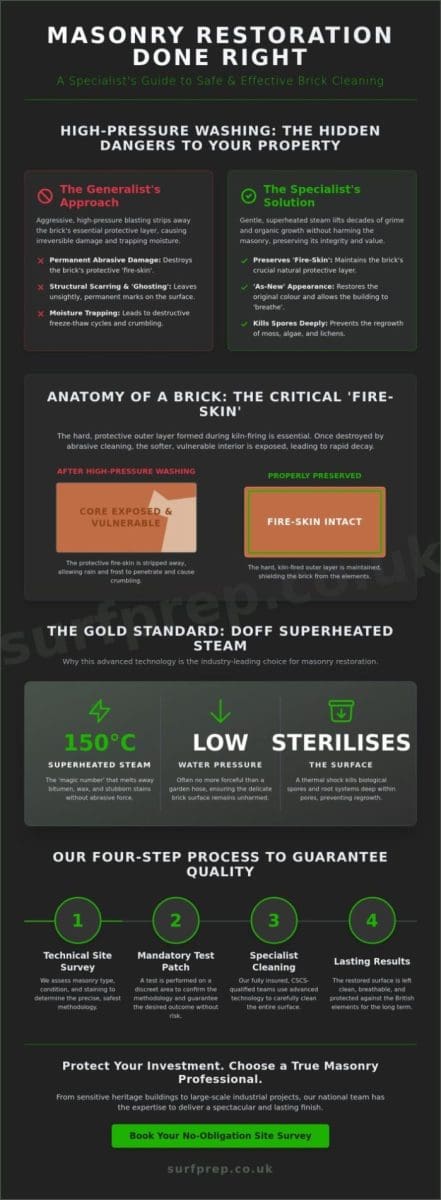
- Preserving the “Fire-Skin”: Many older bricks have a hard, protective outer layer known as the “fire-skin,” formed during the firing process. Aggressive, high-pressure cleaning can strip this layer away, exposing the softer, more porous core to accelerated decay. A specialist’s first duty is to protect this crucial surface.
- Understanding UK Weather Impact: Professional masonry care is a necessity, not a luxury, for combating the effects of atmospheric pollution and dampness that define the British climate.
Specialist vs. Generalist: Why the Distinction Matters
Hiring a generalist contractor for a specialist job introduces significant risk. Lacking masonry-specific training, they may default to abrasive methods that cause irreversible damage. A key indicator of a true professional is the “Expert Admission”—the willingness to advise against a particular method, or even turn down a job, if they believe it will harm the property. Furthermore, credible national brick cleaning specialists will hold comprehensive insurance and relevant accreditations, providing a level of assurance that local handymen simply cannot match.
Understanding UK Masonry Types and Their Vulnerabilities
The UK’s architectural landscape features a diverse range of brick types, each with its own characteristics. Common examples include the mass-produced Flettons, the historic London Stocks, and the dense, durable Engineering bricks used in civil projects. Each type responds differently to cleaning; for example, a soft, handmade brick from the Victorian era requires a far more delicate approach than a modern engineering brick. A specialist can identify the brick type and assess its condition, ensuring the chosen cleaning method is both safe and effective.
Advanced Technologies: Why Superheated Steam Cleaning is the Industry Standard
For decades, the challenge in masonry restoration has been to find a method powerful enough to remove stubborn contaminants without causing physical damage. The solution is superheated steam cleaning. Systems such as DOFF and Thermatec operate on a principle of high temperature but low pressure, offering a gentle yet highly effective approach to restoration.
This technology heats water to temperatures of up to 150°C, creating a fine vapour that is sprayed onto the brick surface. This high temperature is the “magic number” that effortlessly melts away paint, bitumen, and wax, while also killing the spores of moss, algae, and fungi. Because the system uses very low pressure and a minimal amount of water, the surface is never saturated, and drying times are remarkably fast. This makes it an environmentally friendly choice, as it rarely requires the use of harsh chemicals.
The Science of Superheated Steam at 150°C
The effectiveness of superheated steam lies in its ability to break the molecular bonds of dirt and grime without relying on brute force. The heat transfers energy to the substrate, causing the unwanted material to lift away. This “thermal shock” effect is particularly effective against biological growth, as it neutralises spores deep within the pores of the brick, preventing rapid regrowth. It is for this reason that the method is trusted and frequently specified by heritage organisations like Historic England for work on listed buildings.
Superheated Steam vs. Traditional Chemical Cleaning
While chemical cleaning has its place, it comes with inherent risks. Aggressive acids and alkalis can be effective but pose a threat to surrounding vegetation, public pathways, and the building’s substrate if not managed with extreme care. An “Honest Specialist” will acknowledge that there are rare scenarios—such as removing deep-seated metallic staining—where a mild, carefully selected chemical may be required as a supplement. However, for the vast majority of projects, superheated steam provides a superior, safer, and more controllable result without the associated environmental hazards.
Assessing Masonry Damage: Risks of DIY and Unqualified Contractors
One of the most pervasive myths in property maintenance is that a standard high-pressure jet wash is a safe way to clean brickwork. This is dangerously incorrect. Unqualified operators, often dubbed “cowboys,” can cause catastrophic and expensive damage in a matter of minutes by using the wrong equipment or technique.
High-pressure water can strip the protective face from old bricks, leading to spalling and disintegration during freeze-thaw cycles. It can create permanent “ghosting” or scarring from improper nozzle use and force huge volumes of water into the wall’s cavity, potentially causing severe internal damp. A specialist knows that what seems like a cheap DIY solution often results in a far more costly bill for professional repairs and repointing down the line.
The Problem with High-Pressure Jet Washing
High PSI (pounds per square inch) acts like a blunt instrument, eroding the brick surface and blasting out mortar joints. This saturation can also trigger efflorescence, a chemical process that draws salts to the surface of the brick, leaving behind unsightly white deposits after drying. The damage is often not immediately apparent, revealing itself months later as the weakened brickwork begins to fail.
Identifying “Cowboy” Practices in the Cleaning Industry
Be wary of any contractor who immediately suggests aggressive methods like sandblasting for a heritage facade or provides a quote without a site survey. The refusal to perform a small, free test patch is a major red flag. This simple step is non-negotiable for a professional, as it proves the method’s effectiveness and ensures no damage will occur. A cheap quote often ignores the hidden costs of the inevitable repointing and repair work that follows a botched cleaning job.
The Restoration Process: From Initial Survey to Final Surface Protection
A professional masonry restoration project follows a meticulous, multi-stage process designed to guarantee safety, quality, and client satisfaction. It moves far beyond a simple “spray and pray” approach, ensuring every variable is accounted for before the main work begins.
Step 1: The Technical Site Survey and Assessment
The process begins with a thorough on-site survey. A specialist will identify the type of brick and mortar, assess the structural integrity of the joints, and determine the exact nature of the contaminants, whether they are atmospheric carbon, organic growth, or man-made coatings like paint. This initial assessment dictates whether the project requires delicate heritage restoration or more robust industrial surface preparation.
Step 2: The Critical Test Patch
Before committing to the full project, a specialist will always conduct a test patch on a small, inconspicuous area of the building. This is the only way to guarantee a no-damage result. The test patch allows the team to calibrate the temperature and pressure of their equipment perfectly, while also showing you, the client, a clear “before and after” to set realistic and exciting expectations for the final outcome.
Step 3: Execution and Quality Control
Once the method is proven, the main work can commence. This phase involves meticulous protection of windows, doors, and surrounding properties. The cleaning itself is performed systematically, typically from the top down to ensure a uniform finish without streaks. The final stage includes a thorough rinse-down and a complete site clear-up, leaving your property looking its best and the surrounding area tidy. If requested, a breathable siloxane sealant can be applied to provide long-term protection against water ingress; for those looking to source high-quality industrial materials, you can discover Fosseway Tapes & Fixings Limited.
Surfprep: Your National Partner for Specialist Brick and Stone Restoration
At Surfprep, we embody the “Reliable Veteran” approach to masonry restoration. With over a decade of expertise, we combine the precision required for delicate heritage work with the industrial-grade efficiency needed for large-scale commercial projects. Our national UK footprint means we have the logistical capability and technical knowledge to deliver exceptional results, no matter the size or location of your project.
Our commitment is to provide the right solution, not just the quickest one. From superheated steam cleaning to graffiti removal and industrial surface preparation, we offer a comprehensive suite of services built on a foundation of integrity and expertise.
National Reach, Specialist Precision
Operating from our base in East Yorkshire, our teams are deployed across the country to manage complex projects for national commercial clients. We have built a reputation for our “can-do” attitude, taking on jobs that others may find too large or technically challenging. We handle all the logistics, from scaffolding and water access to public safety, ensuring a seamless process from start to finish.
Beyond Bricks: A Comprehensive Restoration Portfolio
Our expertise extends beyond brickwork to include stone cleaning and the delicate restoration of wooden beams. We are also trusted partners in the industrial sector, providing essential surface preparation for large-scale infrastructure and manufacturing facilities. Whatever your restoration needs, our team has the skill and the equipment to preserve and protect your valuable assets.
Complementing masonry restoration with professional finishes is essential for a complete property transformation; for inspiration on high-quality residential and commercial aesthetics, Deluxe FX Painting & Decorating provides excellent examples of expert craftsmanship.
Contact Surfprep for a professional masonry assessment and discover how we can restore the true character of your property.
Frequently Asked Questions
-
Is brick cleaning safe for listed buildings in the UK?
Yes, when performed by a specialist using approved, non-abrasive methods. Superheated steam cleaning is the preferred technique for listed buildings as it gently removes contaminants without damaging the historic substrate, a method often recommended by conservation bodies.
-
How much does professional brick cleaning cost per square metre?
The cost varies depending on factors like the type of brick, the level of contamination, access requirements (e.g., scaffolding), and the location. A professional will always provide a detailed quote after a site survey rather than a generic per-metre price.
-
Will superheated steam cleaning remove graffiti or old paint from my walls?
Absolutely. The high temperature of the steam is extremely effective at melting and lifting multiple layers of paint, as well as spray-can graffiti, without the need for harsh chemicals or abrasive blasting.
-
How long does a professional brick cleaning project typically take?
A standard residential property might take 2-4 days, whereas large commercial or industrial projects can take several weeks. The timeline is determined during the initial site survey and depends on the scale and complexity of the work.
-
What is the difference between superheated steam cleaning and standard jet washing?
Superheated steam cleaning uses very high temperatures (up to 150°C) and low pressure to gently lift dirt. Standard jet washing relies on extremely high pressure (brute force) which can easily damage the brick face and mortar, causing long-term structural problems.
-
Can you clean internal brick fireplaces and soot-stained walls?
Yes, the low moisture and precise nature of superheated steam systems make them ideal for internal work, effectively removing decades of soot and smoke staining from fireplaces and interior brick features with minimal mess.
-
Does my property need repointing after it has been cleaned?
If the mortar is already in poor condition, cleaning may reveal the need for repointing. A specialist will assess the mortar integrity during the initial survey and advise if repointing should be done before or after the clean for the best long-term result.
-
Will the cleaning process damage my garden or plants?
A professional team takes extensive measures to protect the surrounding environment. Because superheated steam cleaning uses minimal water and no harsh chemicals, the risk to gardens and plants is negligible. Any delicate areas will be covered and protected before work begins.
