
The most expensive mistake you can make with commercial graffiti removal Bradford isn’t leaving the paint on the wall; it’s choosing a cleaning method that permanently etches your building’s history into its stone. We understand the sinking feeling of arriving at your property in Little Germany or the city centre only to find fresh spray paint on your heritage masonry. It’s a genuine concern, and one we’ve addressed since we started in November 2000, that the wrong pressure or chemical might leave a permanent “ghost” of the vandalism behind.
This guide provides the technical clarity you need to preserve your building’s aesthetic and market value. You’ll learn how to match specific cleaning technologies to your substrate, from using superheated steam like Thermatech (frequently referred to as DOFF) on delicate stone to why we prefer dry grit blasting for internal works to avoid moisture issues. We’ll also cover the essential role of anti-graffiti coatings in creating a long-term protection strategy that satisfies both conservation officers and your bottom line.
Key Takeaways
- Learn how to select the right technology for Bradford’s Victorian sandstone, ensuring you avoid permanent etching by choosing between Thermatech (DOFF) steam and gentle sand jet systems.
- Discover why a rapid response strategy for commercial graffiti removal Bradford is the most effective deterrent; clearing tags within 48 hours significantly reduces the likelihood of repeat vandalism.
- Understand the critical distinction between damp outdoor processes and dry internal grit blasting, which is essential for protecting your property from moisture ingress and structural damage.
- Evaluate the financial benefits of anti-graffiti coatings that alter surface tension, allowing for easier future cleaning whilst preserving the original character of your brickwork or stone.
- Gain insights into complying with local conservation standards in historic areas like Little Germany by using non-destructive, specialist restoration techniques established over two decades.
Evaluating Graffiti Removal Methods for Bradford’s Stone and Brickwork
Bradford’s iconic Victorian sandstone is notoriously difficult to clean. Because it’s so porous, standard high-pressure washing often fails; it either pushes pigment deeper into the stone or scars the surface. We’ve refined our approach since November 2000 to prevent “ghosting,” which occurs when a faint, permanent silhouette of the tag remains visible after cleaning. Effective commercial graffiti removal Bradford requires a technical understanding of how different graffiti removal techniques interact with historic masonry. We prioritise the substrate’s integrity over a quick fix, ensuring the “face” of the brick or stone isn’t blown away by excessive force.
Thermatech and DOFF: The Power of Superheated Steam
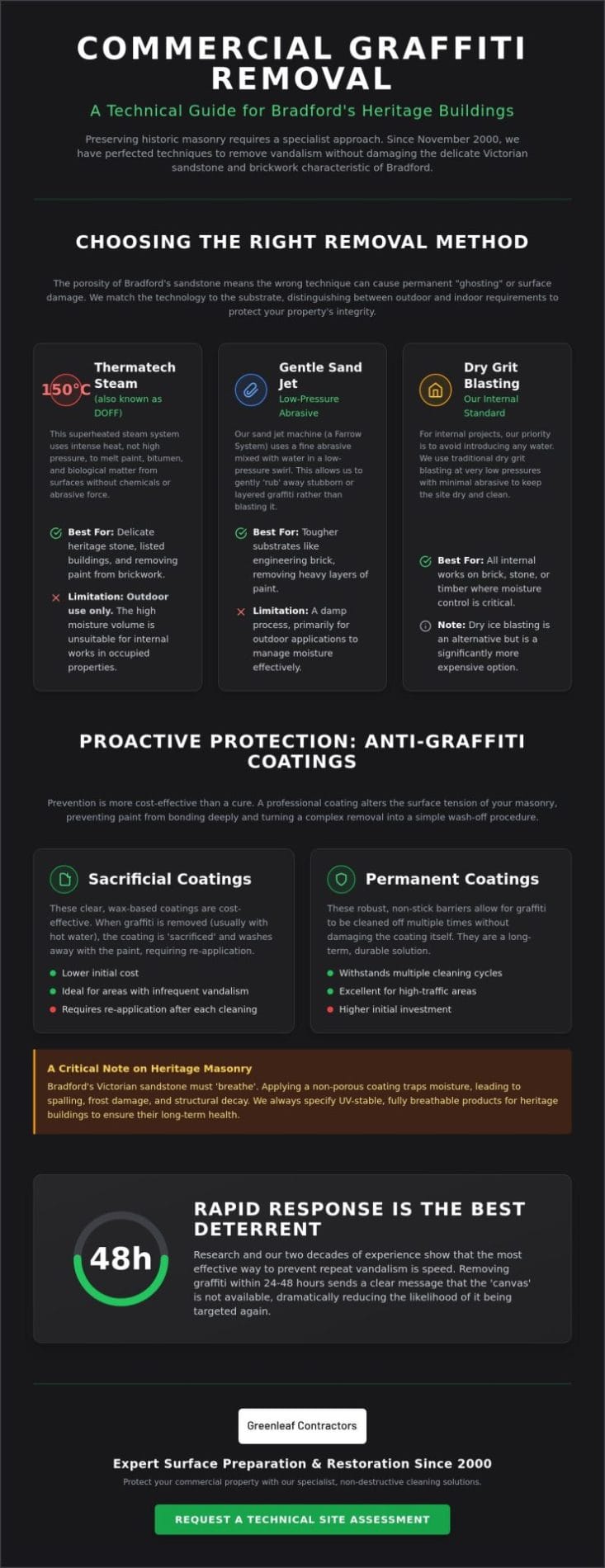
For delicate facades in areas like Little Germany and Saltaire, we utilise Thermatech. This system, often referred to by the industry term DOFF, reaches temperatures of 150°C. The secret isn’t pressure; it’s the intense heat that liquefies spray paint and bitumen, allowing it to be rinsed away without the need for harsh chemicals. It’s the gold standard for listed buildings because it avoids the risk of chemical leaching or salt crystallisation. However, we strictly limit this to outdoor applications. Introducing that volume of moisture into an internal environment can lead to long-term damp issues, especially in occupied commercial spaces.
The Sand Jet: Gentle Abrasive Cleaning for Stubborn Vandalism
When dealing with heavily layered industrial graffiti on tough engineering bricks, steam might not be enough. In these cases, we deploy our sand jet machine, a technology we’ve championed since we acquired our first Farrow System in November 2000. It’s a damp process that uses a swirl of low-pressure air, water, and a fine abrasive. It’s far gentler than traditional sandblasting, allowing us to “rub” the paint away rather than blast it.
For internal commercial projects, our preference shifts entirely to avoid water. We use traditional dry grit blasting at very low pressures and low abrasive rates to keep the site dry and manageable. Whilst dry ice blasting is a valid alternative for internal work, it’s often a significantly more expensive option for most businesses. For more details on our specific equipment, you can view our guide to sand jet cleaning.
Choosing an Anti-Graffiti Coating: Protecting Your Bradford Premises
Investing in prevention is often more economical than reactive cleaning, especially in high-footfall areas like the Bradford city centre. Prevention saves time. By applying a specialist coating, you alter the surface tension of the substrate. This prevents the spray paint from bonding deeply into the pores of the masonry. It’s about turning a complex restoration job into a simple wash-off procedure. When Evaluating Graffiti Removal Methods, it’s clear that the easiest way to remove a tag is to ensure it never truly sticks in the first place. Professional commercial graffiti removal Bradford is as much about future-proofing as it is about current restoration.
Sacrificial vs. Permanent Coatings: Which is Right for You?
Sacrificial coatings are typically wax-based and cost-effective, but they “sacrifice” themselves during the cleaning process. When we steam away the graffiti, the coating comes with it, requiring a fresh layer. Permanent coatings are more robust, “non-stick” barriers, excellent for modern industrial cladding or metal shutters. Selecting the right match for your stone or brickwork is vital to ensure long-term protection without compromising the building’s appearance.
Selecting a Coating Based on Material Porosity
Bradford’s Victorian sandstone is a living material; it needs to breathe. If you apply a non-porous coating, you risk trapping moisture behind the surface, leading to spalling and structural decay. We always recommend breathable, UV-stable products for heritage masonry. Metal shutters require different chemical primers to ensure adhesion compared to porous brick. Don’t risk a “glossy” finish that ruins the look of a historic facade. We can provide a technical assessment to find the right balance for your commercial graffiti removal Bradford plan. Feel free to get in touch if you’d like us to look at your specific site requirements.
Strategic Graffiti Management: Rapid Response and Surface Protection
Speed is the most effective deterrent in your arsenal. Removing tags within 24 to 48 hours signals to vandals that the site is actively managed and their “work” won’t be seen. This proactive approach is a core pillar of any robust commercial curb appeal strategy. When graffiti is left to sit, it often invites further vandalism, leading to a cycle that’s harder and more expensive to break. Since November 2000, we’ve helped Bradford businesses break this cycle by providing rapid, technically sound interventions that preserve the building’s integrity.
UK commercial property owners also have a practical responsibility to maintain their premises. In Bradford’s regenerating commercial districts, a clean facade is essential for maintaining public trust and tenant satisfaction. Neglected graffiti can lead to a decline in perceived property value and may even attract attention from local authority enforcement if left unaddressed. Our commercial graffiti removal Bradford service is designed to handle these challenges with the grit and determination required for large-scale urban restoration.
The ROI of Professional Maintenance
The cost-benefit of professional cleaning becomes clear when you consider the risks of DIY attempts. Using the wrong pressure or aggressive chemicals on porous sandstone can lead to permanent etching, which often costs significantly more to rectify than the original cleaning. Professional maintenance preserves the underlying substrate whilst ensuring the building looks its best. We frequently integrate graffiti clearance with broader brick cleaning services to provide a cohesive, refreshed look for the entire property facade.
What to Look for in a Bradford Specialist
Technical literacy is a non-negotiable requirement for any contractor. You should ensure they understand Sa 2.5 standards for preparing metal shutters, but crucially, they must know to avoid these standards when cleaning masonry. Wood, brick, and stone require a far gentler touch than industrial steel.
Always verify insurance, site-specific RAMS (Risk Assessment and Method Statements), and the contractor’s experience with Bradford’s heritage materials. We recommend requesting a test patch on an inconspicuous area before work begins. This confirms the removal method won’t cause ghosting or surface damage. It’s an honest, transparent way to ensure you get the results you expect without any unpleasant surprises for your commercial graffiti removal Bradford project.
Securing the Long-Term Value of Your Bradford Assets
Managing a commercial property requires a balance between immediate restoration and long-term surface protection. We’ve explored how matching the right removal technology, whether it’s the superheated precision of Thermatech (DOFF) or the gentle damp process of a sand jet machine, is vital for avoiding permanent substrate damage. By prioritising rapid removal and breathable anti-graffiti coatings, you ensure that your building remains a professional asset rather than a target for repeat vandalism.
As specialists in heritage restoration across Bradford and West Yorkshire since 2000, we bring first-hand expertise to every project. We don’t believe in a one-size-fits-all approach; we provide the technical clarity needed to protect everything from modern industrial cladding to Victorian sandstone. If you’re ready to implement a professional strategy for commercial graffiti removal Bradford, we’re here to help you get it right the first time.
Contact our Bradford specialists for a technical assessment and quote to discuss your property’s specific needs. We’re committed to helping you maintain a clean, resilient, and professional facade that stands the test of time.
Frequently Asked Questions
Will graffiti removal damage the original brick or stone on my Bradford building?
No, provided the removal method is correctly matched to the substrate’s porosity and condition. We avoid high-pressure water jetting, which can scar masonry; instead, we use Thermatech (DOFF) superheated steam or our gentle sand jet machine. These systems are designed to lift the pigment without aggressive abrasion, preserving the delicate “face” of Victorian sandstone or historic brickwork.
How much does professional commercial graffiti removal cost in West Yorkshire?
The cost of commercial graffiti removal Bradford depends on several variables, including the total surface area, the type of paint used, and the height of the building. Porous surfaces like stone often require more careful, time-intensive treatment than non-porous metal shutters. We provide transparent, job-specific quotes rather than flat rates to ensure you only pay for the specific technical requirements of your property.
Is it better to paint over graffiti or have it professionally removed?
Professional removal is always the superior choice for long-term property health. Painting over a tag often creates an unsightly “patchwork” effect and can trap moisture within the masonry, leading to structural spalling. Spray paint also lacks a stable bond with masonry paint; the new layer often flakes off within months. Restoration ensures the building’s original appearance and breathability are maintained.
How long does the graffiti removal process typically take for a commercial property?
Most commercial graffiti removal Bradford projects are completed within a few hours to a full day. A single tag in an accessible location is a quick task, whilst a large-scale industrial facade with multiple layers of paint may require a more methodical approach. We prioritise a rapid response to ensure that vandalism is cleared within 48 hours, which is the most effective way to deter repeat offences.
Can you remove graffiti from delicate or listed buildings in Saltaire or Little Germany?
Yes, we specialise in heritage restoration and have worked on numerous sensitive sites across Bradford since November 2000. For listed buildings, we utilise Thermatech (DOFF) superheated steam, which is a non-chemical and non-abrasive process approved by many conservation officers. It’s particularly effective for the complex carvings and porous sandstone found in Saltaire, as it liquefies the paint without damaging the underlying stone.
What is an anti-graffiti coating and how long does it last?
An anti-graffiti coating is a protective layer that prevents spray paint from bonding with a surface. Sacrificial coatings are wax-based and are removed during the cleaning process, whilst permanent coatings provide a long-lasting, non-stick barrier that can withstand multiple cleans. Depending on the exposure to UV light and local weather conditions, a permanent, breathable coating on masonry can remain effective for several years before requiring a reapplication.
