
Did you know that proper concrete surface preparation for epoxy coating accounts for 80% of the success of your floor? It’s a sobering thought when you consider that most failures happen because the bond wasn’t strong enough from day one. We understand the worry of seeing a fresh industrial coating start to peel and flake within months, leaving your workspace in a mess. You want a durable, long-lasting finish that stands up to heavy use without the fear of delamination.
In this guide, we’ll share the professional techniques we’ve refined since November 2000 to help you achieve an industrial-grade bond. You’ll learn why mechanical profiling is the only reliable choice for internal floors and how low-pressure dry grit blasting provides the ideal surface profile whilst keeping your property dry. We’ll also cover the moisture thresholds you need to meet before opening a tin of epoxy.
Key Takeaways
- Identify why removing “laitance” is the critical first step to ensuring your epoxy floor achieves a permanent, industrial-grade mechanical bond.
- Discover why low-pressure dry grit blasting is the most reliable method for concrete surface preparation for epoxy coating on internal warehouse and garage floors.
- Learn why we recommend avoiding damp cleaning processes indoors to protect your property from moisture entrapment and future coating delamination.
- Understand the professional process of using Thermatech superheated steam for degreasing followed by mechanical profiling to reach the correct surface profile.
Why Concrete Surface Preparation is Critical for Epoxy Adhesion
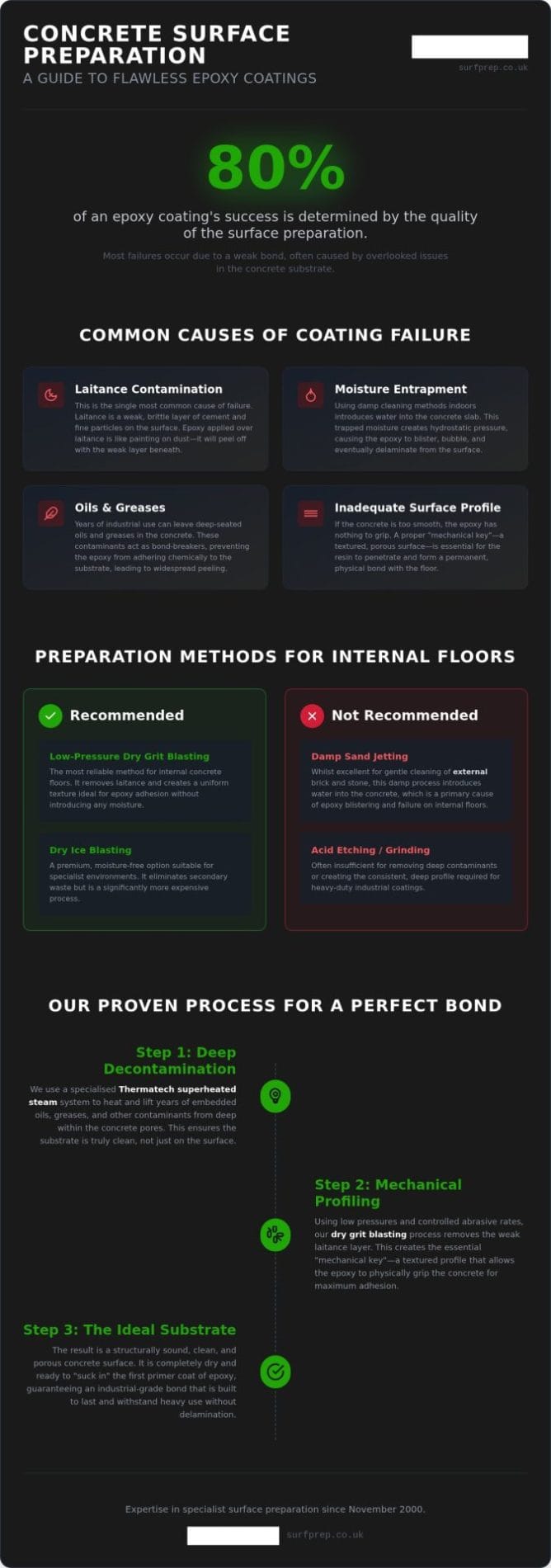
Applying an epoxy floor is a chemical process, not just a cosmetic one. For a successful concrete surface preparation for epoxy coating, you must create what we call a “mechanical key”. Without this physical grip, the resin sits on top like a sheet of plastic rather than becoming part of the floor. This integration is similar to the principles found in Polymer Concrete, where the resin acts as a binder; if the substrate isn’t porous, the resin has nowhere to go. Our primary goal is always to reach sound, porous concrete that can literally “suck in” the first coat of epoxy.
Industrial floors often carry years of hidden history. Oils, greases, and residues from old coatings act as bond-breakers, preventing the chemical adhesion required for a permanent finish. If these contaminants aren’t properly removed, the epoxy will simply float on the surface. Since we started in November 2000, we’ve found that laitance remains the single most common cause of early coating failure. If you skip the preparation, you’re essentially painting over dust. We’ve seen countless projects fail because the installer didn’t realise that even a seemingly clean floor can have deep-seated oils that reject the coating.
Common Causes of Epoxy Floor Failure
Most industrial failures stem from two main issues: moisture and profile. Surface moisture trapped under the coating creates hydrostatic pressure, which eventually forces the epoxy to blister and pop. Equally common is inadequate profiling; if the concrete is too smooth, the epoxy won’t have enough surface area to grip. Proper concrete surface preparation for epoxy coating ensures this profile is met. Laitance is the brittle, milky layer of cement and fine aggregates that rises to the surface during curing and must be removed to expose the sound concrete beneath. Ignoring these factors leads to a coating that peels off in sheets within months, whilst causing significant downtime for your business.
Specialist Methods for Preparing Industrial Concrete Floors
Selecting the correct mechanical method is essential to meet ASTM Standards for Floor Surfacings. Whilst diamond grinding and shot blasting are common industry choices, we’ve prioritised low-pressure dry grit blasting for internal concrete surface preparation for epoxy coating since our founding in November 2000. This method provides a consistent, uniform texture that’s ideal for resin adhesion without the risk of over-profiling the substrate. For specialist environments like food production or clean rooms, we also offer dry ice blasting. It’s a premium, moisture-free option that eliminates secondary waste, though we always advise clients that it carries a significantly higher cost than traditional methods.
To help you benchmark these costs, you can explore Industrial coating and abrasive blasting service fees options from industry experts like Valu Industrial Services, which can provide a useful reference point for your project budgeting.
We believe in being transparent about our processes, which includes an important expert admission. Our sand jet machine, which we’ve operated since November 2000, is a fantastic tool for cleaning delicate external stone. However, we’ll never use it for internal concrete preparation. Because the sand jet is a damp process, it introduces water into the slab. Epoxy and moisture simply don’t mix; any water trapped in the concrete will eventually lead to the coating lifting or blistering. We always recommend dry methods for internal works to protect the integrity of your property.
Dry Grit Blasting vs. Damp Sand Jetting
The sand jet, originally acquired as a Farrow System, is a gentle alternative to harsh sandblasting, making it perfect for external brickwork or heritage stone. For internal warehouse and garage floors, our preferred approach is traditional dry grit blasting using low pressures and low abrasive rates. This refined technique ensures we achieve the necessary surface profile whilst keeping the workspace manageable and entirely dry. If you’re unsure which method fits your facility in the North of England, you can contact us for straightforward, expert advice on your flooring requirements.
The Surfprep Approach: Achieving the Perfect Surface Profile
Our methodology is built on over two decades of site experience. Since November 2000, we’ve refined a methodical step-by-step process that ensures every floor is ready for its new coating. We begin with a thorough decontamination phase using Thermatech superheated steam. This specialised equipment is necessary to lift grease and oils that have migrated deep into the slab, a step often overlooked by less experienced contractors. Following degreasing, we execute the concrete surface preparation for epoxy coating by selecting specific abrasives and adjusting our blast pressures to match the unique density of your floor. This tailored approach ensures we don’t damage the underlying structure whilst removing the weak surface layer. Whilst we utilise the sand jet for industrial surface preparation on external masonry, our internal focus remains on dry, low-pressure grit blasting to maintain a moisture-free environment.
Assessing Your Concrete Surface Profile (CSP)
The success of your floor depends on meeting the correct Concrete Surface Profile (CSP). This industry scale ranges from 1 to 9, but most concrete surface preparation for epoxy coating projects require a CSP 2 or 3. This level of roughness provides the mechanical grip needed for the epoxy to anchor itself permanently. The resulting surface should feel like medium-grit sandpaper and appear uniform across the entire area. If you’re managing a facility in Leeds, Manchester, or York, we suggest contacting our experts for a comprehensive site survey. Our team will assess the hardness of your slab and determine the exact methodology required to achieve a durable, industrial-grade finish that won’t fail under heavy traffic.
Secure the Future of Your Industrial Floor
Achieving a permanent bond requires more than just a clean surface; it demands a precise mechanical key. By choosing dry, low-pressure grit blasting over damp methods, you ensure that moisture doesn’t compromise your investment. Since November 2000, we’ve provided expert concrete surface preparation for epoxy coating across Leeds, York, Hull, Manchester, and the wider North of England. Our 25 years of specialist experience means we understand exactly how to reach the ideal surface profile whilst protecting your property’s internal environment from moisture entrapment. Don’t risk a costly coating failure by skipping the essential groundwork. If you’re ready to transform your workspace with a durable, industrial-grade finish that stands the test of time, Request a Professional Floor Survey from Surfprep today. We’re here to ensure your project starts on solid, expertly prepared ground.
Frequently Asked Questions
Can I just use acid etching for my epoxy floor preparation?
Acid etching is rarely sufficient for professional grade results because it fails to remove the weak laitance layer effectively. Whilst DIY kits suggest it, the process introduces significant moisture into the slab, which often leads to the coating peeling. For a permanent industrial finish, mechanical concrete surface preparation for epoxy coating via dry grit blasting is the only method we’ve recommended since November 2000.
How long does professional concrete grit blasting take?
The duration depends on the floor’s condition and total square metres, but most standard industrial units are completed within one to two working days. Our methodical approach ensures we achieve the correct surface profile without rushing the process. Because we use dry methods, there’s no need to wait days for the slab to dry out, which significantly reduces your total project downtime.
Is grit blasting concrete floors a dusty process for indoor areas?
We utilise modern, dust controlled equipment to keep your workspace as clean as possible during the preparation phase. Whilst no mechanical profiling is entirely dust free, our low pressure dry grit blasting systems are designed to contain the majority of debris at the source. This allows us to work in active commercial environments without causing the mess associated with traditional, unregulated sandblasting methods.
Will grit blasting remove old floor paint and oil stains?
Dry grit blasting is highly effective at stripping away old floor paint and rubber tyre marks to reveal sound concrete. For deep seated oil stains, we first use our Thermatech machine to provide superheated steam cleaning, which lifts grease to the surface. Combining these two professional techniques ensures the concrete surface preparation for epoxy coating is thorough enough to prevent any future delamination.
How soon after preparation can I apply the epoxy coating?
You can usually apply the epoxy coating immediately after we finish the dry grit blasting process. Since we don’t use the damp sand jet method indoors, there’s no residual moisture trapped in the concrete pores. This immediate turnaround is a major advantage of our dry preparation specialist service, as it allows your flooring contractors to begin their work without any delay.
What is the best way to clean a concrete floor before coating?
Mechanical profiling through dry grit blasting is the most reliable way to clean and prepare a floor for resin. It removes contaminants and creates the necessary sandpaper texture for the epoxy to grip. We’ve found that relying on chemicals or simple pressure washing often leaves residues behind, whereas our dry, low pressure system delivers a consistent, industrial grade bond every time.
