
The most durable anti-graffiti coating isn’t automatically the right choice for your property. A treatment suited to modern brick may not be appropriate for older, more sensitive masonry, and an unsuitable cleaning method can affect the building’s appearance. A cost-benefit analysis of anti-graffiti coatings should therefore start with the surface, not just the promise of easier graffiti removal.
To make a useful comparison, look at the condition and material of the wall, its exposure to graffiti, and the work involved in applying and maintaining a treatment. Then weigh those factors against the role the coating is intended to play. This article explains how to compare coating systems, plan for future cleaning and assess whether sealing belongs in your property maintenance plan. Surfprep has provided cleaning and surface preparation services since November 2000, including brick and stone sealing using Silane and anti-graffiti products.
Key Takeaways
- A sound cost-benefit analysis of anti-graffiti coatings considers the surface, its exposure to graffiti and how the property is maintained.
- Compare each treatment’s intended role with its application, cleaning and upkeep requirements. No single option suits every building.
- Record the masonry type, condition and finish before deciding whether to consider a treatment.
- Graffiti removal and sealing are separate parts of property care. Surfprep provides brick and stone sealing using Silane and anti-graffiti products.
When is an anti-graffiti coating worthwhile for a UK property?
A coating is worth considering when its intended role suits both the surface and the way the property is managed. The decision is not simply whether graffiti could occur. Consider whether a treatment could make future cleaning more manageable without creating problems for the masonry or its appearance. That balance is central to a cost-benefit analysis of anti-graffiti coatings.
Start by reviewing three things: the wall’s exposure to graffiti, how the area is used, and what the surface is made from. A street-facing wall that has needed repeated cleaning may have different maintenance needs from a sheltered courtyard wall. At a busy entrance, keeping the area presentable may be a priority. Use the property’s maintenance and cleaning records to inform the decision rather than relying on assumptions about future incidents.
What should a property manager expect an anti-graffiti coating to do?
An anti-graffiti coating is intended to help manage graffiti on a treated surface. It does not guarantee that graffiti cannot be applied, and it does not remove existing marks. As a general overview of coating types and uses, see the Anti-graffiti coating Wikipedia article. For a property decision, check the technical information for the specific coating system, including what it is designed to do and what cleaning or maintenance it requires.
A coating can support graffiti management, but it cannot guarantee a property will remain graffiti-free. Removal and sealing are separate tasks. Removal deals with marks already on the building; sealing is a preventive maintenance measure considered for a cleaned surface.
Brick and stone need individual consideration. Their condition, finish and surface characteristics can affect which treatment is suitable and how cleaning should be approached. A porous brick wall and a dressed stone entrance should not be treated as interchangeable simply because both are masonry. Surfprep provides brick and stone sealing using Silane and anti-graffiti products. Its brick cleaning service can also help inform an assessment of the brickwork before a treatment decision.
How to compare coating benefits with maintenance demands
A useful cost-benefit analysis of anti-graffiti coatings compares the intended benefit with the work involved in preparing, treating and maintaining the surface. First, describe the property and its cleaning history. Then compare the technical information for the coating systems being considered. Pay attention to preparation requirements, the recommended approach to graffiti removal and whether the system needs attention after cleaning. These details help you compare the complete maintenance task, not just the coating’s headline benefit.
The table below provides a practical starting point. It is a planning aid, not a substitute for the technical information for a specific coating system.
| Surface | Exposure | Intended benefit | Ongoing maintenance to consider |
|---|---|---|---|
| Brick, with its condition recorded | Regular graffiti concerns on an accessible frontage | Support a more manageable approach to cleaning | How graffiti will be removed and whether the treatment needs attention afterwards |
| Stone, noting its finish and condition | Occasional marking in a less exposed area | Protect the appearance as part of planned property care | How cleaning could affect the stone and what upkeep the system specifies |
| Brick or stone, condition requiring assessment | Exposure or cleaning history not yet clear | Establish whether treatment is suitable before setting expectations | Further surface assessment and review of application and maintenance guidance |
Assess the coating system and the substrate together. A treatment’s intended benefit matters only if it is appropriate for the material and the way the property will be maintained. The product guidance should set out how to prepare the surface, clean graffiti and care for the treatment. Do not assume that instructions for one system apply to another.
Which questions make the comparison specific to your building?
Record whether the surface is brick or stone, its current condition and any visible variations in finish. Note previous cleaning or treatment where that information is available. Next, consider how exposed the wall is and how important it is to keep the area presentable for residents, visitors or day-to-day use. Finally, review the technical information for the specific system, including preparation, application and upkeep requirements.
For a surface-specific view of brickwork, explore Surfprep’s brick cleaning work as part of assessing the property’s maintenance needs.
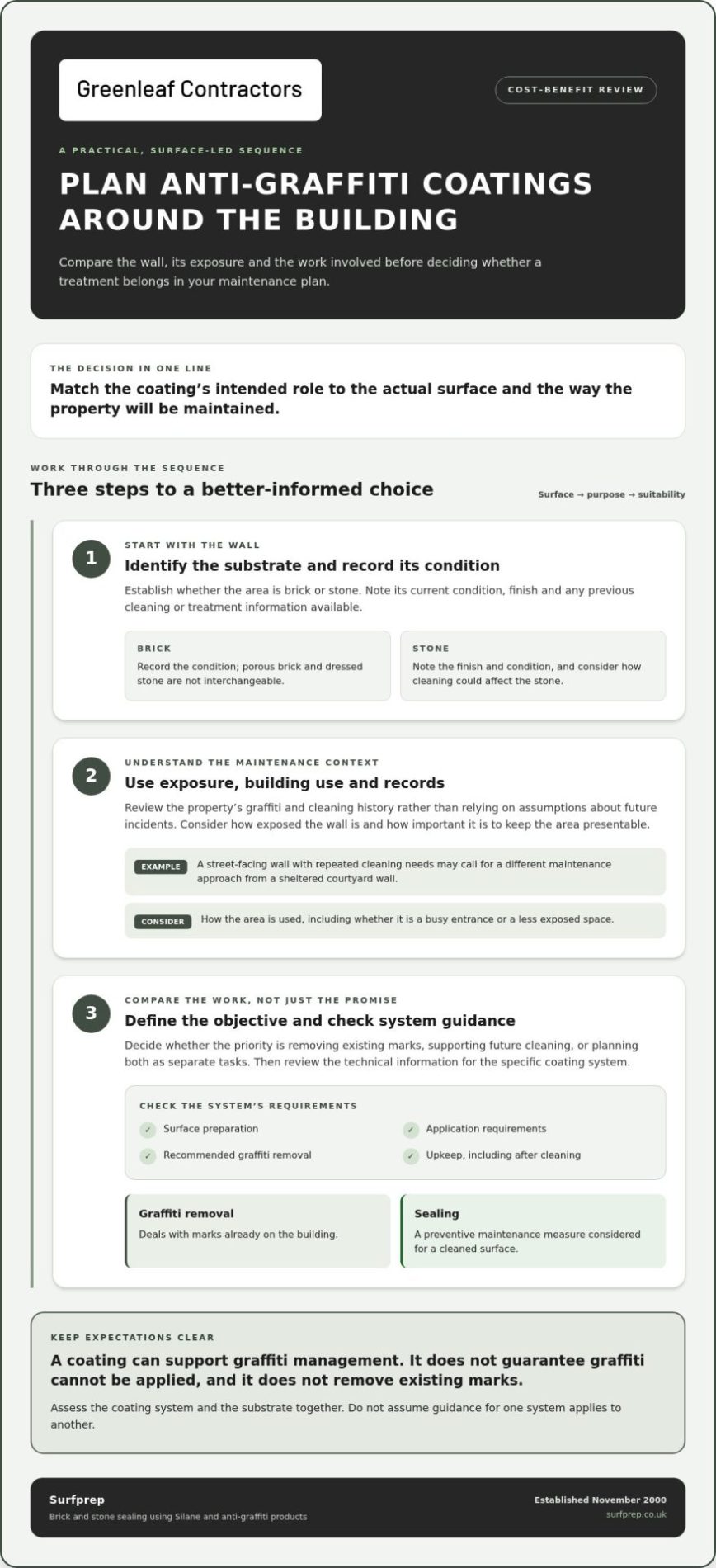
Plan coating and graffiti removal around the building surface
Once you have compared the maintenance demands, turn the decision into a surface-led plan. A practical cost-benefit analysis of anti-graffiti coatings connects the building’s condition with the cleaning work and sealing being considered. Treating a coating as a stand-alone fix can leave important questions unanswered, such as how existing graffiti will be removed and what care the surface will need afterwards.
- Identify the substrate. Establish whether the area is brick or stone, and note its condition and finish.
- Define the maintenance objective. Decide whether the priority is removing existing graffiti, supporting future cleaning, or planning both as separate tasks.
- Assess suitable treatment. Consider sealing in relation to the specific surface, the coating information and the property’s upkeep requirements.
Surfprep provides brick and stone sealing using Silane and anti-graffiti products. The assessment starts with the actual material and its condition, rather than an assumption that one approach suits every masonry surface. For brickwork, the brick cleaning service is relevant when considering surface condition alongside a sealing plan. Stone needs the same careful consideration in its own right.
How does coating fit into a wider property maintenance plan?
Plan graffiti removal and sealing together, but do not treat them as interchangeable. Removal addresses marks already on the building; sealing is a separate maintenance consideration for the surface. Keep a record of the masonry’s condition, previous cleaning work and any treatment applied. This gives property managers a clearer basis for planning future upkeep, rather than responding to each incident without considering the surface history.
For a property-specific discussion, talk to Surfprep about your building’s surface and maintenance requirements. A clear description of the brick or stone, its condition and your objective gives the conversation a practical starting point.
Make your next decision surface-specific
Turn your assessment into a clear brief: note the building material, its current condition, any previous cleaning or treatment, and what you need future maintenance to achieve. This keeps treatment decisions tied to the property rather than general claims about coatings. A thoughtful cost-benefit analysis of anti-graffiti coatings should help you decide whether the treatment’s intended role and upkeep requirements make sense for the surface.
Surfprep has daily access to Yorkshire, Lincolnshire, Nottinghamshire and Derbyshire, with regular work in Leeds, York, Hull, Bradford and Lincoln. The company also works in Nottingham, Manchester, Derby, Newcastle, Durham, Scarborough and Beverley. If you are assessing a brick or stone building, discuss your surface requirements with Surfprep and take the next step towards a considered maintenance plan.
With the surface details and maintenance objective clearly set out, you can make a more informed decision about the next step.
Frequently Asked Questions
Can anti-graffiti coatings be used on every brick or stone surface?
No. Suitability depends on the masonry and the coating system. Repairs, weathering, previous treatments and changes in finish can all affect the assessment. A wall with patched sections, for example, may not have a uniform surface throughout. Review the system’s technical information against the actual condition of the masonry before deciding whether treatment is appropriate.
Is an anti-graffiti coating the same as graffiti removal?
No. Graffiti removal deals with marks that are already present; applying a coating is a separate step in property care. If a wall has been marked, the removal method should suit the masonry and its condition. A coating does not replace cleaning, and cleaning does not automatically include sealing afterwards.
How can I tell whether an anti-graffiti coating is worthwhile?
Compare the intended maintenance benefit with the system’s application and upkeep requirements, using the property’s actual graffiti and cleaning history rather than guesswork. A simple record of incidents, cleaning work and changes in the surface can help show whether treatment merits consideration. This makes a cost-benefit analysis of anti-graffiti coatings more relevant to properties in Leeds, York, Hull, Bradford and other local areas.
Does an anti-graffiti coating prevent all future graffiti?
No coating should be treated as a guarantee that graffiti will not be applied. Its role is to support management of the treated surface, not to stop every future incident. If graffiti appears, follow the removal guidance for that specific coating and masonry, since an unsuitable cleaning approach may affect the building’s finish.
