
Could the very method you choose to restore your period timber beams actually be the thing that ruins them? When you’re dealing with sensitive internal wood in a Leeds or York property, the fear of introducing moisture (which often leads to rot) or being buried under a mountain of dust is entirely valid. Since we established Surfprep in November 2000, we’ve seen many homeowners struggle to weigh up the benefits of dry ice blasting vs traditional grit blasting for internal wood cleaning. You want that clean, light finish that makes a barn conversion or heritage home sing, but you also need to keep a close eye on the restoration budget.
We agree that finding the right balance between cleanliness and cost is the biggest challenge in any timber project. This article provides an honest, veteran’s perspective on the most effective moisture-free methods for restoring your beams while minimising post-cleaning disruption. We’ll break down why dry ice is the premium “no-mess” option (albeit a more expensive one) and how low-pressure grit blasting can offer a highly cost-effective result when handled by a specialist who understands the value of a gentle touch.
Key Takeaways
- Understand why we prioritise dry methods for internal timber restoration, avoiding the moisture risks associated with steam cleaning or damp processes like the sand jet.
- Weigh up the pros and cons of dry ice blasting vs traditional grit blasting for internal wood cleaning to find the right balance between preservation and price.
- Discover the “mess factor” of each method, including why dry ice is favoured for occupied properties because it sublimates without leaving secondary waste.
- Learn how to achieve a clean, light finish on historical beams whilst managing your budget effectively on larger barn conversion or restoration projects.
Understanding the Methods: Dry Ice vs Low-Pressure Grit Blasting
Internal restoration requires a strict “dry only” approach to protect the structural integrity of your property. Since we established Surfprep in November 2000, we’ve seen the long-term damage caused by introducing moisture into old timber. This is why we never recommend our Thermatech superheated steam machine or our sand jet system for indoor wood. When weighing up dry ice blasting vs traditional grit blasting for internal wood cleaning, the choice depends entirely on the thickness of the coating and the sensitivity of the environment.
The Science of Sublimation vs Controlled Abrasion
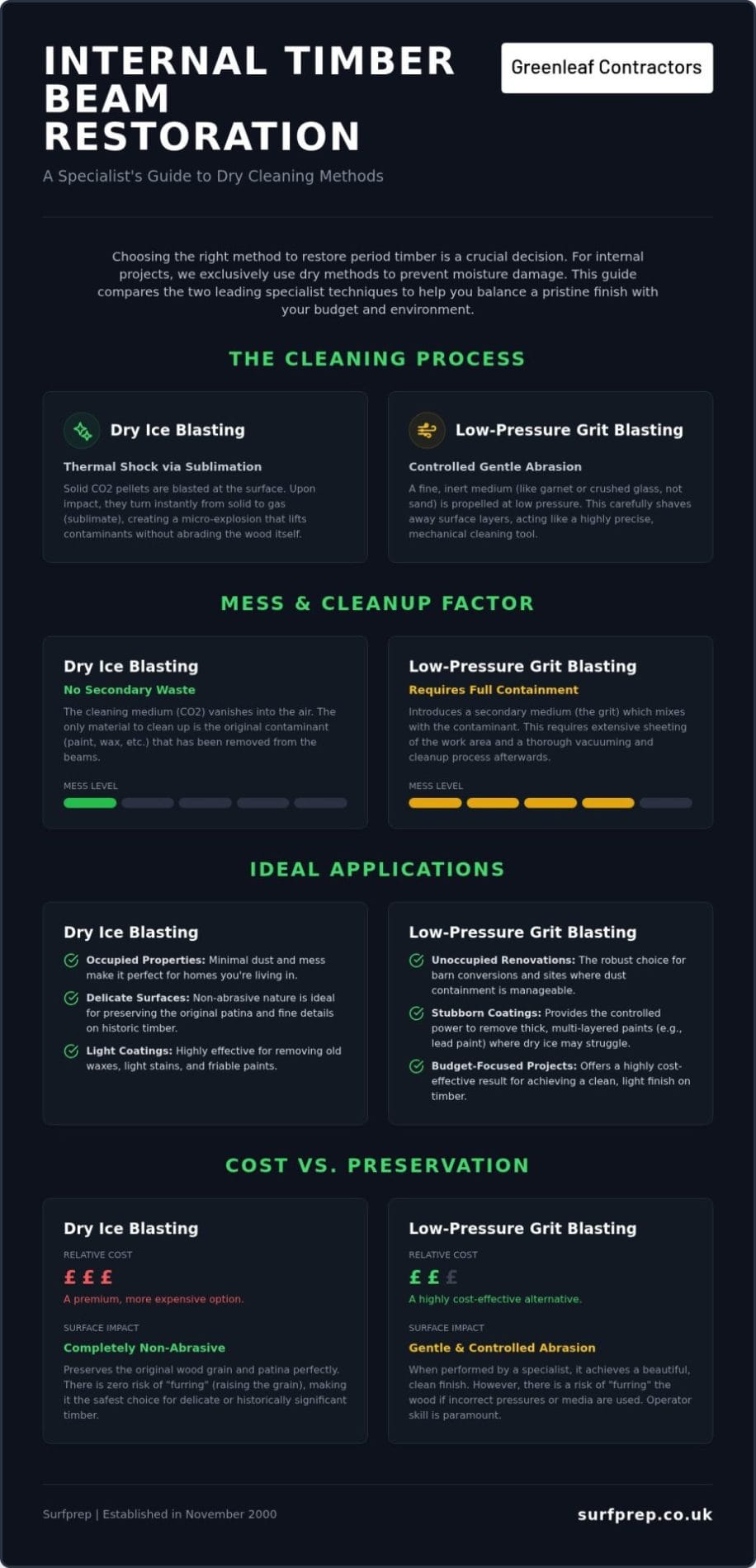
Dry-ice blasting works through a process called sublimation. Solid CO2 pellets hit the surface and turn instantly into gas, creating a “thermal shock” that lifts old waxes and light stains without any surface abrasion. It’s an incredibly clean method, but it isn’t always the most effective for heavy-duty restoration. In contrast, low-pressure grit blasting is the preferred specialist standard for UK barn conversions; it provides the controlled power needed to shave away stubborn, multi-layered lead paints that dry ice often leaves behind. By using fine, inert media at precisely managed pressures, we achieve a level of detail that blunt cleaning methods simply can’t match.
Why Traditional Sandblasting is a Misnomer
The term “sandblasting” often conjures images of aggressive industrial work, but the wooden beam cleaning we perform is a delicate craft. We don’t use high-pressure sand; instead, we utilise specialist media like garnet or crushed glass. These materials are far gentler on historical timber. It’s about being an honest specialist; we’ll tell you if your project needs the non-abrasive touch of dry ice or if a low-pressure grit approach will deliver a better finish for your budget. Whilst dry ice is a premium, more expensive option, it offers benefits in clean-up that traditional methods can’t equal, especially in occupied homes where dust control is paramount.
Performance Comparison: Finish, Mess, and Cleanup
The practical reality of a restoration project often comes down to the aftermath. When comparing dry ice blasting vs traditional grit blasting for internal wood cleaning, the “mess factor” is usually the deciding point for homeowners in Leeds and York. Dry ice is often the favourite for occupied properties because the media simply vanishes into the atmosphere, whereas grit blasting requires a methodical approach to containment and disposal. We’ve spent over two decades refining our site preparation to ensure that regardless of the method, your home remains protected.
The “No Secondary Waste” Advantage
Dry ice is the clear winner for “in-situ” cleaning where heavy furniture, delicate flooring, or fixed fixtures cannot be moved. Because the CO2 pellets sublimate on impact, the only waste produced is the contaminant being removed (such as old wax or friable paint). In contrast, grit blasting introduces a secondary media that must be managed. At Surfprep, we organise grit blasting sites with extensive heavy-duty sheeting and industrial-grade vacuuming systems to minimise dust spread. Whilst grit requires more intensive setup and cleanup time, it remains a robust choice for unoccupied renovation sites where a slightly more aggressive removal is needed.
Surface Integrity and “Furring”
Achieving that sought-after “honey” look on oak or pine beams requires a delicate balance. One risk of traditional blasting is “furring” the wood, where the grain is raised too aggressively, resulting in a fuzzy, over-processed texture. Dry ice is entirely non-abrasive, making it the superior choice for preserving the original patina and the most delicate wood grain. However, a skilled operator using low-pressure grit can achieve a similarly beautiful finish on harder timbers without compromising the surface. Our specialist wooden beam cleaning services focus on maintaining the character of the timber rather than stripping it of its history.
In terms of speed, dry ice allows for a much faster return to normal life in an occupied house, even if the cleaning process itself takes slightly longer per square metre. Grit blasting often gets the physical cleaning done faster on stubborn layers but adds significant time to the backend of the project for thorough site clearance. If you are trying to decide which route fits your timeline and property type, we can provide an honest appraisal of your timber to ensure you get the result you expect without the stress of an unexpected mess.
Making the Right Choice: Cost vs Preservation for Your Project
Deciding between dry ice blasting vs traditional grit blasting for internal wood cleaning often comes down to a transparent look at your project’s constraints. We’ve been providing these specialist services since November 2000, and our role is to act as an honest advisor rather than a high-pressure salesperson. Whilst both methods deliver exceptional results, the budget realities are quite different. Dry ice is undoubtedly the premium option; the high cost of the CO2 pellets and the specialised logistics required to keep them at temperature make it a significant investment compared to traditional media.
For large-scale projects, such as an unoccupied barn conversion with several hundred square metres of timber, low-pressure grit blasting is almost always the more cost-effective path. It’s also the better choice for stripping away heavy, multi-layered lead paints that have baked into the grain over decades. Conversely, you should invest in dry ice for high-end interiors, delicate hand-carved features, or any project where the time and cost of a deep-clean after grit blasting would be prohibitive.
Cost-Benefit Analysis for UK Barn Conversions
When we look at the logistics of a typical Yorkshire restoration, we have to weigh the price of grit media against the complex transport of dry ice. Grit is easy to store and move, making it ideal for rural sites with limited access. Dry ice requires a just-in-time delivery to ensure the pellets don’t dissipate before they’re used. We leverage our 25 years of experience to recommend the most efficient route; sometimes that means a hybrid approach, using grit for the heavy lifting in main halls and dry ice for the finished living areas.
Next Steps for Your Restoration
Before any cleaning begins, it’s vital to check for structural rot and active woodworm. Cleaning a beam that has lost its structural integrity can do more harm than good. We recommend a thorough specialist survey to identify these issues early. Once you’re ready to proceed, ensure the property is clear of loose debris and that any areas not being treated are properly sealed. If you’re unsure which method fits your heritage property, contact Surfprep for an honest appraisal of your internal wood cleaning project. We’ll help you balance the preservation of your timber with the practicalities of your budget.
Reveal the True Character of Your Timber
Restoring internal beams is a balance between aesthetic goals and practical realities. Whether you choose the premium, non-abrasive finish of dry ice or the budget-friendly efficiency of low-pressure grit, the goal is a light, clean result that respects the history of the wood. Deciding on dry ice blasting vs traditional grit blasting for internal wood cleaning is much easier with an honest specialist by your side. We prioritise the “dry-only” rule for interiors, ensuring your Leeds or York property remains free from the moisture risks associated with steam or damp cleaning methods.
Since we established Surfprep in November 2000, we’ve focused on delivering results through quiet confidence and technical competence. Our experience across the North with specialist equipment, including the Thermatech and our original Farrow System sand jet, means we understand exactly how different materials react to preparation. We don’t just provide a service; we offer the reliable expertise needed to protect your investment for another generation. We look forward to helping you transform your space.
Request a Specialist Survey for your Wood Restoration Project
Frequently Asked Questions
Is dry ice blasting better than sandblasting for internal oak beams?
The choice depends on your specific restoration goals and the condition of the timber. Dry ice is superior for preservation because it is entirely non-abrasive and won’t “fur” the wood grain, but it can struggle with thick, multi-layered lead paints. When comparing dry ice blasting vs traditional grit blasting for internal wood cleaning, grit is often more effective for heavy-duty stripping, whereas dry ice is the preferred choice for light cleaning and wax removal.
How much mess does grit blasting actually make inside a house?
Grit blasting creates a significant amount of dust and secondary waste that requires methodical containment. Unlike dry ice, which vanishes on impact, the abrasive media remains on-site and must be physically removed. We manage this by using heavy-duty sheeting and industrial-grade vacuum systems to protect your property, but you should expect a much more intensive cleanup process than you would with a dry ice project.
Can I use steam cleaning or a Doff machine on my internal wooden beams?
We strongly advise against using superheated steam on internal timber. Whilst we utilise a Thermatech machine for external masonry, introducing high-temperature moisture into indoor wood risks causing structural warping, splitting, or rot. Since we established Surfprep in November 2000, we’ve maintained a strict “dry only” rule for internal wood restoration to ensure the long-term integrity of the building’s fabric.
Why is dry ice blasting considered an expensive option for wood restoration?
The premium price of dry ice is driven by the cost of the CO2 pellets and the complex logistics involved in their transport. Because the pellets begin to sublimate and disappear from the moment they’re manufactured, we have to coordinate “just-in-time” deliveries for every project. This specialised supply chain, combined with the high volume of media required for timber, makes it a more significant investment than traditional grit methods.
Will grit blasting damage the original patina of my historic timbers?
Aggressive industrial blasting will certainly ruin the surface, but our low-pressure specialist techniques are designed to preserve character. By using fine, inert media at precisely controlled pressures, we can gently shave away grime while leaving the historic patina intact. It’s the difference between a blunt industrial tool and the careful, restorative touch of a veteran specialist who understands how to handle sensitive heritage materials.
How do I prepare my property for a professional beam cleaning service?
Preparation starts with clearing the workspace of all furniture, textiles, and floor coverings that could trap dust. You should seal internal doors with tape and plastic sheeting to prevent any stray particles from migrating into living areas. It’s also essential to have a specialist check the beams for structural rot or active woodworm before we begin, as cleaning fragile or compromised timber requires a different level of caution.
