
Most property owners assume that once a structural beam has turned black with char, it’s destined for the skip. It’s a distressing sight to see centuries of heritage hidden under a thick layer of soot, and the persistent, acrid smell of smoke only adds to the feeling that the damage is permanent. We’ve been providing specialist fire damage cleaning for wooden beams since November 2000, and we’ve found that even heavily carbonised timbers can often be saved. You’re likely worried about abrasive methods ruining the delicate grain or introducing too much moisture into your home, which is a valid concern that requires a specialist’s eye.
In this guide, you’ll discover the safest, most effective UK methods for restoring fire-damaged timbers whilst preserving their structural integrity and heritage character. We’ll walk you through our “moisture-first” logic, explaining why we prioritise dry grit blasting at low pressures for internal beams to protect your property from damp. You’ll also learn about the role of our sand jet machine for external works and why we strictly avoid superheated steam systems like Thermatech, also known as DOFF, for indoor wood restoration. We’ll show you how it’s possible to remove soot and eliminate stubborn odours to reveal the wood’s natural colour once again.
Key Takeaways
- Learn how to distinguish between superficial soot staining and deep carbonisation, understanding why heavy timbers often retain their structural core despite surface charring.
- Discover why we prioritise low-pressure dry grit blasting for fire damage cleaning for wooden beams located indoors to avoid the risks of introducing moisture into your property.
- Understand the “moisture-first” logic that dictates when to use a gentle sand jet machine for external timbers versus dry methods for occupied heritage interiors.
- Find out how deep cleaning the carbonised layer effectively eliminates the persistent “campfire” smell by removing the particles responsible for smoke odour.
- Get transparent advice on restoration costs and why expensive options like dry ice blasting or moisture-heavy systems like Thermatech (DOFF) may not always be the right fit for your project.
Assessing Fire Damage: Charring, Soot, and Structural Integrity
Walking into a property after a fire is a heavy experience. The sight of blackened timbers often leads owners to believe the building’s heart is gone, but that’s rarely the full story (though it certainly feels like it at the time). As specialists in disaster restoration since November 2000, we’ve seen how resilient old English oak and pine can be. Before we even consider the logistics of a project, we must understand exactly how the heat has interacted with the timber fibres.
Soot vs Charring: What Can Be Restored?
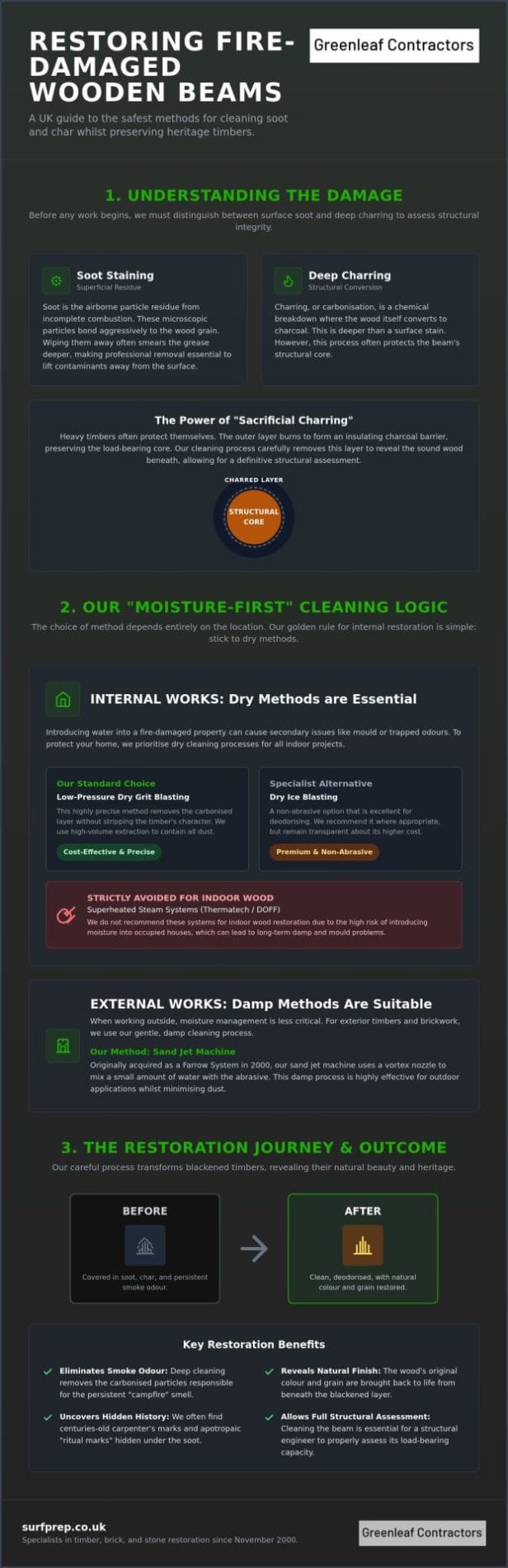
There’s a fundamental difference between soot staining and true carbonisation. Carbonisation is the chemical breakdown of wood under extreme heat, where the timber itself converts into charcoal. Soot, by contrast, is the airborne residue of incomplete combustion that settles on the surface. These microscopic particles bond aggressively to the wood’s grain. If you try to wipe them away with a damp cloth, you’ll likely just smear the grease deeper into the pores, making the stain permanent. Professional fire damage cleaning for wooden beams focuses on lifting these contaminants away from the surface rather than pushing them in.
The Importance of Structural Assessment
We always recommend obtaining a structural engineer’s report before commencing any abrasive cleaning. An engineer will assess the “allowable stress” and ensure the load-bearing capacity remains safe. It’s a common misconception that a charred beam is a dead beam. In fact, heavy timber often benefits from “sacrificial charring.” This is where the outer layer burns and creates a layer of charcoal that acts as an insulator, protecting the structural core from the heat. It’s nature’s own fireproofing mechanism.
Our role in wooden beam cleaning often serves a dual purpose. By carefully removing the carbonised layer, we reveal the fresh, healthy wood beneath, allowing the engineer to make a definitive assessment of the beam’s integrity. During this process, we often uncover history that’s been hidden for centuries. We’ve found carpenter’s marks and even ancient “ritual marks” (apotropaic symbols intended to protect the home) that were buried under soot or layers of old lead paint. Restoring these beams isn’t just about safety; it’s about uncovering the heritage that the fire tried to hide.
Professional Cleaning Methods: Dry vs Damp Processes
Managing moisture is the most critical decision in any restoration project. We’ve learned over the last two decades that successful fire damage cleaning for wooden beams isn’t just about removing black marks; it’s about managing the property’s environment. The “golden rule” for internal restoration is simple: stick to dry methods. Introducing water into a fire-damaged house can lead to secondary issues like mould or trapped odours, which are notoriously difficult to shift once they’ve been locked in by moisture.
Internal Works: Low-Pressure Dry Grit Blasting
We understand the concern about dust when working inside a finished home or commercial building. To manage this, we use a combination of rigorous sheeting and high-volume extraction to keep debris contained. Our standard choice for interiors is traditional dry grit blasting at exceptionally low pressures. The technical advantage of this method lies in its precision; by using a low abrasive rate, we can remove the carbonised layer without stripping away the gnarled character of old oak. It’s a delicate balance that requires a seasoned hand. If you’re looking for an honest assessment of your project, you can see our approach to wooden beam cleaning here.
While some contractors push dry ice blasting as the only solution, we take a more transparent view. It’s a brilliant, non-abrasive alternative for deodorizing smoke-damaged lumber, but it’s also an expensive option. In most cases, low-pressure grit blasting achieves the same result at a much more reasonable price point for the client.
External Works: The Sand Jet Alternative
When we’re working on the outside of a building, the logic shifts. For outdoor structural wood and brick cleaning, we prefer the damp process of our sand jet machine. Originally acquired as a Farrow System in November 2000, this machine uses a unique vortex nozzle that mixes a small amount of water with a fine abrasive. This damp process suppresses dust whilst ensuring a gentle, non-destructive finish on weathered timbers. We often use Thermatech (a superheated steam system also known as DOFF) for stone, but we never recommend it for indoor wood restoration due to the moisture risks in occupied houses. For external beams, the sand jet remains our preferred, versatile tool.
The Restoration Journey: From Blackened Timber to Natural Finish
The final stage of restoration is where the transformation truly happens. Once the structural engineer has given the green light, we begin the methodical process of peeling back the damage to reveal the building’s original character. By using the low-pressure dry grit blasting methods we’ve refined since November 2000, we strip away the carbonised “skin” of the beam. This reveals the fresh, healthy timber that’s been protected by the sacrificial charring layer. It’s often surprising to see how much of the original wood remains intact and vibrant after such a seemingly devastating event.
Odour Neutralisation and Surface Preparation
The persistent “campfire” smell that lingers after a fire isn’t just an atmospheric issue; it’s physically trapped in the carbonised wood. We’ve seen owners try to mask this with chemical sprays or ozone treatments, but these are often temporary fixes that don’t address the root cause. Mechanical removal during fire damage cleaning for wooden beams is the only permanent solution. By stripping the charred particles away, we remove the source of the odour entirely. This process also ensures the timber remains “breathable.” We’re careful not to seal the wood too early, as trapping residual moisture can lead to rot or damp issues later on. Whilst we use Thermatech (also known as DOFF) superheated steam for masonry, we strictly avoid it for internal wood to keep the property’s environment dry.
Choosing Your Final Aesthetic
Once the beams are clean and odour-free, you’re left with a blank canvas. Some clients prefer the raw, pale look of freshly blasted oak, which fits well in modern, minimalist interiors. Others opt for a more traditional aesthetic, using clear waxes or oils to deepen the grain and return the wood to a rich, historic hue. We can also prepare the surface for specialist fire-retardant coatings if your insurance or building regulations require them. You can see various examples of these finished results on our wooden beam cleaning page. Whatever finish you choose, the goal is always to restore the wood’s natural beauty whilst ensuring it remains a safe, functional part of your home’s structure.
Revitalising Your Heritage Timber
Restoring a property after a fire is a complex journey, but it’s one we’ve been navigating alongside our clients since November 2000. By prioritising dry, low-pressure grit blasting for internal works, we ensure that your structural beams are cleaned without the risks associated with moisture or aggressive chemicals. We’ve seen first-hand how effective fire damage cleaning for wooden beams can be at stripping away charring whilst preserving the unique heritage character of old English oak. Whether you’re dealing with superficial soot or deep carbonisation, our focus remains on providing a technical, honest solution that prioritises the long-term health of your building.
With over 25 years of restoration expertise serving Leeds, York, Manchester, and the wider North, we’re ready to help you uncover the fresh timber hidden beneath the damage. Our heritage-approved methods ensure a thorough clean that also addresses those persistent smoke odours once and for all. Contact our specialist team today for a technical assessment and take the first step toward bringing your property back to life. Your beams have survived the heat; now they deserve a professional finish.
Frequently Asked Questions
Can charred wooden beams be saved after a house fire?
Yes, in many cases charred beams can be saved due to a phenomenon known as sacrificial charring. The outer layer of charcoal actually insulates the inner core from the heat, preserving its structural integrity. We always recommend a structural engineer’s assessment first; however, once the carbonised layer is removed, the healthy wood beneath is often perfectly sound and capable of remaining in situ.
How do you get the smell of smoke out of structural timbers?
The only permanent way to remove smoke odour is to mechanically remove the carbonised wood where the smell is trapped. Masking agents or ozone sprays only provide temporary relief because they don’t address the source. By using specialist fire damage cleaning for wooden beams, we strip away the burnt particles, effectively neutralising the “campfire” smell and leaving the wood fresh and breathable for future treatments.
Is sandblasting safe for historic or listed oak beams?
Traditional high-pressure sandblasting is often too aggressive for heritage timber, but our sand jet machine is a much gentler alternative. For internal listed beams, we utilise low-pressure dry grit blasting with very low abrasive rates. This allows us to remove soot and char whilst carefully preserving the original gnarled character and carpenter’s marks that make historic oak so valuable to a property’s heritage.
What is the difference between dry grit blasting and dry ice blasting for fire damage?
Dry grit blasting uses fine abrasive media at low pressure to physically lift away char and soot, making it highly effective for heavy damage. Dry ice blasting uses frozen CO2 pellets that turn to gas on impact, lifting lighter smoke residue without creating secondary waste. Whilst dry ice is a brilliant technology for specific smoke damage, it is often a significantly more expensive option compared to our precise dry grit methods.
