
The most aggressive abrasive is rarely the right starting point for a sensitive surface. With gentle abrasive blast cleaning, the media and settings are matched to the substrate, existing coating and required finish. The aim is to remove unwanted material without etching or distorting the surface, while preserving what needs to remain intact.
Removing a coating is only part of the task: the surface also needs a suitable profile for the next finish to adhere. This article explains how professionals select media, adjust pressure and abrasive feed, and assess the surface for coating adhesion. It also compares methods for industrial coatings and explains why damp Sand Jet cleaning suits some external work, while dry methods are preferred indoors.
Key Takeaways
- Match abrasive type and grade to the substrate and coating, rather than choosing solely for removal speed.
- Balance coating removal with the surface profile needed for the next finish to adhere.
- Professionals tailor pressure and abrasive rates to reduce the risk of etching, distortion or damage to delicate materials.
- A damp sand jet can suit some external cleaning and preparation work, while dry methods are preferred indoors.
How Do Professionals Choose the Best Sand Blasting Media?
Media selection depends on the substrate, coating, contaminants and required finish. The aim is to remove unwanted material while controlling surface damage and leaving a profile suited to the next treatment.
How professionals match media to substrates and surface profiles
Media selection starts with the substrate and the texture needed for the finish. Softer materials call for gentler organic or plastic abrasives to help prevent etching, while harder, angular media can create a deeper profile on steel. For composites and precision applications, plastic media is useful because it generates minimal heat. Airblast Type V plastic media has a hardness of 3-4 Mohs and comes in 12-80 mesh sizes.
How professionals select abrasives for contaminants and coatings
The coating and contaminants determine how much cutting action is needed. Light deposits or a finish that must remain smooth call for a less aggressive approach; tough industrial coatings on steel may need harder, angular abrasives. Professionals also consider what blasting may reveal beneath the coating, such as rust or an existing surface treatment. This helps balance effective stripping with the condition required for the next coating.
How abrasive performance informs a professional’s media selection
Professionals compare how each medium cuts, finishes and can be recovered. Glass beads, with a hardness of 5.5-6 Mohs, are used for cleaning and finishing, while steel grit creates a more angular impact than spherical steel shot. Equipment matters too: grit blasting commonly uses a gun and nozzle in a sealed chamber or cabinet. Where suitable, recovering media can reduce waste. A damp process is another alternative; damp abrasive preparation may suit appropriate external work practised by Surfprep.
UK rules and environmental requirements
In the UK, the Control of Substances Hazardous to Health Regulations prohibit using sand or another substance containing free silica as an abrasive for blasting articles, according to the UK Government. This rules out silica sand for that purpose. Media recovery can reduce waste and environmental impact, but spent abrasive also carries removed coating and contaminants. Professionals therefore consider the material being stripped and keep the resulting waste controlled for appropriate handling.
Professional abrasive selection for industrial coating removal
Removing an industrial coating starts with identifying the coating, substrate and required finish. A hard coating on steel may need a more aggressive, angular abrasive to cut through layers and create a deeper profile. Thin metal or a sensitive substrate needs a gentler approach, as excessive impact can damage the material beneath the coating. The choice should balance effective stripping with the surface condition needed afterwards.
For tough coatings on steel, aluminium oxide is suited to removal and surface profiling for coating adhesion. White aluminium oxide is described as 99.5% ultra-pure. Glass beads offer a gentler cleaning and finishing option, particularly where aggressive cutting is unnecessary. Their hardness is 5.5-6 Mohs, making them less suited to heavy coating removal than harder angular media.
Media performance also affects environmental impact and practical handling. Crushed glass grit is made from 100% recycled bottle glass, while garnet can typically be reused once or twice, depending on quality. Steel grit can be reused for up to hundreds of blasting cycles. Recovery is useful where the equipment and work area allow it, but media contaminated by removed coatings still needs appropriate handling.
There is no single abrasive for every industrial job. Professionals weigh coating thickness, substrate condition, required profile, media recovery and the finish specification together. For example, a coating that must come off steel before recoating calls for a different cutting action from light contamination on a delicate component. For projects involving extensive coating removal, explore industrial surface preparation options.
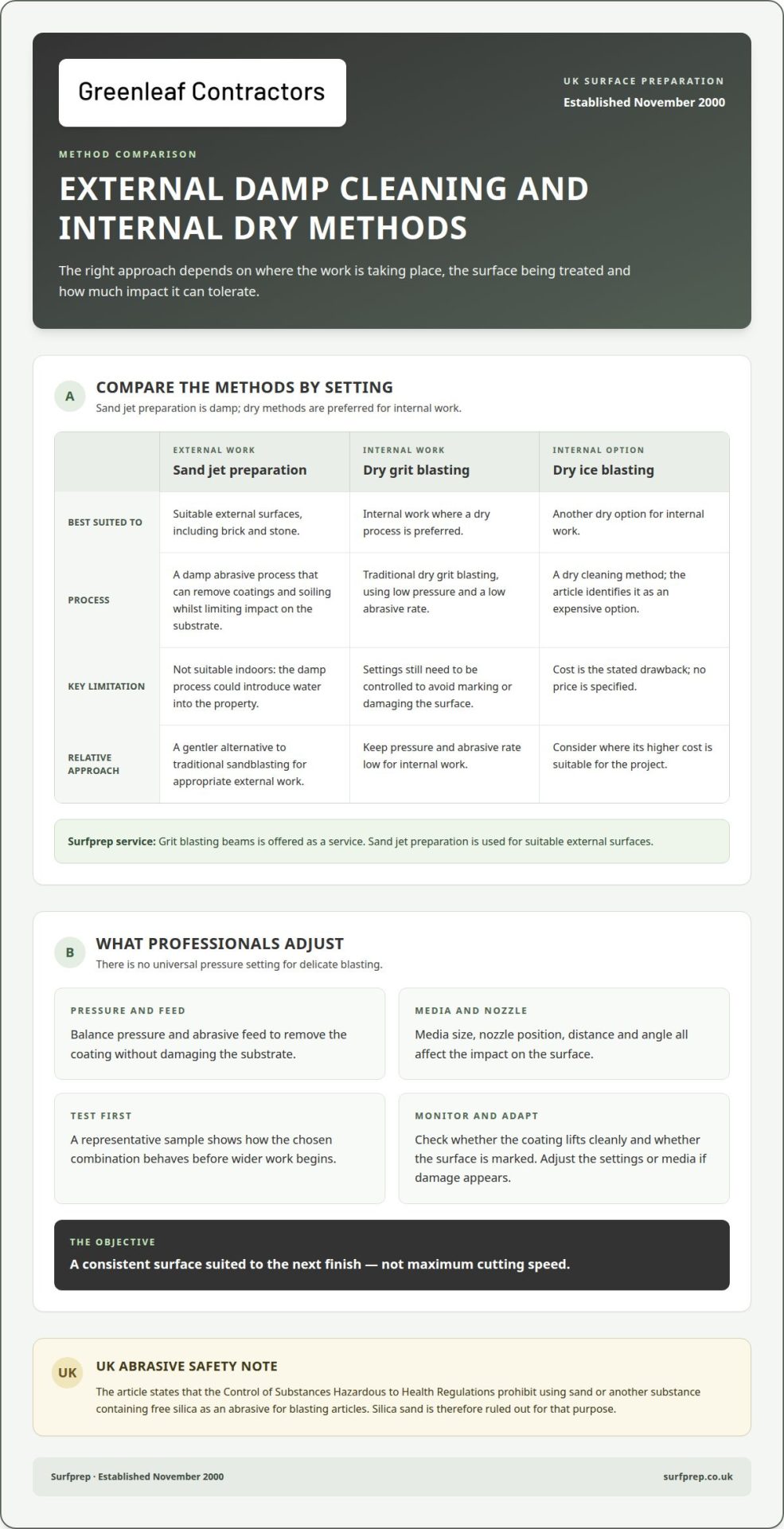
What pressure and abrasive settings do professionals use for delicate surfaces?
There is no universal pressure setting for delicate blasting. Professionals balance pressure, abrasive feed, media size and nozzle position according to the material and coating. On soft wood, excessive impact can lift fibres or leave an uneven finish. Lower pressure and a reduced abrasive rate help limit that risk while allowing controlled cleaning.
Settings are adjusted together, not in isolation. A finer abrasive may cut differently from a coarser grade, even at similar pressure, while nozzle distance and angle affect the impact reaching the surface. For a composite panel, plastic media can help limit heat; for a coated, sensitive component, the priority is removing the coating without damaging the substrate. A test on a representative sample reveals how the chosen combination behaves before wider work begins.
Indoor conditions also affect method selection. Sand Jet is a damp process, so it is unsuitable indoors where it could introduce water into the property. For internal work, dry grit blasting at low pressure and a low abrasive rate is preferred. Dry ice blasting is another option, but it is an expensive method.
During the work, professionals assess whether the coating is lifting cleanly and whether the surface is being marked. If the substrate shows signs of damage, they can adjust the pressure, abrasive feed, nozzle position or media. The target is a consistent result suited to the next finish, not maximum cutting speed. For delicate surfaces, discuss professional surface preparation with Surfprep.
Surfprep: gentle abrasive cleaning – the sand jet
Established in November 2000, Surfprep provides gentle abrasive cleaning with a sand jet for suitable external surfaces where traditional sandblasting may be too aggressive. The damp process can help remove coatings and soiling from materials such as brick and stone while limiting the impact on the substrate. It isn’t suitable for indoor work, as it introduces water into the property.
For a building façade or other external surface, sand jet preparation may be the right approach when the surface needs careful cleaning or preparation. The appropriate method depends on the substrate, what needs removing and the finish required. Surfprep also provides brick cleaning, stone cleaning and gritblasting of wooden beams.
To discuss your surface and the work required, contact Surfprep.
Plan the right preparation for your surface
Start by defining what must be removed and the condition the surface needs afterwards. This gives a professional a clear basis for choosing a suitable approach to gentle abrasive blast cleaning, rather than relying on force alone. Surfprep cleans brick, stone and wooden beams, matching the method to the material and setting.
Share the surface type, its location and the coating or soiling involved to start a practical conversation about the work. Contact Surfprep about abrasive blasting, and take the next step towards a properly prepared surface.
Frequently Asked Questions
What Is Abrasive Media?
Abrasive media is the material propelled against a surface to clean it, strip a coating or alter its texture. Particle shape, size and hardness affect how the media cuts and the finish it leaves. Rounded media tends to produce a smoother result than angular grit, which cuts more sharply.
What is Abrasive Blasting?
Abrasive blasting directs particles at a material using blast equipment. It can remove paint, rust and other unwanted layers, or prepare a surface for a new coating. The process can suit industrial components and building materials when the media and settings match the substrate and intended result.
What is gentle abrasive blast cleaning?
Gentle abrasive blast cleaning uses controlled impact to remove unwanted material while limiting changes to the underlying surface. It can help preserve detail, for example when cleaning patterned brickwork or removing a coating near delicate features. The professional balances removal with the required appearance rather than aiming for the fastest or most forceful cut.
Which abrasive media are used for gentle blast cleaning?
Plastic media, walnut shell, corn cob and glass beads are among the options, each suited to different surfaces and cleaning aims. Walnut shell and corn cob are organic choices for delicate work; glass beads can clean and finish. Selection also depends on the coating being removed, the debris produced and whether the surface needs to remain smooth.
Which surfaces and materials can a professional safely clean with gentle abrasive blasting?
Brick, stone, wood, metal and composites may all be suitable for abrasive cleaning, but the surface condition and coating affect the method. Surfprep provides brick cleaning, stone cleaning and wooden beam cleaning, with local work in Leeds, York, Hull, Bradford, Nottingham, Manchester, Derby, Lincoln, Newcastle, Durham, Scarborough and Beverley. Assessing the material helps determine an appropriate cleaning approach.
