
Did you know that attempting to scrub graffiti off your own Grade II listed property could land you with an unlimited fine or a prison sentence? It’s a sobering thought, but when dealing with heritage masonry, the law is as delicate as the stone itself. We understand the worry that ghosting or permanent scarring might ruin your building’s facade. Specialist graffiti removal from listed buildings uk requires more than a quick fix; it demands a deep respect for the historic fabric (and its long-term breathability) that has stood for centuries.
Since November 2000, we’ve acted as honest advisors to owners facing these heritage challenges. This guide reveals the safest, conservation-approved methods for complete paint removal without risking structural damage. You’ll learn about the precision of Thermatech superheated steam and how our gentle sand jet system provides a damp alternative for exterior masonry, ensuring your property remains protected and your Conservation Officer stays satisfied.
Key Takeaways
- Understand the legal necessity of obtaining Listed Building Consent and the severe penalties for using unauthorised cleaning methods on historic masonry.
- Discover why specialist graffiti removal from listed buildings uk relies on superheated steam to protect the underlying stone’s natural breathability.
- Learn how to distinguish between external damp cleaning processes, such as the sand jet, and the delicate requirements for internal heritage works.
- Find out why site trials and a contractor’s long-standing heritage experience are non-negotiable for achieving a result that satisfies your local Conservation Officer.
The Technical Challenges of Graffiti Removal from Listed Buildings
Historic masonry is remarkably durable, yet it’s uniquely vulnerable to modern aerosol paints. Unlike modern cladding, materials like limestone, sandstone, and heritage brick are naturally porous. This means paint doesn’t just sit on the surface; it’s drawn deep into the capillaries of the stone. A December 2025 survey by the National Lottery Heritage Fund found that 39% of UK heritage sites had experienced intentional damage, making graffiti removal from listed buildings uk a common necessity. We must account for ‘breathability’ during removal; using aggressive chemicals or high-pressure washers can seal pores, trapping moisture and salts that lead to spalling and structural decay.
Legally, any work on a listed building requires careful navigation. You must consult your local Conservation Officer before starting. Unauthorised alterations are a criminal offence, and the wrong cleaning method can cause irreversible damage. Since we established our business in November 2000, we’ve seen how ‘quick fixes’ often lead to repair notices from the council. Professional graffiti removal from listed buildings uk ensures that the methods used align with BS 7913 standards, protecting the building’s long-term integrity.
Understanding Masonry Porosity and Paint Adhesion
Different stones react uniquely to vandalism. Soft, calcareous stones absorb pigment much faster than denser sandstones. This deep absorption creates ‘ghosting’, where a faint, permanent shadow remains etched in the stone’s pores. We frequently encounter these challenges when working with:
- Bath Stone: Highly porous and prone to deep staining.
- York Stone: Denser, yet still susceptible to surface etching.
- Heritage Brick: Often has a delicate ‘face’ that can be easily blown by high pressure.
For stone cleaning, we balance pressure and temperature to lift the paint whilst preserving the original patina. It’s a delicate process where the wrong abrasive can permanently scar the masonry.
Specialist Methods: Thermatech and Gentle Sand Jetting
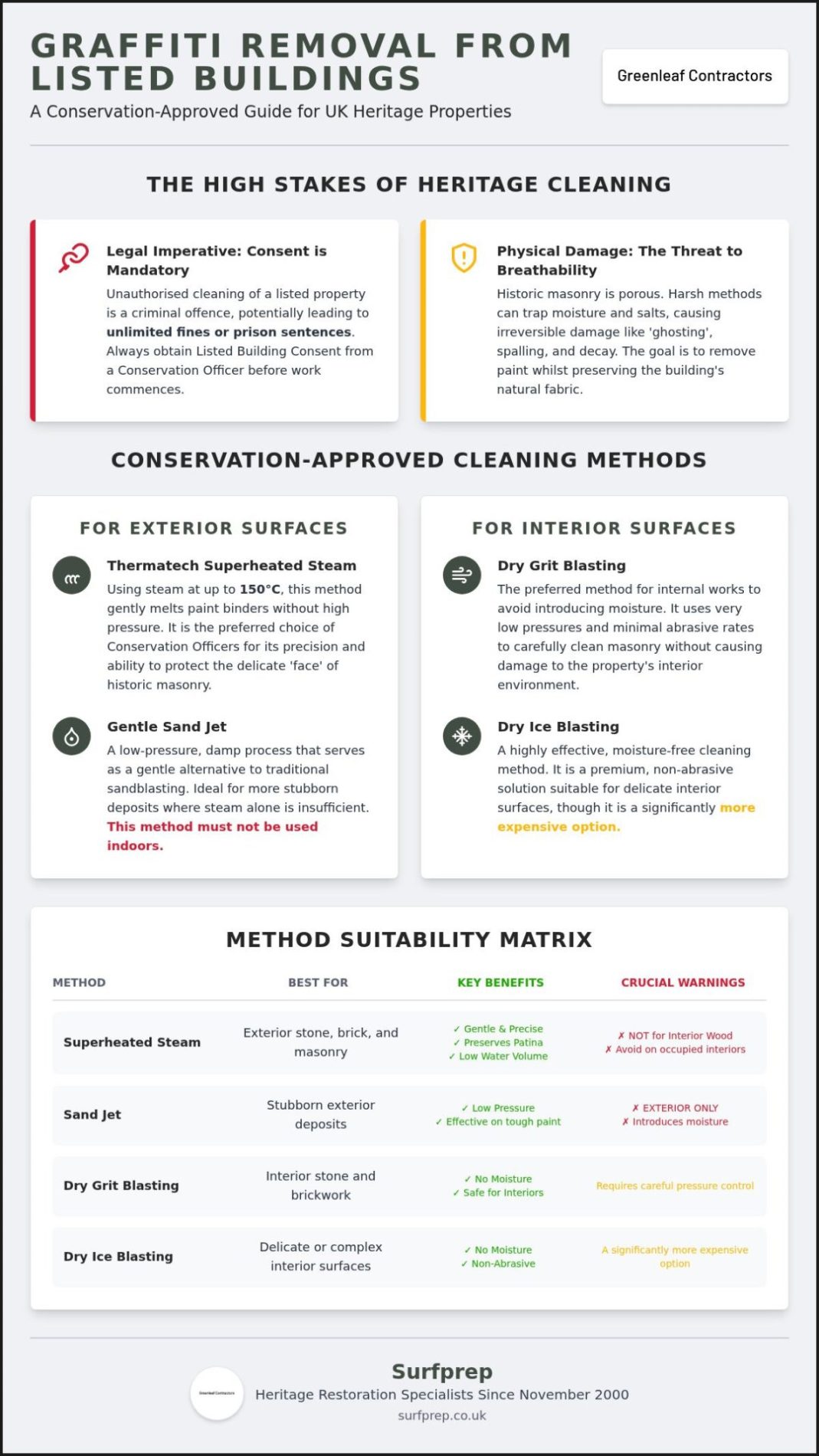
When approaching graffiti removal from listed buildings uk, we always advocate for a “gentle-first” hierarchy. The ThermaTech system is our primary tool for this task. It uses superheated steam at temperatures up to 150°C to emulsify paint binders. Because the heat does the heavy lifting, we don’t need the aggressive, high-pressure impact that often strips the protective “face” off historic masonry. It’s a precise, controllable process that respects the stone.
For more stubborn deposits where steam alone isn’t enough, we utilise a gentle sand jet machine. This equipment, which we originally acquired as a Farrow System in November 2000, offers a low-pressure alternative to traditional sandblasting. It’s a damp process that effectively cleans without the destructive force of dry abrasives. However, because it introduces water, we never recommend the sand jet for indoor use. If you’re unsure which method fits your project, contact our specialists for honest advice.
We believe in transparency regarding limitations. Whilst superheated steam is ideal for external stone facades, it’s unsuitable for internal wood or occupied properties. Introducing moisture into an indoor heritage environment can lead to rot or damp issues. For internal masonry, we prefer traditional dry grit blasting at low pressures or dry ice blasting, though we’ll always state that dry ice is a significantly more expensive option.
Why Superheated Steam is the Conservation Officer’s Choice
Conservation Officers favour Thermatech because it minimises water volume and avoids harsh chemicals. By melting the paint rather than blasting it, the stone’s natural patina remains intact. This methodical approach ensures the building’s breathability is preserved. For internal heritage works, dry grit blasting at low pressures and low abrasive rates is the preferred alternative to damp processes, ensuring delicate interior features remain dry and protected.
Choosing a Heritage Contractor for Your Listed Property
Selecting a contractor for graffiti removal from listed buildings uk requires looking far beyond a standard commercial quote. You need a partner with a long-standing history in heritage restoration who understands the weight of a local authority repair notice. Since we were established in November 2000, we’ve found that the most valuable trait a specialist can offer is “Expert Admission.” This is the willingness to state clearly when a specific method is not suitable for your building type. We’ll always prioritise the right solution over a quick sale, even if it means recommending a more complex, dry approach for delicate internal works.
The Essential Trial Patch Process
Site trials or sample patches are non-negotiable for any listed property. A specialist will select a discreet, inconspicuous area to test various combinations of temperature, pressure, and abrasive mixes. These trials are particularly vital for stone cleaning projects. They allow us to observe how the masonry reacts before committing to the full facade, preventing permanent substrate damage or the “ghosting” that occurs when settings are too aggressive for the stone’s porosity.
You should always seek a bespoke restoration plan rather than a “one-size-fits-all” pressure washing quote. A seasoned veteran won’t rush the process; they’ll build a case for their methodology through detailed explanations and physical evidence on the stone itself. This methodical approach is what ultimately earns the approval of a Conservation Officer. Our goal is always a result that looks as though the vandalism never happened, whilst ensuring the historic fabric remains entirely intact for the future.
Restore Your Heritage Facade with Confidence
Protecting the integrity of your listed property requires a balance between rapid response and technical restraint. We’ve explored how maintaining masonry breathability is essential to prevent long-term decay, and why specialist equipment like Thermatech offers the safest path forward. Successful graffiti removal from listed buildings uk isn’t just about cleaning; it’s about preserving a piece of history through methodical, low-impact techniques that respect the original stone.
Since November 2000, we’ve served as reliable veterans for heritage projects across Leeds, York, Manchester, and the North. Our team combines the precision of Thermatech with gentle sand jetting to deliver results that satisfy both owners and Conservation Officers. Don’t risk permanent scarring with aggressive pressure washing. Contact our heritage restoration specialists for a bespoke graffiti removal assessment and let us help you return your building to its original state safely. Your building’s history deserves this specialist care.
Frequently Asked Questions
Do I need Listed Building Consent for graffiti removal?
Yes, you must obtain Listed Building Consent from your local authority in cities like York or Leeds before starting any works. Carrying out unauthorised graffiti removal from listed buildings uk is a criminal offence under the Criminal Damage Act 1971. This process ensures that the cleaning methods won’t harm the historic fabric. We always recommend consulting a Conservation Officer to verify your specific requirements.
Will Thermatech steam cleaning damage my historic brickwork?
No, the Thermatech system is designed to be non-destructive. By using superheated steam at 150°C, we melt the paint binders without the need for high-pressure impact that can blow the face off delicate bricks. This is why we’ve used this technology since November 2000 for heritage projects across Manchester and Hull. It preserves the brick’s natural patina whilst ensuring the masonry remains breathable.
Why is sandblasting discouraged for listed buildings in the UK?
Traditional sandblasting is often too aggressive for historic masonry, as it can strip away the protective outer layer of the stone. This damage leads to moisture retention and accelerated decay. Instead, our graffiti removal from listed buildings uk services utilise a gentle sand jet for external surfaces in Newcastle or Durham. It’s a damp, low-pressure alternative that cleans effectively without destructive force.
Can graffiti be removed from internal wooden beams safely?
Yes, but we never recommend superheated steam for wood inside a property, especially in occupied houses in Beverley or Scarborough. Moisture from steam can cause swelling or rot. For internal wooden beam cleaning, we prefer low-pressure dry grit blasting or dry ice blasting. While dry ice is an expensive option, it provides a completely dry solution that protects the timber’s integrity and your interior environment.
