
The most expensive mistake you can make with a York industrial facade isn’t ignoring the grime; it’s choosing a cleaning method that treats heritage brickwork like common concrete. We understand that industrial building facade cleaning York projects carry significant weight, particularly when you’re balancing the need for a professional appearance against the risk of surface damage or moisture ingress. It’s a common concern for property managers who need to maintain high-level areas safely without falling foul of the city’s stringent heritage restrictions. Since we established our business in November 2000, we’ve focused on delivering results that prioritise the building’s integrity over a quick, aggressive fix.
In this guide, you’ll discover the most effective, material-safe methods for restoring industrial facades, from the precision of superheated steam to our specialist sand jet machine (a gentle alternative to traditional sandblasting). We’ll explain why we favour the Thermatech system (sometimes referred to as DOFF) for external masonry and why dry grit blasting is the only sensible choice for internal projects where water is the enemy. This overview provides a clear roadmap for achieving a restored aesthetic that complies with 2026 safety standards whilst ensuring the long-term preservation of your building’s fabric.
Key Takeaways
- Learn why effective industrial building facade cleaning York requires a bespoke strategy that respects the unique blend of historic masonry and modern industrial materials.
- Understand the technical benefits of Thermatech, a DOFF-recognised superheated steam system, for removing carbon staining and organic growth without damaging delicate substrates.
- Discover why our sand jet machine, a low-pressure evolution of the Farrow System, provides a gentle yet thorough damp-cleaning solution for outdoor restoration.
- Identify the critical differences between indoor and outdoor projects, including why we prioritise dry grit blasting internally to avoid introducing moisture into your property.
- Explore the logistical essentials for high-level work, including safe access via MEWPs and the importance of adhering to modern safety and environmental standards.
The Essentials of Industrial Building Facade Cleaning in York
We define high-level industrial cleaning as the technical removal of atmospheric pollutants, organic growth, and carbon staining from large-scale facades. It’s a process that goes far beyond simple aesthetics. Understanding The Essentials of Building Restoration helps clarify why these interventions are vital for a building’s structural health. In York, this isn’t a one-size-fits-all task. Our city features a complex mix of historic limestone, traditional brickwork, and modern industrial cladding, all of which react differently to environmental stress. Integrating professional industrial surface preparation ensures that building aesthetics are restored whilst the underlying material is preserved. This is why industrial building facade cleaning York specialists must assess every substrate before work begins.
Regular maintenance is particularly important in the damp Yorkshire climate, where moisture ingress can lead to rapid structural decay if left unchecked. By removing biological growth and salt deposits, we help property owners maintain their asset value and avoid the astronomical costs of full-scale masonry replacement. We’ve been providing these specialist services since November 2000, ensuring local businesses meet their safety and preservation obligations.
York’s Unique Facade Challenges
Centuries of industrial activity have left a legacy of heavy carbon staining on York’s landmark buildings. We’ve found that limestone and soft red bricks are particularly susceptible to this atmospheric damage. Here is an expert admission: standard high-pressure washing is often the worst thing you can do to these surfaces. It can force water deep into the substrate or strip away the protective surface of a brick, leading to accelerated crumbling. Industrial building facade cleaning York requires a more measured, specialist approach to avoid permanent damage to the city’s unique architectural fabric.
Commercial vs. Industrial Requirements
There is a clear distinction between the aesthetic needs of a retail park and the technical requirements of a manufacturing facility. While a commercial site might focus on visual appeal, an industrial plant often requires deep preparation to ensure new coatings bond correctly. We always evaluate whether a damp or dry process is most appropriate for the environment. For instance, external projects often benefit from the damp process of our sand jet machine, whereas internal works must strictly remain dry to protect sensitive machinery and prevent moisture traps in occupied spaces.
Comparing High-Level Methods: Thermatech, Sand Jet, and Dry Blasting
Selecting the right tool for industrial building facade cleaning York projects depends entirely on the substrate and the environment. We don’t believe in a universal approach. Instead, we match the technology to the material to ensure effective restoration without compromising structural integrity. Whether we’re dealing with carbon-stained limestone or grease-laden industrial steel, the method must be as precise as the execution. Since we started in November 2000, we’ve refined these processes to ensure they meet the specific needs of Yorkshire’s diverse building stock.
When to Use Thermatech (DOFF) Steam Cleaning
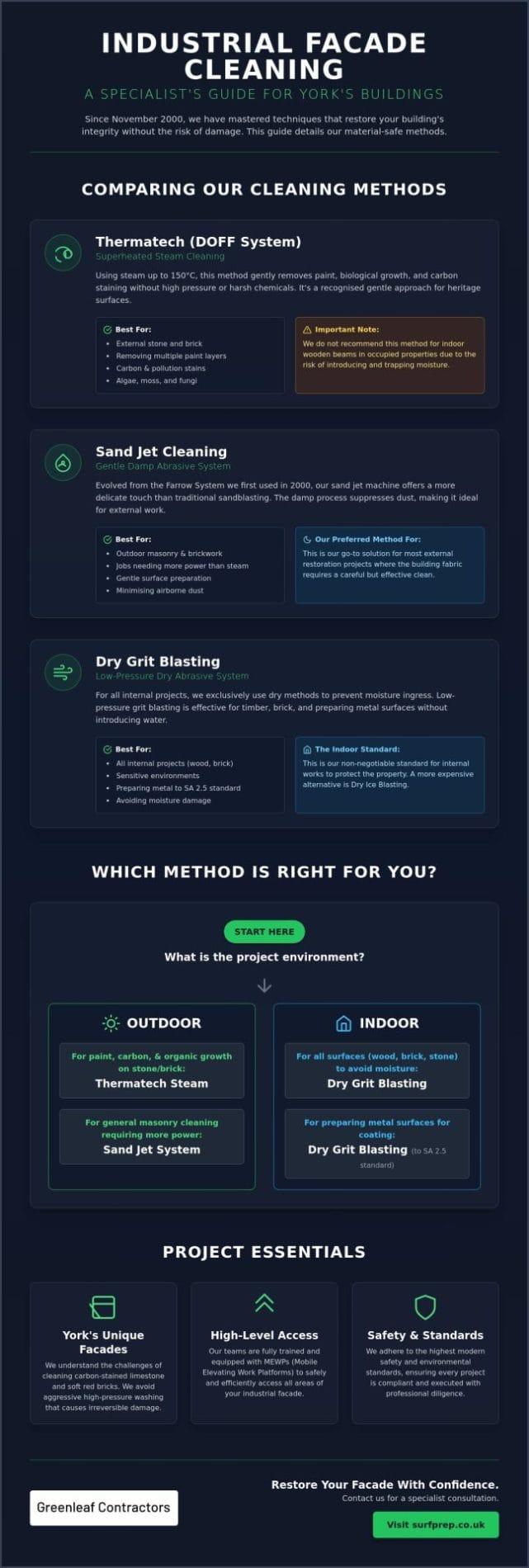
Thermatech is our preferred choice for stone and brick cleaning. By using superheated steam at temperatures up to 150°C, it removes layers of paint and biological growth without the need for aggressive chemicals or excessive pressure. It’s often referred to as a DOFF system in the industry and is highly regarded for its gentle nature. We must offer an expert admission here: we don’t recommend superheated steam for indoor wooden beams in occupied properties. The moisture introduced can linger and cause issues, so we always suggest alternative dry methods for internal timber restoration.
The Sand Jet: A Gentle Revolution in Surface Prep
For outdoor masonry that requires a bit more ‘bite’ than steam alone, our sand jet cleaning machine is the ideal solution. Originally acquired as a Farrow System, this technology uses a damp abrasive process that’s significantly more delicate than traditional sandblasting. It’s perfect for Yorkshire’s external brickwork where we want to avoid the dust of dry blasting whilst keeping pressures low enough to protect the surface.
When the work moves inside, moisture management becomes the priority. For internal industrial works, we shift to dry grit blasting at low pressures. This prevents water from entering sensitive machinery or building fabric. While dry ice blasting is a viable alternative for specific high-end applications, it remains an expensive option compared to precision grit blasting. Regardless of the method, we ensure all projects comply with the Work at Height Regulations 2005. If you’re preparing metal surfaces, we can achieve technical Sa 2.5 standards, though these metrics aren’t relevant for wood or stone. If you aren’t sure which method fits your facility, we can discuss the best technical approach for your specific site.
Executing High-Level Projects: Access, Safety, and Standards
Successfully managing industrial building facade cleaning York requires more than just the right cleaning technology; it demands a meticulous approach to logistics and safety. Since we established our business in November 2000, we’ve focused on the practicalities of reaching high-level surfaces without compromising the site’s daily operations. Whether we’re deploying Mobile Elevating Work Platforms (MEWPs), commonly known as cherry pickers, or erecting mobile towers, our choice of access is always dictated by the building’s footprint and the surrounding environment. This often includes clearing the facade of redundant fixtures, where a professional satellite dish removal service can safely strip away outdated equipment to ensure an unobstructed clean.
In sensitive industrial settings, particularly where precision engineering or food production occurs, we prioritise dust-free surface preparation methods. This ensures that whilst we restore the facade, we aren’t introducing contaminants into your facility’s internal atmosphere. We pride ourselves on being honest specialists. If our initial site survey reveals that a requested method might damage your specific substrate, we’ll tell you. We’d rather recommend a safer alternative than risk the integrity of your property for a quick sale. This transparent approach is why we’ve remained a trusted partner for Yorkshire businesses for over two decades.
Safety and Compliance at Height
Working at height in busy industrial zones involves significant risk. We manage this through rigorous, site-specific risk assessments and method statements (RAMS). Every operative we deploy is fully trained and holds valid IPAF and PASMA certifications, ensuring that access equipment is used safely and efficiently. We don’t just follow the regulations; we integrate them into every stage of the project to protect both our team and yours.
Planning Your Facade Restoration
For facilities managers, successful planning starts long before the equipment arrives. We recommend an early consultation to determine whether your site requires a damp process, like our sand jet machine, or a dry method to protect internal assets. Consider the following checklist for your York site:
- Water Access: Is there a reliable high-flow supply for Thermatech systems?
- Waste Management: How will run-off or spent abrasives be contained and responsibly removed?
- Site Access: Are there parking restrictions or height barriers that might impede MEWPs?
By addressing these factors early, we ensure your project remains on schedule and within budget whilst delivering a superior finish.
Restoring Your York Facility’s Integrity with Precision
Maintaining a professional exterior whilst protecting the structural fabric of your property requires a methodical approach that respects both modern standards and historic materials. We’ve demonstrated that successful industrial building facade cleaning York depends on the careful selection of technology, from the gentle superheated steam of Thermatech (DOFF) for masonry to precision dry grit blasting for internal industrial environments. Since we established our business in November 2000, we’ve remained committed to providing honest, technical advice that prioritises the longevity of your building over a one-size-fits-all solution.
With 25 years of specialist expertise in using the sand jet machine and advanced steam systems, we understand the logistical complexities of working at height in Yorkshire’s industrial zones. We don’t just clean surfaces; we prepare them for the future. If you’re ready to secure the value and safety of your assets, we invite you to request a technical site survey for your York industrial facility. Our team is here to ensure your building restoration is handled with the grit, determination, and technical accuracy it deserves. Let’s work together to keep your facility looking its best for years to come.
Frequently Asked Questions
What is the difference between DOFF and Thermatech for facade cleaning?
Thermatech and DOFF both utilise superheated steam at temperatures up to 150°C to remove paints, carbon staining, and biological growth. We primarily use the Thermatech system, whilst recognising DOFF as a widely understood industry term for this specific technology. Both systems are exceptionally gentle because they rely on thermal shock rather than high pressure to break the bond of surface contaminants, making them ideal for York’s historic masonry.
Is sandblasting safe for old industrial brickwork in York?
Traditional high-pressure sandblasting is often too aggressive for York’s historic industrial brickwork and can lead to permanent surface erosion. Instead, we specialise in using a sand jet machine, which we originally acquired as a Farrow System in November 2000. This low-pressure, damp abrasive method is a much gentler alternative, allowing us to restore the brick’s original appearance without stripping away its protective outer face.
How do you clean high-level facades without causing water damage inside?
We manage moisture risk by strictly separating our indoor and outdoor methodologies. For external industrial building facade cleaning York projects, damp processes like the sand jet are preferred to control dust. However, for internal works, we switch to dry grit blasting at low pressures or dry ice blasting. This ensures we don’t introduce water into occupied spaces, protecting both the building fabric and internal machinery. We never recommend superheated steam for indoor wood due to these moisture concerns.
What are the Sa 2.5 surface preparation standards and do they apply to my building?
Sa 2.5 is a technical standard that describes a ‘near-white’ metal finish, achieved when a surface is blast-cleaned to remove almost all mill scale, rust, and foreign matter. It applies strictly to industrial steelwork and metal machinery preparation. We don’t use these standards when discussing the cleaning of wood, brick, or stone, as those materials require restoration techniques focused on substrate preservation rather than metallic purity.
