
The safest way to clean Portland stone may be to leave it alone. A change in colour or a weathered surface doesn’t automatically mean the stone needs cleaning, and the wrong household cleaner, pressure or abrasive treatment can cause lasting marks. As a limestone, Portland stone can be vulnerable to harsh or acidic cleaning. If you’re wondering how to clean Portland stone without damaging it, first identify what’s causing the discolouration and decide whether cleaning is needed at all.
This guide explains how to assess the surface, which common approaches to avoid and when persistent staining or a larger project calls for specialist help. Surfprep has provided stone cleaning and restoration since the business was established in November 2000. The right process depends on the stone, the soiling and the setting, so no single method suits every job.
Key Takeaways
- Before deciding how to clean Portland stone, identify the type of soiling and consider whether the change in appearance needs attention.
- Avoid patio cleaners, acids, salt and abrasive materials, which can harm the stone’s surface.
- Reassess before taking further action instead of repeating a treatment that hasn’t improved the staining.
- Persistent marks or a large façade may call for professional assessment. The right method depends on the stone, soiling and setting.
How to clean Portland stone starts with deciding whether it needs cleaning
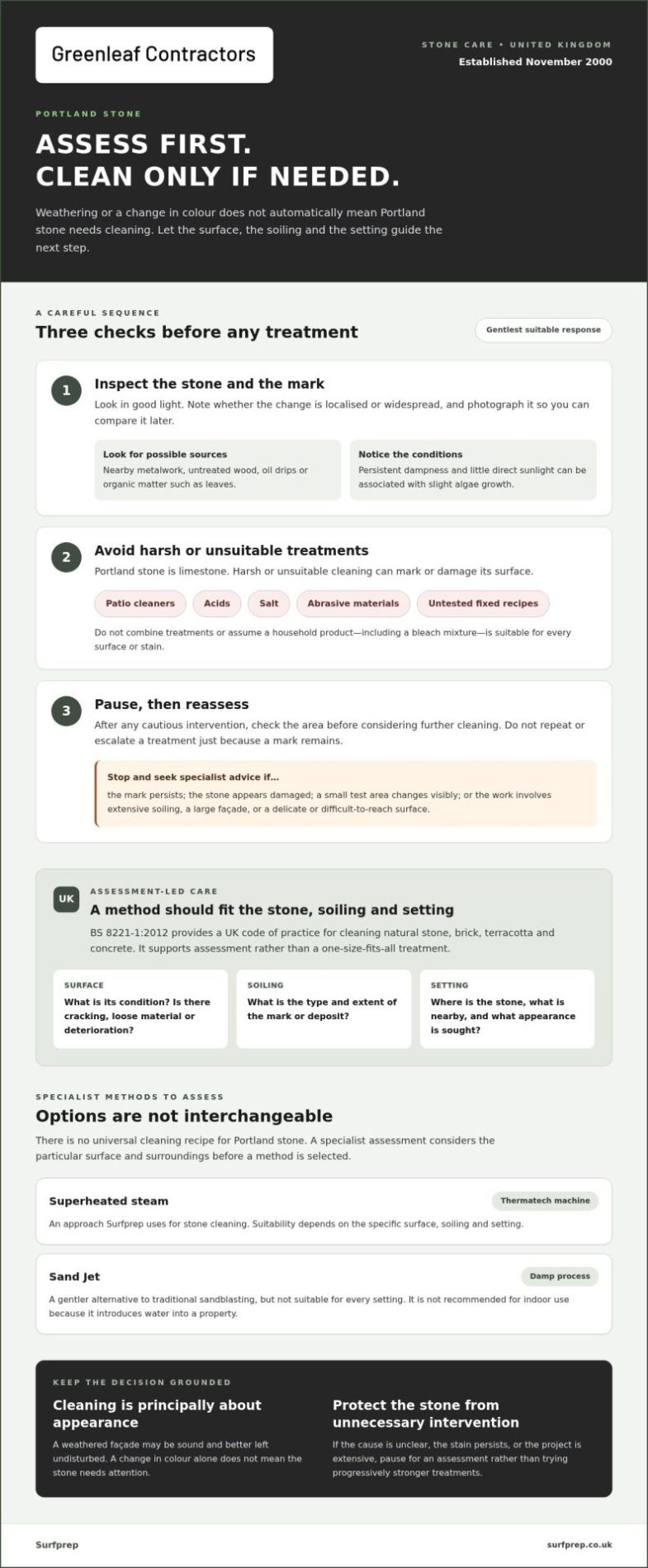
Portland stone is a limestone, and its colour and surface can change naturally as it weathers. That change alone isn’t a reason to clean it. For background on the stone’s composition and history, see What is Portland Stone? Before deciding how to clean Portland stone, inspect the affected area in good light. Note whether the change is widespread or concentrated in one place, and take a photograph so you can compare it later.
Cleaning is principally an appearance decision, not a guaranteed way to extend the stone’s lifespan. A weathered façade may be sound and better left undisturbed, while a local deposit may have an identifiable source. Record where the discolouration appears and what is nearby before choosing any treatment.
What should you check before cleaning Portland stone?
Distinguish general weathering or uneven colour from localised staining, possible algae growth and visible damage. Check for nearby metalwork, untreated wood, oil drips or organic matter such as leaves, as these may help explain a mark. Persistent dampness and limited direct sunlight can be associated with slight algae growth, particularly in shaded areas.
- Note whether the mark is isolated or spread across the surface.
- Look for deposits, damage and possible sources of staining around the stone.
- Observe whether the area stays damp or receives little direct sunlight.
If you see cracking, loose material or deterioration as well as discolouration, don’t assume cleaning is the answer. These observations can help guide a careful assessment. For persistent concerns or a larger project, Surfprep’s stone cleaning service can assess the work and consider the stone, soiling and setting before selecting an approach.
How to clean Portland stone safely without harsh or unsuitable methods
There’s no universal cleaning recipe for Portland stone. Identify the surface and the type and extent of soiling, then consider the gentlest suitable response. In the UK, BS 8221-1:2012 provides a code of practice for cleaning natural stone, brick, terracotta and concrete. It supports an assessment-led approach rather than a one-size-fits-all treatment. The method needs to suit the stone, its condition and the setting.
Avoid patio cleaner, acids, salt and abrasive materials. Portland stone is limestone, and harsh or unsuitable treatments can mark or damage its surface. The Natural Stone Institute’s General Natural Stone Care Guidelines offer further context on natural stone care and avoiding acidic cleaners. Be cautious with fixed online recipes, including bleach mixtures: they can’t account for every surface or source of staining.
A careful sequence helps limit unnecessary intervention:
- Identify the affected surface and visible soiling, and note nearby fittings or potential sources of marks.
- Avoid harsh chemicals, salt and abrasive scrubbing. Don’t combine treatments or assume a household product is suitable.
- After any cautious intervention, reassess the area before considering further cleaning.
When should you stop DIY cleaning and seek specialist advice?
Stop if the mark persists, the stone appears damaged or a small test area changes visibly. Attached nameplates and fittings may need protection during cleaning, as residue or runoff could stain the surrounding stone. Repeated attempts can make assessment harder, so pause rather than escalating the treatment.
For a persistent mark or a more involved job, Surfprep’s Portland stone-cleaning service can provide a specialist assessment. Surfprep uses superheated steam cleaning with a Thermatech machine. A damp Sand Jet process is another option to assess, but it is not interchangeable with steam cleaning or suitable for every setting. The approach should be chosen for the particular surface, rather than assumed from a general recipe.
When professional Portland stone cleaning may be the right next step
Some marks won’t respond to cautious home cleaning, and repeated attempts can risk changing the stone without resolving the cause. Persistent staining, extensive soiling or a large façade are good reasons to seek a professional assessment, particularly if the surface is delicate or difficult to reach. A specialist can consider the condition and context before recommending whether cleaning is appropriate and which approach may suit the work.
Surfprep provides stone cleaning and restoration, including superheated steam cleaning using a Thermatech machine. The damp Sand Jet process offers a gentler alternative to traditional sandblasting, but its use depends on the stone and setting. Neither method is a blanket recommendation for Portland stone: the right choice depends on the surface, the soiling and the surroundings. Cleaning decisions should be based on the specific work, not a promise of a particular result.
What happens during a specialist stone-cleaning assessment?
An assessment considers the surface and its condition, the type and extent of soiling, the location and the appearance you want to achieve. These details help shape a practical plan and determine whether a cleaning method is suitable. Surfprep works across Leeds, York, Hull, Bradford, Nottingham, Manchester, Derby, Lincoln, Newcastle, Durham, Scarborough and Beverley, as well as nearby areas.
Understanding how to clean Portland stone safely means recognising when a larger or persistent problem needs more than another home treatment. Surfprep’s stone-cleaning information explains the company’s restoration service and gives you a starting point for considering your project.
Choose a careful next step for your Portland stone
Good care doesn’t have to mean returning stone to a uniform, newly cleaned appearance. A considered result respects the character of the material and avoids intervention that isn’t needed. If you’re still weighing how to clean Portland stone, let the condition of the surface and the result you want guide the decision, rather than trying progressively stronger treatments.
For a project that feels too extensive or uncertain to tackle yourself, a specialist assessment can help establish a sensible way forward. Note what you’ve observed and what you hope to achieve so the discussion can focus on the stonework and its condition.
Discuss your stone-cleaning project with Surfprep and take the next step with confidence.
Frequently Asked Questions
Does Portland stone need regular cleaning?
No, Portland stone doesn’t need cleaning simply because a set period has passed. A routine wash can mean unnecessary intervention, so judge the surface by what you can see. If you’re unsure whether a change is new or longstanding, take a clear photograph and compare it later. That gives you a useful reference before deciding whether any action is needed.
Can you use bleach to clean Portland stone?
Don’t assume bleach is suitable for Portland stone or use a recipe intended for another surface. A dilution that appears mild doesn’t establish that it’s appropriate for this stone or the particular deposit, and an unsuitable treatment may alter the appearance. If a mark hasn’t responded to cautious cleaning, stop rather than increasing the bleach concentration or leaving it on for longer.
What should you never use to clean Portland stone?
Avoid patio cleaner, acidic products, salt and abrasive materials. Leave wire wool, scouring pads and stiff wire brushes out of the cleaning kit too, as they can scratch or mark the surface. Don’t direct a forceful pressure-washer jet at the stone. If a deposit won’t lift without scrubbing or stronger chemicals, pause rather than escalating the treatment.
When should Portland stone be professionally cleaned?
Arrange a professional assessment if staining remains after cautious attention, covers a large area or appears alongside surface deterioration. A specialist can help distinguish a deposit from a change in the stone itself and consider an appropriate approach. Surfprep works in Leeds, York, Hull, Bradford, Nottingham, Manchester, Derby, Lincoln, Newcastle, Durham, Scarborough and Beverley, as well as nearby areas.
