
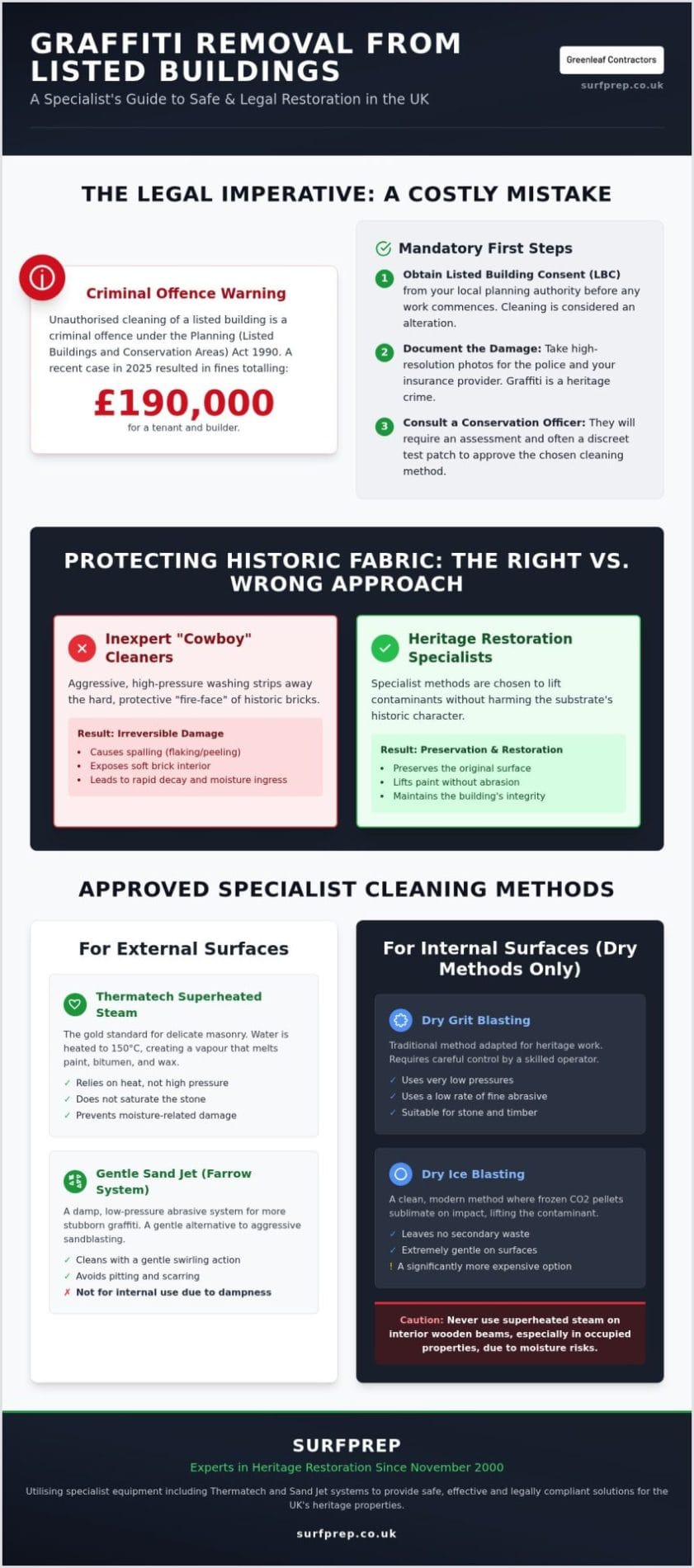
In 2025, a tenant and builder were fined a total of £190,000 for unauthorised work on a Grade I listed building, a sobering reminder that “cleaning” a historic facade is actually a legal minefield. It’s heartbreaking to find spray paint on your property, and we know your first instinct is likely to scrub it off as fast as possible. However, when dealing with heritage masonry, the wrong approach can lead to permanent scarring or even a criminal record. Understanding how to remove graffiti from listed buildings UK requires more than just a bucket of water; it demands a balance of legal compliance and technical precision.
We’ve been restoring historic surfaces since November 2000, and we promise to show you how to navigate Listed Building Consent (LBC) whilst protecting the historic fabric of your property. You’ll discover why superheated steam is often the gold standard, specifically using Thermatech systems, and why our gentle sand jet is a far safer alternative to traditional, aggressive sandblasting. This guide previews the safe, specialist methods required to restore your building without the risk of “cowboy” cleaners ruining your stone or brickwork for good.
Key Takeaways
- Understand why obtaining Listed Building Consent is a mandatory legal step to avoid criminal penalties and protect your property’s heritage status.
- Learn how to remove graffiti from listed buildings UK using Thermatech superheated steam to dissolve paint safely without saturating the underlying masonry.
- Discover the advantages of the sand jet (originally the Farrow System) as a gentle, damp abrasive alternative for sensitive external restoration projects.
- Identify the correct dry-cleaning methods for internal graffiti removal to prevent moisture damage to historic interiors and timber beams.
- Evaluate the long-term impact of anti-graffiti coatings, including the risks that non-breathable sealants pose to stone breathability and structural integrity.
Understanding the Legal Requirements and Risks for Heritage Masonry
Graffiti on a designated heritage asset is legally classified as criminal damage, but the real danger often lies in the cleanup. When property owners ask how to remove graffiti from listed buildings UK, the answer starts with the law, not the equipment. Under the Planning (Listed Buildings and Conservation Areas) Act 1990, any work that affects the character or appearance of a listed building requires Listed Building Consent (LBC) from your local planning authority. Because cleaning methods can fundamentally change the surface of the masonry, most conservation officers view removal as a controlled alteration. Carrying out these works without formal approval is a criminal offence that can lead to unlimited fines.
Hiring an inexpert contractor is the quickest way to cause irreversible damage. Standard high-pressure washers, often used by “cowboy” cleaners, frequently strip away the “fire-face” of historic bricks. This is the hard, protective outer layer formed during the original kiln-firing process. Once this layer is gone, the softer interior of the brick is exposed, leading to rapid spalling and decay. Before you explore various graffiti removal techniques, you must record the damage. Take high-resolution photographs for the police and your insurance provider, as graffiti is considered a heritage crime. Ensure the site is safe and avoid using DIY solvent cleaners that might drive the paint pigment deeper into the porous stone.
Consulting Your Local Conservation Officer
A conservation officer’s primary concern is the preservation of the “historic fabric.” They will require an assessment to identify exactly what material you’re dealing with, whether it’s porous sandstone, dense limestone, or fragile handmade bricks. This is why we always recommend a professional brick cleaning approach that starts with a small, discreet test patch. These trials are often a mandatory requirement for heritage approval. They allow us to demonstrate that our methods, such as the Thermatech system we’ve used since our inception in November 2000, will lift the paint without bruising the stone or leaving ghostly shadows behind.
Specialist Removal Methods: Superheated Steam and Sand Jetting
Deciding how to remove graffiti from listed buildings UK requires a method as sympathetic as the original construction. Since November 2000, we’ve utilised Thermatech superheated steam as our primary tool for delicate masonry. By heating water to 150°C, the system creates a high-temperature vapour that melts away spray paint, bitumen, and wax-based tags. Because this process relies on heat rather than high pressure, it doesn’t saturate the stone substrate. This prevents the moisture-related issues that often plague heritage sites after less sophisticated cleaning attempts.
Selecting the correct technique for how to remove graffiti from listed buildings UK involves assessing the age and porosity of the material. For more stubborn pigments or older, multi-layered graffiti, we often deploy the sand jet. Originally acquired as a Farrow System in November 2000, this setup is a remarkably gentle alternative to traditional sandblasting. We’ll be honest: we avoid standard sandblasting on listed structures because it’s far too aggressive, often causing irreversible pitting and scarring that ruins the building’s aesthetic value. The sand jet uses a low-pressure, damp abrasive stream that cleans by gently swirling across the surface rather than impacting it directly.
External vs Internal Graffiti Removal
Choosing the right environment is vital. Whilst the sand jet cleaning method is excellent for external walls, it’s a damp process that we don’t recommend for interior works. Introducing water into an enclosed historic property can lead to dampness or salt crystallisation. For internal stone or timber, we prefer traditional dry grit blasting at very low pressures or dry ice blasting. Dry ice is a significantly more expensive option, though it leaves no secondary waste. We strongly advise against superheated steam for interior wooden beams, especially in occupied houses, to avoid moisture damage. If you’re unsure which method fits your project, talk to our team for a technical assessment.
Post-Removal: Prevention and Long-Term Heritage Preservation
Once the spray paint is gone, the focus shifts to preventing a recurrence without compromising the building’s health. We’ve seen many well-intentioned owners apply heavy sealants that do more harm than the graffiti itself. The choice between sacrificial wax-based coatings and permanent breathable solutions is critical. As honest specialists, we must warn you: non-breathable coatings are often a death sentence for historic masonry. They trap moisture behind the surface, causing salt crystallisation and rapid decay. If the stone can’t “breathe”, the face will eventually flake off, leading to costly structural repairs.
Restoring the aesthetic involves more than just paint removal. A bright, clean patch on a 200-year-old wall looks unnatural and can be just as distracting as the original tag. We use our expertise, built since November 2000, to ensure the cleaned area blends into the weathered surroundings. This requires a nuanced touch with our Thermatech or sand jet systems to avoid over-cleaning. It’s about restoration, not just a quick scrub, ensuring the historic fabric remains visually consistent.
Maintaining Building Integrity Post-Cleaning
Maintaining building integrity goes beyond a one-off fix. Regular stone cleaning plays a major role in general building health and curb appeal, as it removes atmospheric pollutants that weaken the substrate. When you’re figuring out how to remove graffiti from listed buildings UK, think about a rapid-response plan. Research from August 2024 shows heritage crime is rising, but removing tags quickly often deters repeat attacks. Taggers want their work seen; if it disappears within 48 hours, they usually move to a different location. After a professional restoration is complete, use this checklist to maintain your property:
- Ensure the masonry is completely dry before applying any conservation-approved sacrificial coatings.
- Check that any proposed sealant is fully vapour-permeable to prevent moisture entrapment.
- Document the completed restoration with photographs for your local conservation officer’s records.
- Establish a monitoring routine to catch new damage before it bonds deeply with the porous stone.
Securing Your Heritage for the Future
Protecting a historic property requires a shift in mindset from simple cleaning to careful restoration. The legal framework surrounding Listed Building Consent is just as important as the physical removal process itself. By choosing specialist systems like Thermatech superheated steam or the gentle sand jet, you avoid the permanent scarring caused by aggressive, high-pressure methods. We’ve spent over 25 years refining our approach to how to remove graffiti from listed buildings UK, ensuring that every project respects the unique breathability and fire-face of historic masonry.
Since establishing our business in November 2000, we’ve become a trusted partner for heritage sites across Leeds, York, Hull, and the wider Northern region. We don’t just offer a quick fix; we provide honest, technical guidance to ensure your building remains structurally sound for another century. If you’re facing a recent act of vandalism, don’t risk a DIY approach that could lead to local authority fines or stone decay. Contact Surfprep for a specialist heritage cleaning assessment to discuss your requirements. Restoring your building’s integrity is a journey, and we’re here to help you get it right the first time.
Frequently Asked Questions
Do I really need permission to remove graffiti from my own listed building?
Yes, you usually need Listed Building Consent from your local planning authority before undertaking any cleaning. Even though you own the property, the “historic fabric” is protected by law, and using the wrong method is a criminal offence. We’ve been advising clients on these requirements since November 2000. It’s best to consult a conservation officer first, as they’ll likely insist on a test patch to verify the safety of the removal technique.
Will superheated steam cleaning damage the mortar joints between my bricks?
No, the Thermatech superheated steam system is specifically designed to be safe for delicate mortar joints. Whilst high-pressure cold water can easily blow out lime mortar, Thermatech relies on 150°C heat at low pressure to liquefy paint. This means we can effectively clean the surface without the risk of damaging the pointing. It’s a precise tool that preserves the structural integrity of your masonry whilst removing unsightly tags.
What is the difference between a sand jet and traditional sandblasting for stone?
The primary difference is the level of aggression and the use of moisture. Traditional sandblasting is a dry, high-pressure process that often leaves stone pitted and scarred. In contrast, the sand jet, which we acquired as a Farrow System in November 2000, uses a damp, swirling motion at much lower pressures. When property owners ask how to remove graffiti from listed buildings UK, we recommend the sand jet for its gentle, non-destructive results.
Can you remove graffiti from historic wooden doors or beams inside a property?
We can certainly restore internal timber, though we avoid using superheated steam for these specific works. Introducing moisture into historic wooden beams or doors, particularly in lived-in houses, can cause warping or long-term damp problems. For interior surfaces, we suggest dry ice blasting or low-pressure dry grit blasting. Dry ice is an expensive option, but it’s highly effective for removing paint without leaving any secondary abrasive waste inside your property.
