
The most common approach to restoring historic timber, aggressive manual sanding, is often the quickest way to permanently ruin the very character you’re trying to save. It’s a frustrating reality for many homeowners (and even some contractors) who find themselves staring at layers of thick, dark gloss or centuries-old lime wash. You likely want those beams returned to their original glory, but the fear of damaging the underlying oak or filling your home with toxic lead dust is enough to stall any project.
Removing paint from structural wooden beams doesn’t have to be a destructive or dangerous process if you choose a controlled methodology. In this guide, you’ll discover the safest, most effective methods for stripping paint from historic and structural timbers whilst preserving the wood’s natural character. We’ll explore the balance between modern chemical gels and specialised tools, identify which techniques are safe for structural integrity, and explain how to manage the logistical challenge of a dust-controlled restoration. Whether you’re dealing with a domestic cottage or a larger commercial project, understanding the chemistry and physics of the wood is the first step toward a successful finish.
Key Takeaways
- Learn to identify various coatings, such as Victorian bitumen and traditional limewash, and why a lead test is the essential first step before any physical work begins.
- Discover the technical advantages of using peel-away poultices over liquid strippers for removing paint from structural wooden beams whilst protecting the surrounding environment.
- Understand how to avoid the “Sanding Trap,” ensuring you don’t accidentally erase historic adze marks and the natural grain that gives structural timber its value.
- Gain a clear, step-by-step methodology for site preparation and sectional removal to ensure a dust-controlled restoration that respects the integrity of the wood.
Evaluating Your Beams: Identifying Paint Types and Timber Condition
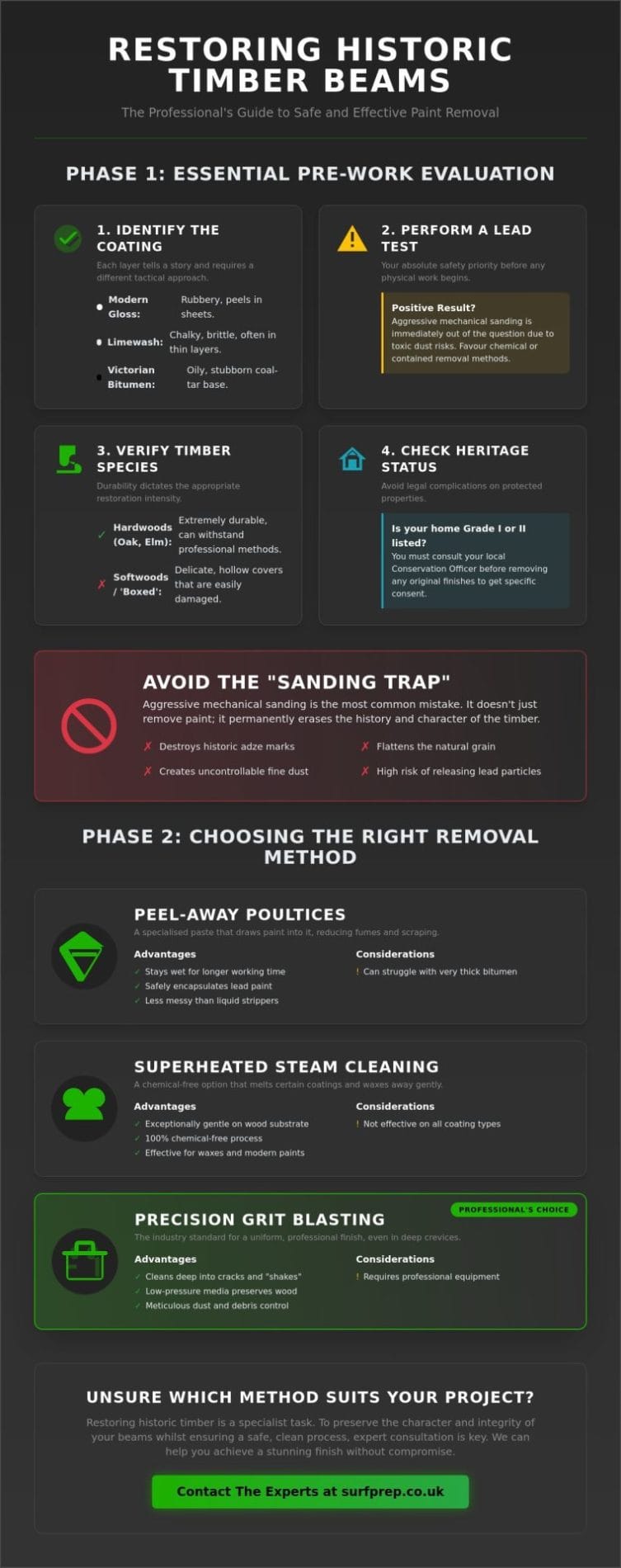
Before you commit to a restoration project, you must accurately identify what’s actually covering your timber. A period property in York might have three centuries of decor layered on a single oak joist, and each layer requires a different tactical approach. Modern gloss paint is usually the easiest to spot; it feels rubbery and often peels away in sheets. Traditional limewash, by contrast, is chalky and brittle (often found in dozens of thin, white layers). The most difficult coating is typically Victorian bitumen. This coal-tar based substance was frequently used to "protect" wood but often leaves a stubborn, oily residue that resists standard cleaning methods.
Safety is your absolute priority. You must perform a lead test before any physical intervention begins. In the UK, lead-based paints were widely used until the 1960s and weren’t completely banned for general sale until 1992. If your test returns a positive result, mechanical sanding is out of the question due to toxic dust risks. In these cases, we often look toward specialised chemical paint strippers or poultice systems that can safely encapsulate the lead whilst the coating is removed.
You also need to verify the timber species. Solid oak and elm are incredibly durable and can withstand professional removing paint from structural wooden beams, but softwood "boxed" beams (essentially hollow covers) are far more delicate. If your home is Grade I or II listed, don’t start work without consulting your local Conservation Officer. Removing original finishes in a Listed Building without specific consent can lead to legal complications and a requirement to reinstate the original (albeit ugly) blackened appearance.
Common Challenges with ‘Blackened’ Beams
The "blackened" look common in many English cottages usually stems from thick gloss or bitumen. These substances are notoriously difficult because they don’t just sit on the surface; they settle into the deep, natural crevices of the grain. Even after the bulk of the paint is gone, you may encounter "ghosting." This is when old pigments have migrated deep into the wood fibres over decades, leaving a faint stain that requires professional-grade equipment to lift without thinning the timber excessively.
Paint Removal Methods: From Manual Stripping to Professional Grit Blasting
Many homeowners reach for a belt sander when they first attempt removing paint from structural wooden beams. It’s a mistake we see far too often. Aggressive mechanical sanding doesn’t just remove paint; it erases the historic adze marks and the unique patina that defines the timber’s character. If you value historic woodwork preservation, you need a method that respects the wood’s "skin" rather than grinding it away. Sanding also creates an immense volume of fine dust that’s nearly impossible to fully extract from a domestic living space.
Chemical strippers offer a different route, but they aren’t all created equal. Traditional liquid strippers can be incredibly messy and often emit harsh fumes in enclosed rooms. We generally recommend peel-away poultices for internal use. These systems stay wet for longer, drawing the paint into a specialised paste. This reduces the need for the heavy-handed scraping that often gouges the wood surface. However, even the best chemicals can struggle with the thickest Victorian bitumen or multiple layers of lead-based gloss.
For a truly professional finish, precision grit blasting is the industry standard. By using low-pressure equipment and specialist media like crushed glass or crushed walnut shells, we can clean the surface without "pitting" or damaging the timber. Another highly effective, chemical-free option is superheated steam cleaning. This method melts away certain modern coatings and waxes whilst remaining exceptionally gentle on the underlying substrate – but it will introduce water into your property – fine for a barn conversion in the early stages – not so appropriate for a fully occupied, carpeted house! If you’re unsure which approach fits your home, it’s often best to consult an expert before starting.
Dry Ice Blasting is a common request, and has advantages in that no additional ‘dust’ is introduced to the property, because the abrasive evaporates on contact, and contaminants like paint and limewash are removed by thermal shock and the volume change as dry ice turns into gaseous carbon dioxide. We can price for this, but admit that when confronted with the price, most customers opt for traditional grit blasting. Not only is the dry ice an expensive ‘abrasive’ but doesn’t hang around to be used on the next job! It is also subject to wild price fluctuations – and isn’t anything like as ‘clean’ inside a house as it might appear. The dust that is difficult to deal with is the removed contaminant – and dry ice generates that as effectively as grit blasting!
Laser cleaning is a new option, vaporising the contaminant – and produces very clean and smooth results. But… it is extremely slow in comparison to other methods.
Why Professionals Favour Precision Grit Blasting
The primary advantage of precision blasting is its reach. Structural timber often features "shakes" (natural splits) and deep cracks where brushes and scrapers simply cannot penetrate. When removing paint from structural wooden beams, the ability to clean into these recesses ensures a uniform finish across the entire span. We typically utilise dry methods in domestic environments to manage moisture levels, though we’re meticulous about sealing the work area to contain debris. Yorkshire and Manchester homeowners can explore our dedicated wooden beam cleaning services to see how these professional techniques transform dark, oppressive rooms into light, characterful spaces.
A Step-by-Step Guide to Restoring Structural Beams Safely
Successful restoration begins long before the first layer of paint is lifted. If you’re removing paint from structural wooden beams in a domestic setting, your primary challenge is containment. You must mask off the centre of the room with heavy-duty polythene and seal every doorway with tape to prevent fine particulate matter from migrating into soft furnishings. It’s a significant logistical commitment that separates a professional job from a messy DIY attempt. We always advise removing as much furniture as possible, as dust has a habit of finding even the smallest gaps in protective sheeting.
Once the area is secure, the removal phase should proceed in manageable sections, typically no more than one or two metres at a time. This methodical approach allows you to monitor the timber’s reaction and ensure consistent results across the entire structural span. If you’ve used chemical systems, neutralisation is the next critical step. Any residue left in the grain will interfere with your final finish, potentially causing oils or waxes to fail or discolour over time. A thorough cleaning of the grain with a stiff, non-wire brush ensures the timber is "open" and ready to receive treatment.
The final choice of finish depends on the desired aesthetic and the age of the property. Traditional beeswax provides a soft, authentic sheen that suits historic oak, whilst modern hard-wax oils offer better durability for high-traffic areas. Some homeowners prefer the raw, honest look of the timber left natural, though this offers less protection against moisture and airborne dust. Whatever you choose, ensure the wood is completely dry before application.
Post-Removal: Lightening and Aftercare
Sometimes, even after the paint is gone, the wood remains "stained" by old tannins or bitumen. You can safely lighten these areas using specialised wood bleaches, but this should be done with a light touch to avoid a bleached, artificial appearance. This stage is also the ideal time to prepare timbers for woodworm treatment. In barn conversions, where beams have often been exposed to the elements or livestock, treating the freshly cleaned wood ensures long-term structural integrity. For those who prefer a guaranteed result without the logistical headache, contacting a specialist for a professional site survey and quote is the most reliable way to handle projects across the North of England.
Restoring the Natural Beauty of Your Period Timbers
Successful restoration is about balance. You now understand that protecting the wood’s original adze marks and managing lead safety are just as vital as the removal itself. By moving away from aggressive sanding and towards controlled, specialist methods, you ensure your home’s structural history remains intact. It’s about revealing the timber’s story rather than erasing it through brute force.
Removing paint from structural wooden beams is a significant undertaking that requires precision and the right equipment. For over a decade, we’ve acted as trusted advisors for domestic and commercial clients across York and Leeds. As specialists in Doff superheated steam cleaning, we provide a methodical, honest approach to even the most complex timber challenges. If you’re ready to uncover the true character of your home, you can request a professional beam restoration quote from Surfprep. Your project deserves the expertise of a seasoned specialist who understands the value of historic wood. With the right care, these beams will remain a stunning focal point for generations to come.
Frequently Asked Questions
Is it safe to remove paint from structural beams myself?
DIY removal is possible but carries significant health and structural risks, particularly regarding lead-based paint and dust inhalation. Most period homes built before the 1990s likely contain lead-based coatings; disturbing these without HEPA-filtered extraction or specialised chemical encapsulation creates a serious health hazard. Additionally, aggressive DIY sanding often permanently damages the wood grain and original adze marks, reducing the historic value of your property.
How do I remove black gloss paint from old oak beams?
Black gloss and bitumen are best removed using a peel-away poultice system or low-pressure precision grit blasting. These methods are far more effective than manual scraping, which often fails to reach the pigment lodged deep within the natural crevices of the oak. When removing paint from structural wooden beams that have been "blackened" for decades, a multi-stage approach often yields the most uniform results without gouging the timber.
Will grit blasting damage the surface of my wooden beams?
Precision grit blasting won’t damage the timber if it’s performed by a specialist using low-pressure equipment and soft media . Unlike traditional industrial sandblasting, which is far too aggressive for historic wood, these refined techniques clean the surface whilst preserving the delicate patina. It’s a matter of choosing the correct pressure and media for the specific density of your timber. If any damage is seen we will stop and discuss, not press on regardless.
Can you remove paint from beams in a Listed Building?
You can remove paint from beams in a Listed Building, but you must obtain Listed Building Consent from your local planning authority first. Conservation officers typically require a detailed method statement and a small test patch to ensure the proposed technique doesn’t harm the historic fabric. We often work alongside conservationists to ensure the chosen method aligns with heritage preservation standards and respects the building’s history.
What is the least messy way to strip paint from internal timbers?
The least messy method for internal timbers is usually a peel-away poultice system or laser cleaning. Poultices encapsulate the paint in a paste, preventing toxic dust from becoming airborne in your home. The laser system can be used in a fully occupied and carpeted house.
How much does professional beam cleaning cost in the UK?
Costs for professional restoration vary based on the timber’s condition, the height of the ceilings, and the number of paint layers involved. Projects can range from a few hundred pounds for a single feature beam to several thousand for a full barn conversion or open-plan renovation. Since every project has unique logistical challenges, we recommend a site survey to determine the most cost-effective and safe method for your specific property.
