
Applying a “near-white metal” finish to a 150-year-old oak beam won’t just fail an inspection; it could permanently compromise the structural integrity of your property. Many facility managers find themselves caught in the confusing gap between safety laws like COSHH and technical preparation benchmarks like Sa 2.5. We understand that navigating industrial cleaning standards UK wide can feel like a minefield, especially with the August 2026 GB CLP deadline fast approaching. Since we established our business in November 2000, we’ve seen how easily heritage materials are damaged by aggressive “sandblasting” when a gentler, more considered approach was required.
You likely want to ensure your facility remains compliant without risking the integrity of your assets. This guide will help you master the essential regulations, from the Health and Safety at Work etc. Act 1974 to specific technical benchmarks for different materials. We’ll explain why standards like Sa 2.5 are strictly for metalwork and why we prioritise dry methods for internal works to avoid introducing moisture into a building. By the end, you’ll have the confidence to choose the right method, whether that’s our sand jet machine, originally acquired as a Farrow System, or Thermatech superheated steam, which is often referred to as DOFF.
Key Takeaways
- Master the core legal requirements of HSWA 1974 and COSHH to ensure your operations meet the latest industrial cleaning standards UK businesses must follow.
- Differentiate between technical benchmarks like Sa 2.5 for metalwork and the specific care required for masonry to avoid irreversible material damage.
- Learn why we recommend the damp sand jet machine for outdoor projects whilst switching to low-pressure dry grit blasting for internal works to protect property interiors.
- Understand the limitations of superheated steam systems like Thermatech (often called DOFF) and why they aren’t suitable for every surface, particularly indoor wooden beams.
- Develop the expertise to evaluate contractors based on their understanding of material-specific cleaning and their commitment to long-term structural health.
The UK Legal Framework: HSWA 1974 and COSHH Standards
Compliance isn’t just about ticking boxes; it’s about the fundamental safety of your site and the long-term preservation of your assets. The Health and Safety at Work etc. Act 1974 remains the primary legislation for all industrial cleaning standards UK operations, placing a non-negotiable duty of care on both employers and contractors. Since we began our work in November 2000, we’ve focused on bridging the gap between meeting these legal requirements and delivering technical excellence. We don’t just clean; we manage the risks inherent in industrial environments.
Under the Control of Substances Hazardous to Health (COSHH) regulations, we must meticulously assess and manage risks from cleaning agents and the dust generated during surface preparation. It’s vital to stay ahead of regulatory shifts, such as the August 2026 GB CLP deadline, which mandates updated labelling and Safety Data Sheets for all chemical products. Simply choosing a “standard” cleaning method isn’t enough if it fails to protect the building fabric or the people inside it. We prioritise methods that ensure operative safety whilst maintaining the structural integrity of the substrate.
Managing run-off and waste disposal is another critical layer of compliance. We follow UK local authority guidelines strictly, ensuring that any slurry or waste is captured and disposed of correctly. With the DEFRA Digital Waste Tracking Service (DWTS) becoming mandatory in October 2026, real-time digital recording of waste movement is now a standard part of our logistical planning. This transparency ensures that your facility remains compliant with environmental standards throughout the project lifecycle.
COSHH and Dust Management in Surface Preparation
Old coatings often hide hazardous particulates, including lead-based paints that require specialist handling. We use the damp process of our sand jet machine for outdoor work because it naturally suppresses airborne risks at the source. For internal projects, we shift to low-pressure dry grit blasting combined with Local Exhaust Ventilation (LEV) to capture dust without introducing moisture into the property. We organise every site to ensure a clear separation between active work zones and your staff, keeping everyone safe during active works.
Working at Height and Specialist Access
Our work often takes us to factory ceilings or high-level facades, requiring strict adherence to the Work at Height Regulations 2005. We don’t believe in a one-size-fits-all approach to access. Whether we utilise MEWPs (Mobile Elevated Work Platforms), traditional scaffolding, or industrial rope access, the choice is always driven by a site-specific risk assessment. This ensures we select the safest and most efficient method for your specific environment, prioritising both our team’s safety and your operational continuity.
Technical Standards for Surface Preparation: Sa 2.5 and Masonry Care
Applying the wrong technical benchmark to a substrate is one of the most common mistakes in the industry. Many contractors treat all surfaces the same, but industrial cleaning standards UK professionals know that steel and stone require entirely different methodologies. Whilst metal preparation often demands an aggressive profile to ensure coating adhesion, masonry cleaning focuses on the preservation of the material’s delicate surface. We’ve spent over two decades ensuring that the correct technical standard is matched to the specific material at hand.
The “profile” or anchor pattern is the most critical factor in industrial surface preparation. This refers to the microscopic peaks and valleys created on a surface to provide a mechanical key for subsequent coatings. If the profile is too shallow, the paint will peel; if it’s too deep, you risk wasting expensive coatings or causing structural thinning. We use precise inspection methods to verify that every square inch meets the required ISO or BS standards before any protective layers are applied.
Metal Surface Preparation (Sa 2.5)
When we prepare industrial steelwork, we strictly follow the Sa 2.5 standard, known as “Near-White Metal” blast cleaning. This requires the surface to be free of all visible oil, grease, dirt, mill scale, and rust, with only slight streaks or discolourations remaining. It’s a rigorous benchmark that we typically achieve using dry grit blasting at high pressures. You can read more about this in our guide to Understanding Surface Preparation Standards (Sa 2.5). All such works are conducted in full compliance with COSHH standards and regulations to manage dust and abrasive recovery safely.
Masonry and Stone Restoration Standards
Technical standards for metal must never be applied to brick cleaning or stone. Aggressive sandblasting can destroy the “fire skin” of a brick, leaving it porous and prone to frost damage. Instead, we utilise our specialist sand jet cleaning services, which offer a far gentler alternative for removing industrial soot and carbon. For outdoor stone, we may also recommend superheated steam cleaning via Thermatech (a system often recognised by the industry term DOFF). However, for internal works, we shift to low-pressure dry grit blasting. We avoid steam or water indoors to prevent moisture from being trapped within the building fabric, which is a common cause of long-term damp issues. If you’re dealing with sensitive internal surfaces, our team can advise on the safest dry method for your specific property.
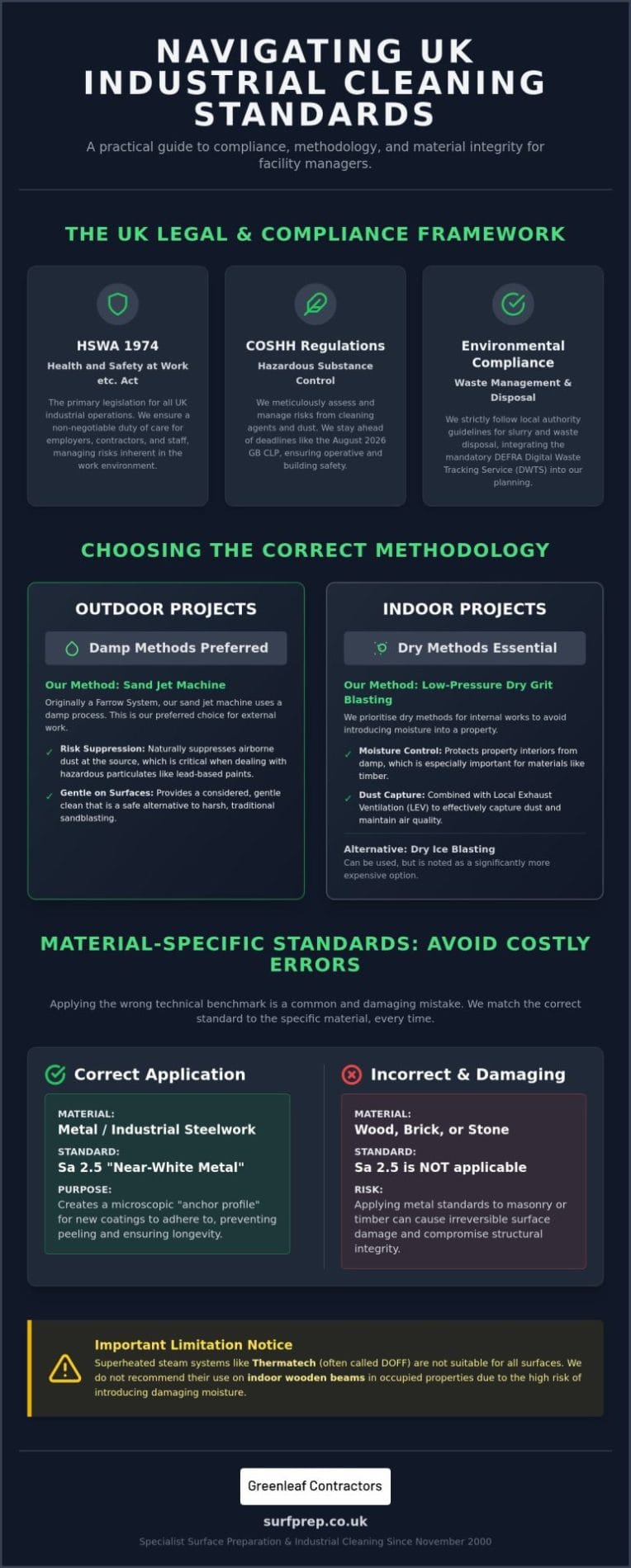
Choosing the Correct Methodology: Moisture Control and Material Integrity
A core principle of our work since November 2000 is what we call the “Expert Admission”: we’ll always prioritise the method that protects your substrate over the one that’s easiest or fastest for us to execute. Adhering to industrial cleaning standards UK facility managers expect means understanding that moisture is often the enemy of long-term structural health. Selecting the wrong equipment can lead to trapped damp, salt efflorescence, or even rot in historic timbers. We base our methodology selection on a rigorous assessment of the environment, specifically distinguishing between the requirements of indoor and outdoor applications.
The decision-making process often hinges on how we manage water. Whilst superheated steam is excellent for certain masonry types, it’s rarely the right choice for internal works where moisture can’t easily escape. On the other hand, improving business curb appeal through exterior restoration allows for damp processes that suppress dust and protect the surrounding public space. Every project requires a balance between safety, efficiency, and material integrity, ensuring the building remains structurally sound for decades to come.
Outdoor Restoration: Thermatech and the Sand Jet
For exterior facades, we frequently utilise the Thermatech superheated steam system (often recognised by the industry term DOFF). By reaching temperatures of 150°C at the nozzle, it allows for the chemical-free removal of organic matter, biological growth, and light coatings without the need for high-pressure water blasting, which can be far too aggressive for weathered industrial brickwork. When a more abrasive touch is required, our sand jet machine (originally the Farrow System) uses a damp abrasive process. This is ideal for outdoor commercial spaces because it significantly reduces airborne dust whilst providing a precise finish that adheres to the Technical Standards for Surface Preparation required for secondary coatings.
Indoor Industrial Works: The Case for Dry Grit Blasting
Internal environments demand a completely different approach to ensure industrial cleaning standards UK compliance. We never recommend superheated steam for internal wooden beam cleaning; the risk of introducing moisture into an occupied or sensitive building is simply too high. Instead, we favour traditional dry grit blasting at low pressures and low abrasive rates. This dry method ensures a clean finish for internal brickwork or structural steel without the lingering threat of damp. Whilst dry ice blasting is an alternative for highly sensitive equipment, it’s typically an expensive option that we only suggest when grit recovery is impossible. For most industrial interiors, our low-pressure dry methods provide the best balance of cost and material safety, much like how Commercial Carpet Cleaners Stockport offers specialised solutions for maintaining soft surfaces in commercial properties.
Securing Compliance and Material Longevity
Adhering to the highest industrial cleaning standards UK facility managers require involves more than just a clean finish; it’s about the marriage of legal safety and technical precision. We’ve seen how often the lines blur between the Health and Safety at Work etc. Act 1974 and specific surface preparation benchmarks. Whether you’re preparing structural steel to an Sa 2.5 standard or restoring a heritage facade, the choice of methodology determines the long-term health of your property, which can be further supported by structural strengthening experts like Composites Construction UK if damage is identified. Since we established our business in November 2000, we’ve prioritised moisture management, favouring dry grit blasting indoors and the damp sand jet or Thermatech (DOFF) systems for external works.
Our experience as specialists in Thermatech and sand jet technology ensures that we don’t just solve the immediate problem; we protect the substrate from future degradation. Don’t risk the integrity of your assets with aggressive, unsuitable methods. We’re here to help you navigate the complexities of compliance whilst delivering a result that stands the test of time. Contact our specialist team for a technical site survey today. Let’s work together to ensure your facility remains safe, compliant, and structurally sound for years to come.
Frequently Asked Questions
What is the Sa 2.5 cleaning standard and does it apply to brickwork?
Sa 2.5 is a technical benchmark for abrasive blast cleaning of steel surfaces, requiring a “near-white metal” finish. It is strictly a metalwork standard and should never be applied to brickwork, stone, or wood. Using metal-specific industrial cleaning standards UK on masonry can strip away the protective fire skin of bricks, leading to permanent structural damage and increased porosity.
How does the UK Health and Safety at Work Act 1974 affect industrial cleaning?
The Health and Safety at Work etc. Act 1974 (HSWA) is the foundational legislation that mandates a duty of care for both the contractor and the site owner. It requires thorough risk assessments, the provision of safe equipment, and strict adherence to COSHH for managing hazardous substances like dust and chemicals. We’ve operated under this framework since November 2000 to ensure every project prioritises operative and staff safety.
What is the difference between Thermatech and DOFF cleaning?
Thermatech and DOFF both utilise superheated steam at 150°C for chemical-free masonry restoration. Whilst DOFF is a well-known industry term, Thermatech is the specific, high-performance system we utilise for its precision and temperature stability. Both methods are effective for removing organic matter and light coatings from delicate surfaces without the need for aggressive pressure. We choose the system that best suits the specific site access and material constraints.
Is sandblasting legal for cleaning historic buildings in the UK?
While traditional, high-pressure sandblasting is often rejected for historic buildings due to its abrasive nature, gentler methods are perfectly legal and widely accepted. We specialise in using a sand jet machine, originally the Farrow System, which provides a low-pressure, damp abrasive process. This method is specifically designed for sensitive restoration work where preserving the original substrate is the primary concern.
Why is dry grit blasting preferred for internal industrial cleaning?
Dry grit blasting at low pressures is our standard choice for internal works because it prevents moisture from being introduced into the building. Introducing water or steam into an occupied property can lead to trapped damp and long-term mould issues. Whilst dry ice blasting is a moisture-free alternative, it remains a significantly more expensive option for most industrial applications.
How much does professional industrial surface preparation cost in 2026?
The cost of professional surface preparation in 2026 depends on several variables, including the material type, the total area, and the required access equipment like MEWPs or scaffolding. Since every industrial site has unique requirements, prices are typically calculated following a technical survey. We prioritise transparency and suggest that clients check for comprehensive quotes that include waste disposal and COSHH compliance rather than just a base rate.
