
Did you know that 92% of the UK’s protected structures are Grade II, and carrying out unauthorised work on them remains a criminal offence that can lead to unlimited fines? It is a heavy burden for any property owner, especially when you are caught between the desire to restore a blackened facade and the fear of causing permanent damage. We understand the anxiety that comes with conflicting advice; whilst one person suggests aggressive sandblasting, another insists on methods that might not suit your specific masonry. This 2026 guide simplifies the process of obtaining listed building consent for stone cleaning, drawing on our expertise established in November 2000 to help you satisfy strict heritage requirements. You will learn about conservation-approved technologies like Thermatech superheated steam and the gentle sand jet system, ensuring your application is successful and your building’s value is preserved for the long term.
Key Takeaways
- Understand why stone cleaning is legally classified as an alteration and how to navigate the statutory 8-week application window effectively.
- Discover why Thermatech superheated steam is the preferred choice for heritage masonry, offering a gentle yet thorough alternative to high-pressure washing.
- Master the requirements for listed building consent for stone cleaning by preparing a detailed Method Statement that satisfies local conservation officers.
- Learn to distinguish between external and internal requirements, including why the damp sand jet process is restricted to outside use to protect historic fabric.
Understanding the Legal Requirement for Listed Building Consent
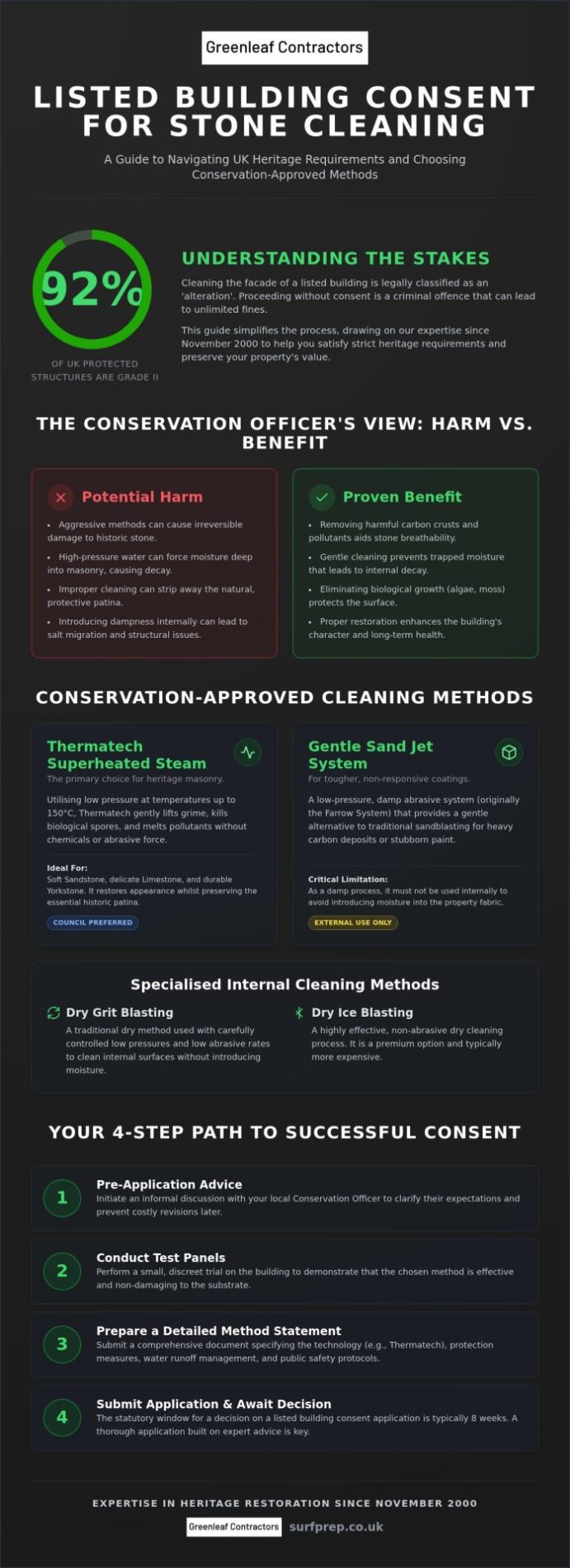
Under the Planning (Listed Buildings and Conservation Areas) Act 1990, any work affecting the character of a protected structure requires formal permission. This means that listed building consent for stone cleaning is mandatory; cleaning is legally classified as an “alteration” because it fundamentally changes the building’s aesthetic and physical state. For those Understanding Listed Buildings and their legal protections, it’s clear that the law prioritises the preservation of the historic fabric. It’s a criminal offence to start work without written consent, regardless of how gentle the method might be.
Conservation officers weigh the “harm vs benefit” of every proposal. While cleaning might seem purely aesthetic, removing heavy carbon crusts or biological growth actually aids stone breathability. This prevents moisture from becoming trapped, which would otherwise cause internal decay. We focus on proving that the long-term preservation benefits outweigh any temporary disruption, ensuring the building’s structural health is maintained.
The Role of the Conservation Officer and Test Panels
Your local Conservation Officer (CO) will typically require a small, discreet test panel before granting full permission. This trial demonstrates that the chosen method removes surface contaminants whilst the stone substrate remains unblemished. Since November 2000, Surfprep has worked alongside heritage authorities in Leeds and York to document these trials meticulously. We provide clear photographic evidence and detailed Method Statements that prove the stone’s integrity remains intact. This transparent approach builds trust with the CO, helping you secure listed building consent for stone cleaning whilst avoiding costly delays.
Selecting Approved Methods: Thermatech vs. Sand Jetting
Choosing the right equipment is critical for securing listed building consent for stone cleaning. We often recommend Thermatech superheated steam as the primary tool. Unlike high-pressure cold water, which can force moisture deep into the masonry and cause internal damage, Thermatech uses a low-pressure spray at temperatures reaching 150°C. This intense heat is incredibly effective at lifting grime and biological matter without the need for aggressive chemicals. For tougher coatings or heavy carbon deposits that steam alone cannot shift, our sand jet (originally the Farrow System) provides a gentle, low-pressure alternative to traditional sandblasting.
We believe in being transparent about technical limitations. Because both Thermatech and the sand jet are damp processes, we don’t recommend them for use inside properties. Introducing water into an internal environment can lead to long-term damp issues or salt migration. For indoor restoration, we prefer dry grit blasting at low pressures or dry ice blasting, though the latter is often a more expensive option. If you need guidance on specific internal requirements, you can speak with our team for an honest assessment of your building’s needs.
Why Councils Favour Superheated Steam for Masonry
Local authorities often specify superheated steam because it’s non-abrasive and environmentally friendly. It effectively kills biological spores and melts atmospheric pollutants whilst leaving the natural patina of the stone intact. This “reversibility” is a core principle of conservation; it restores the building’s appearance without permanently altering the historic fabric. Whether you’re working with soft Sandstone, delicate Limestone, or durable Yorkstone, Thermatech provides a controlled finish that satisfies the most stringent heritage requirements.
Navigating the Application Process for Practical Success
Securing listed building consent for stone cleaning requires a methodical approach that starts long before the machines arrive on site. We always recommend seeking pre-application advice from your local council. This informal discussion helps clarify the conservation officer’s expectations and can prevent costly revisions later. Once the groundwork is laid, your formal application must include a detailed Method Statement. This document is the cornerstone of your submission; it needs to specify the exact technology used, such as our Thermatech system, and outline how you will protect the surrounding area.
In dense urban environments like Manchester or Newcastle, logistical planning is just as important as the cleaning itself. You must demonstrate how you will manage water runoff and ensure public safety in busy thoroughfares. Since November 2000, we’ve refined these processes to ensure that every project meets both heritage standards and local health and safety regulations. We don’t just focus on the stone; we manage the entire site footprint to satisfy the planning authority’s requirements.
Avoiding Common Pitfalls in Historic Stone Restoration
A frequent error in restoration is the desire for a “brand new” look. Over-cleaning can strip away the natural patina that gives a building its historic character. We often admit that some deep-seated metallic stains should be left alone; forcing their removal can cause irreversible damage to the stone’s surface. For internal features where moisture is a risk, we avoid steam and the damp sand jet entirely. Instead, we utilise traditional dry grit blasting at exceptionally low pressures or dry ice blasting—though we recognise dry ice is an expensive option—to ensure your property remains dry and protected.
Secure the Future of Your Heritage Asset
Navigating the legalities of listed building consent for stone cleaning doesn’t have to be a source of anxiety. By choosing non-invasive technologies like Thermatech superheated steam and the sand jet, you satisfy the statutory requirement for reversibility whilst protecting the building’s long-term value. Since November 2000, we’ve acted as honest advisors for Grade I and II listed projects across the North, from Leeds to Hull. We understand that a successful application relies on technical precision and transparent communication with conservation officers. Whether you’re managing a commercial facade or a domestic restoration, our team provides the specialist expertise needed to achieve a clean, heritage-approved result without the risk of enforcement action. Contact our heritage restoration experts for a site survey and test panel to begin your restoration journey with confidence.
Frequently Asked Questions
Do I need consent just to wash my listed building with water?
Yes, you generally require permission. Even simple water cleaning is viewed as an alteration under the Planning Act 1990 because it changes the building’s character. Local authorities in cities like York or Beverley closely monitor any work that affects the historic fabric. Obtaining listed building consent for stone cleaning ensures your method is safe and prevents the risk of permanent substrate damage.
How long does the listed building consent process take for stone cleaning?
The statutory determination period for an application is 8 weeks from the date it is validated. However, if your project in Leeds or Manchester is particularly complex, this can extend to 13 weeks. From the initial pre-application advice to discharging final conditions, you should realistically budget between three to six months for the entire process to reach completion.
Can I use a pressure washer on a listed stone facade?
Standard high-pressure washing is rarely approved by conservation officers. It forces water deep into porous masonry, leading to salt migration and surface faces blowing. Instead, we utilise the Thermatech system for properties in Newcastle or Hull. This reaches 150°C at the nozzle using very low pressure, which melts away grime without the aggressive impact of cold water pressure washers.
Will cleaning my stone building improve its breathability and prevent damp?
Correct cleaning significantly improves a building’s health. Removing heavy carbon crusts or thick moss allows the natural stone to breathe, which is essential for managing moisture levels. For stubborn external coatings that block pores, our gentle sand jet system provides a safe solution. This prevents the damp issues associated with trapped water, helping to preserve the structural integrity of your property.
