
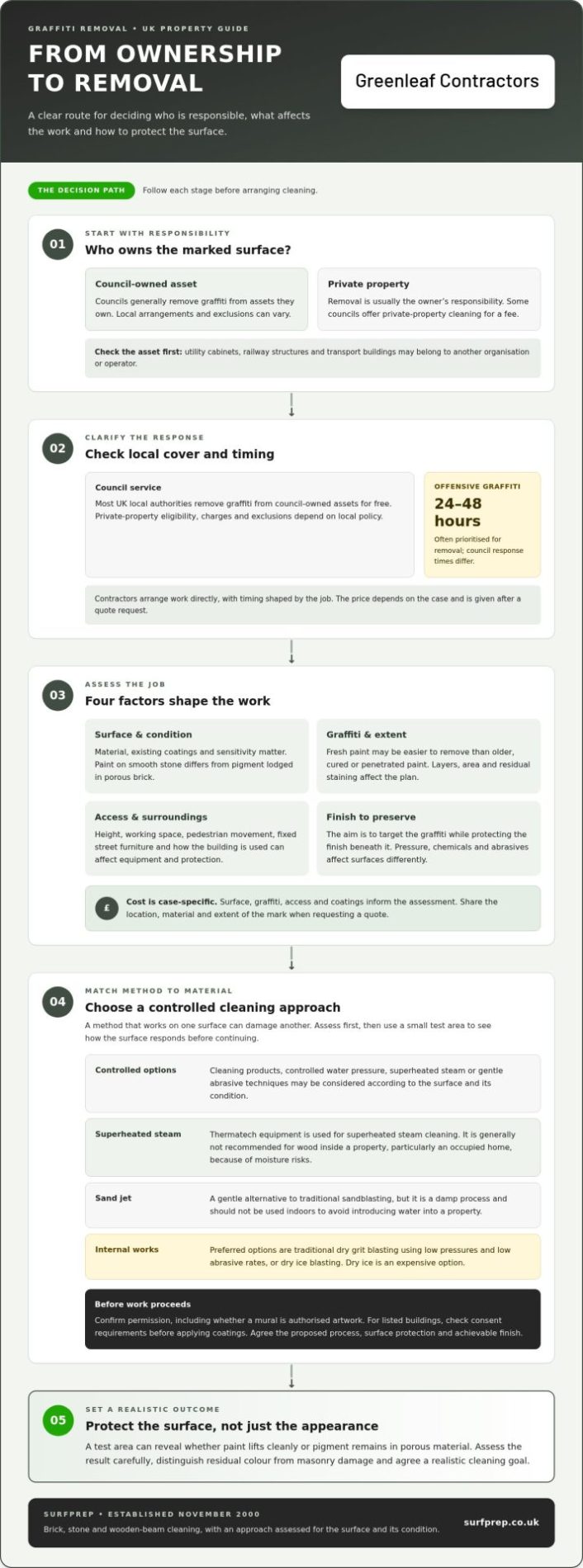
For private property, graffiti removal is usually the owner’s responsibility, while councils generally remove graffiti from assets they own; some authorities also offer private-property removal for a fee. The choice between professional graffiti removal and council services depends on who owns the surface, the type of graffiti and how quickly it needs attention.
Graffiti removal may involve cleaning products, controlled water pressure, superheated steam or gentle abrasive techniques. The right method depends on the surface and its condition: a process suitable for brick may damage stone or a delicate finish.
This guide compares professional graffiti removal vs council services, explains how removal methods differ and outlines when each may be suitable. For private property, the right approach depends on factors such as access, surface sensitivity and the finish you want to preserve.
Key Takeaways
- Start by identifying who owns the marked surface: councils generally handle their own assets, while private-property removal is usually the owner’s responsibility.
- Surface material, the type of graffiti and access to the area all affect the removal approach and the work involved.
- Before arranging removal, find out whether the council offers a service for private properties and whether charges may apply.
- Choosing a method suited to the surface helps avoid unnecessary damage and supports a cleaner finish.
How job costs depend on surface, graffiti and access
The surface determines which removal method is suitable and how carefully the work must be done. Paint on smooth stone behaves differently from pigment lodged in porous brick. An assessment considers the material, its condition and any existing coatings, so cleaning can target the graffiti while protecting the finish beneath it.
The graffiti itself also shapes the plan. Fresh spray paint may be easier to remove than older paint that has cured or penetrated the surface. Multiple layers, a large affected area and residual staining may each need a different treatment. Councils may prioritise offensive graffiti under local arrangements, but first establish whether it is on council property or privately owned premises.
Access affects the equipment and preparation required. A ground-level wall beside a shop entrance in Leeds presents different challenges from a mark high on a facade or behind fixed street furniture. Limited working space, pedestrian movement and how the building is used can all affect access and protection. Clarifying these details helps define the work before cleaning begins.
The price depends on the case and is given after a quote request; the surface, graffiti, access and coatings all inform the assessment. Share the location, material and extent of the mark when requesting a quote. UK local authorities derive graffiti-related powers and duties from the Environmental Protection Act 1990, according to The National Archives. The relevant city council’s provision depends on property responsibility, while privately arranged work follows a separate assessment.
Local authority teams may need specialist equipment to remove graffiti above head height. This can make elevated work a distinct access consideration during assessment when comparing professional graffiti removal vs council services.
Charges for graffiti removal
When comparing professional graffiti removal vs council services, first establish who owns the marked property and whether local arrangements cover it. Policies vary, so identify the asset before arranging cleaning.
Responsibility for different properties
Councils generally clean assets they own, while private-property owners usually arrange removal themselves. Responsibility for public buildings depends on ownership, and transport structures may have a separate operator. In Leeds, for example, identify whether a marked shelter, station structure or building belongs to the council, a transport body or a private owner before reporting it. This directs the request to the responsible organisation.
Eligibility for free council removal
Most UK local authorities remove graffiti from council-owned assets for free. Private-property removal is usually the owner’s responsibility, although some councils offer paid cleaning or recharge commercial owners. Ask the relevant authority about eligibility and exclusions. Offensive graffiti is often prioritised for removal within 24-48 hours, but response times differ between councils; professional contractors arrange work directly, with timing shaped by the job.
Council services commonly cover graffiti on council property, but exclusions depend on local policy and asset ownership. Report graffiti on utility cabinets or railway structures to the organisation responsible for that infrastructure.
When comparing professional graffiti removal vs council services, consider who controls the schedule and method. For contractor work, look for relevant experience, suitable insurance and clear environmental controls. Ask how the proposed process will protect paint, brickwork or historic masonry: abrasive cleaning, chemicals and pressure affect these surfaces differently. For listed buildings, check consent requirements before applying coatings.
Graffiti removal experience
A method that removes paint from one material can damage another. A specialist assesses the surface, the graffiti and its condition before choosing an approach. Comparing professional graffiti removal vs council services also means considering how the work is arranged: a private contractor can discuss the specific site with its owner, while council cleaning follows local arrangements.
A small test area can show how the surface responds before cleaning continues. On an older brick wall, for example, paint may lift while pigment remains in the pores. Careful assessment helps distinguish residual colour from damage to the masonry and set a realistic cleaning goal before work starts.
Permission is another practical consideration. A mural may be authorised artwork rather than vandalism, so establish ownership and approval before arranging its removal. Offensive graffiti may need prompt attention, but the method should still protect nearby finishes and avoid spreading paint across the surface.
Ask for a clear explanation of the proposed process, including how the surface will be tested and what finish is achievable. Professional graffiti removal vs council services also differs in who arranges the work: private owners can discuss their site directly with a contractor. Pressure washing may suit exposed paving, while delicate masonry needs more controlled treatment.
For graffiti on private property, Surfprep provides professional removal using a method suited to the surface.
Surfprep: Brick cleaning
Surfprep offers brick cleaning when graffiti marks private masonry beyond council provision. Established in November 2000, the business assesses the brick and its condition to determine a suitable cleaning approach.
Surfprep also cleans stone and wooden beams, and provides superheated steam cleaning using Thermatech equipment. This method is generally unsuitable for wood inside occupied homes because of moisture risks.
Share details of the affected surface and graffiti to discuss a suitable removal approach. Contact Surfprep to talk through the next step.
Take the next step towards a clean surface
Choosing between professional graffiti removal and council services also means deciding which outcome matters most: removing the visible mark, preserving the building’s character or preparing the surface for later work. Set that priority before arranging cleaning, so the discussion focuses on the result you need.
If you’d like to discuss the marked area and your preferred outcome, contact Surfprep about graffiti removal. A clear starting point can make the way forward easier to plan.
Frequently Asked Questions
How is graffiti removed?
Graffiti removal starts with choosing a method suited to the marked material, then lifting the paint while protecting the finish. Options include cleaning chemicals, controlled pressure, superheated steam and gentle abrasive cleaning. On a painted door, aggressive washing could remove the original coating too, so a discreet test area helps show how the surface responds before treatment continues.
What can I do if my property has graffiti on it?
First establish whether the wall, gate or structure belongs to you, a landlord, a council or a utility operator. Record the graffiti and any existing damage nearby. Avoid scrubbing with household solvents, which can spread pigment or affect the original finish. If you rent, notify the property owner before arranging cleaning.
What graffiti removal services do UK councils provide, and who can request them?
UK councils commonly clean graffiti from assets they own, while help with private property depends on each authority’s arrangements. Residents and property owners can report graffiti through the relevant council’s reporting channel, including its location and the type of asset. Utility and transport structures may fall outside council services, so identify the responsible operator before reporting them.
How do professional graffiti removal companies compare with council services in the UK?
Council provision usually follows local eligibility rules and focuses on council-owned assets. For privately owned surfaces, a property owner can arrange professional cleaning directly and have the method matched to the material. Surfprep serves property owners in Leeds, York, Hull, Bradford, Nottingham, Manchester, Derby, Lincoln, Newcastle, Durham, Scarborough and Beverley.
How much does professional graffiti removal cost in the UK?
The quote depends on the surface material, affected area, paint layers, access and existing coatings. A small mark on accessible brick needs a different assessment from extensive paint on delicate stone or a high wall. Sharing these details helps Surfprep assess the work and provide a relevant quote.
