
A cleaning method is only as good as the judgement behind it. To understand what to ask a brick cleaning contractor, ask why the proposed method suits the brick, its condition and the staining, rather than assuming that greater pressure means a better clean.
It’s reasonable to want clear answers before work starts, especially when cleaning involves water, chemicals or delicate masonry. This guide explains what to ask about DOFF-style steam cleaning, TORIK and superheated steam using a Thermatech machine, as well as protective equipment, chemical handling and specialist training. You’ll also learn what a sound assessment and method trial should involve, so you can understand how the contractor plans to protect the brickwork and the surrounding area.
Key Takeaways
- Ask how the proposed cleaning method suits the brick type, its condition and the staining, and whether a sample area will be tested first.
- Find out what protective equipment and chemical-handling precautions will be used, including how nearby surfaces and dirty water will be managed.
- Look for specialist experience with delicate masonry and ask how training informs the choice between steam, TORIK and other methods.
- Use relevant references, reviews and before-and-after examples to understand the contractor’s approach to comparable brickwork.
Personal protective equipment and chemical safety
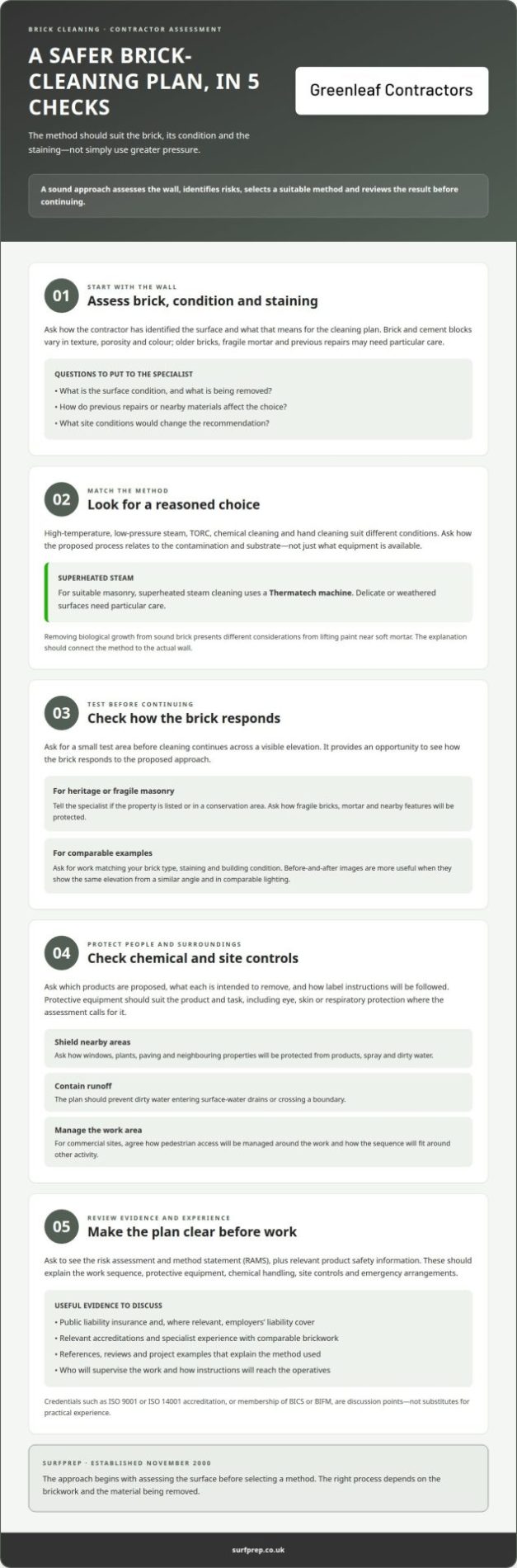
Ask which chemical products are proposed, what each is intended to remove, and how label instructions will be followed. The operative should use protective equipment suited to the product and task, including eye, skin or respiratory protection where the assessment calls for it. Ask whether the contractor has public liability insurance and, where relevant, employers’ liability cover. Request evidence and details of any relevant accreditations.
Protection starts before cleaning. Ask how windows, plants, paving and neighbouring properties will be shielded from cleaning products, spray and dirty water. A practical plan may include covering window frames, moving or covering nearby items, and containing runoff to prevent it entering surface-water drains or crossing a boundary. On a commercial site, agree how pedestrian access will be managed around the work area.
Heritage brickwork needs particular care because its condition and previous repairs can affect the safest approach. Tell the specialist if the property is listed or in a conservation area, and ask how fragile bricks, mortar and nearby features will be protected. Ask for a small test area first: this can show how the brick responds before cleaning continues across a visible elevation.
Ask to see the risk assessment and method statement (RAMS), plus the relevant product safety information. These should explain the work sequence, protective equipment, chemical handling, site controls and emergency arrangements. For graffiti removal, ask how the chosen product will be kept away from glass and planting. The brick cleaning service should include a clear plan for containing dirty water and protecting surrounding surfaces, not simply applying a cleaner and rinsing it away.
Contractor training and specialist expertise
Ask how the contractor assesses the wall and chooses a method. Old brickwork can be fragile, and previous repairs may respond differently from the original masonry. Brick and cement blocks vary in texture, porosity and colour, so the specialist should identify the surface, its condition and the stains before recommending a process. Ask what signs would lead them to change their recommendation.
The practical question of what to ask a brick cleaning contractor starts with how their experience applies to your wall. High-temperature, low-pressure steam, TORC, chemical cleaning and hand cleaning each suit different conditions. A clear explanation connects the method to the contamination and substrate, rather than treating every elevation alike. Removing biological growth from sound brick presents different considerations from lifting paint near soft mortar. Ask how surrounding materials affect the choice.
Ask whether the people doing the work have experience with comparable brick types and cleaning methods. You can also ask about credentials such as ISO 9001 or ISO 14001 accreditation, or membership of BICS or BIFM. These are useful discussion points, not substitutes for practical experience. Ask who will supervise the work and how instructions will reach the operatives.
Can I see references, reviews and before-and-after photos of similar work?
Ask for examples that match your brick type, staining and building condition. A photograph of clean, modern brick may tell you little about work on soft, weathered masonry. Before-and-after images are more useful when they show the same elevation from a similar angle and in comparable lighting. Ask which method was used and whether the photographs were taken before the wall had fully dried.
References add context that images cannot provide. Ask whether the contractor can show a nearby completed project and connect you with the person who managed the work. Ask how the finished surface looked, whether the agreed method was followed and how surrounding areas were protected. For a commercial building, a contract manager may also explain how cleaning was organised around access and daily operations.
Read reviews for specific details, not just star ratings. Comments about brick condition, stain removal, communication or site protection offer more useful evidence than general praise. Look for consistent descriptions across projects, then compare them with the proposed approach for your property. Reviews cannot establish that different masonry will produce the same result, but they can show how the contractor explains decisions and carries out the work.
Keep the comparison practical: ask for a relevant reference, inspect the closest available example, then discuss what differs from your own wall. If you’re planning brickwork cleaning in Leeds, York, Hull or elsewhere in the region, contact Surfprep to discuss the project and the evidence you’d like to see.
Surfprep: Brick cleaning
Surfprep can help when brickwork needs cleaning and the method must suit its condition. Established in November 2000, the business assesses the surface before selecting an approach, rather than assuming one technique fits every wall.
For suitable masonry, superheated steam cleaning uses a Thermatech machine. DOFF is a familiar search term, but Surfprep uses Thermatech equipment. The right approach depends on the brickwork and the material being removed; delicate or weathered surfaces need particular care. Surfprep also handles stone cleaning and wooden beam cleaning, with methods chosen for the material and setting.
If you’re considering work, share details of the brickwork, staining and property so the requirements can be discussed clearly. Explore brick cleaning, or contact Surfprep to discuss your project.
Take the next step with confidence
The questions you ask can turn an uncertain cleaning job into a clear plan. Before arranging work, note which areas need attention, what stains or previous treatments are present, and any access concerns. This gives the conversation a practical starting point and keeps the focus on the condition of the masonry.
Knowing what to ask a brick cleaning contractor helps you explain what matters most, whether that’s preserving older brickwork or improving a tired exterior. Surfprep provides brick, stone and wooden beam cleaning, with the approach suited to the material and project.
Contact Surfprep about brick cleaning to discuss your property and take the next step with confidence.
Frequently Asked Questions
What qualifications and experience should a brick cleaning contractor have in the UK?
Look for task-specific training and practical experience with brickwork similar to yours. Ask how the team handles differences between modern facing brick and older, softer masonry, and who supervises the cleaning. A useful example is a contractor explaining how they would adapt their approach to historic brickwork in York compared with a newer wall in Leeds.
What brick cleaning methods will the contractor use, and are they suitable for my brick type?
The method should match the brick, its condition and the deposits being removed. Options can include high-temperature, low-pressure steam, TORC, chemical cleaning or hand cleaning. Ask why the chosen process suits your wall and what alternatives were considered. For steam cleaning, clarify the equipment being used: Surfprep uses a Thermatech machine for superheated steam cleaning.
What should a brick cleaning quote include, and are there extra charges?
A clear quote should identify the surfaces covered, proposed method, preparation, protection, access equipment, test cleaning, waste collection and exclusions. Ask how changes are handled if access differs from the original assessment or hidden damage becomes visible. The cost depends on the property’s size, access, method and cleaning requirements, and is provided after a quote request.
What risks can brick cleaning cause, including damage to brickwork or mortar?
Unsuitable pressure can damage soft brick faces, drive water into masonry or remove sound mortar. Acidic products can also weaken or stain porous brickwork if handled carelessly. Ask how the contractor will avoid these risks on your particular wall, especially where previous repairs or weathering have left areas vulnerable. The safest choice depends on both the surface and the contamination.
What permissions or rules apply to cleaning listed buildings or properties in conservation areas?
In many cases, brick cleaning in the UK does not require planning permission, but listed properties and buildings in conservation areas may need it. Tell the cleaning specialist about the property’s status before work is planned. For a home in Hull, Bradford or another conservation area, establish whether permission applies before arranging cleaning, as requirements depend on the property and proposed work.
