
Discovering spray paint on a beautiful sandstone wall can be disheartening. Your first instinct might be to scrub or pressure wash the graffiti away, but these common methods can cause irreversible damage to this delicate, porous stone. Sandstone’s unique structure means that paint doesn’t just sit on the surface; it soaks deep into the stone itself, making removal a specialist task.
This guide moves beyond risky DIY tactics to explain the professional, conservation-grade techniques required for safely removing spray paint from sandstone. We will explore why methods that work on harder surfaces will fail here, and how to restore your stonework without causing spalling, staining, or permanent scarring.
Table of Contents
Understanding Sandstone Porosity and the Risks of Improper Removal
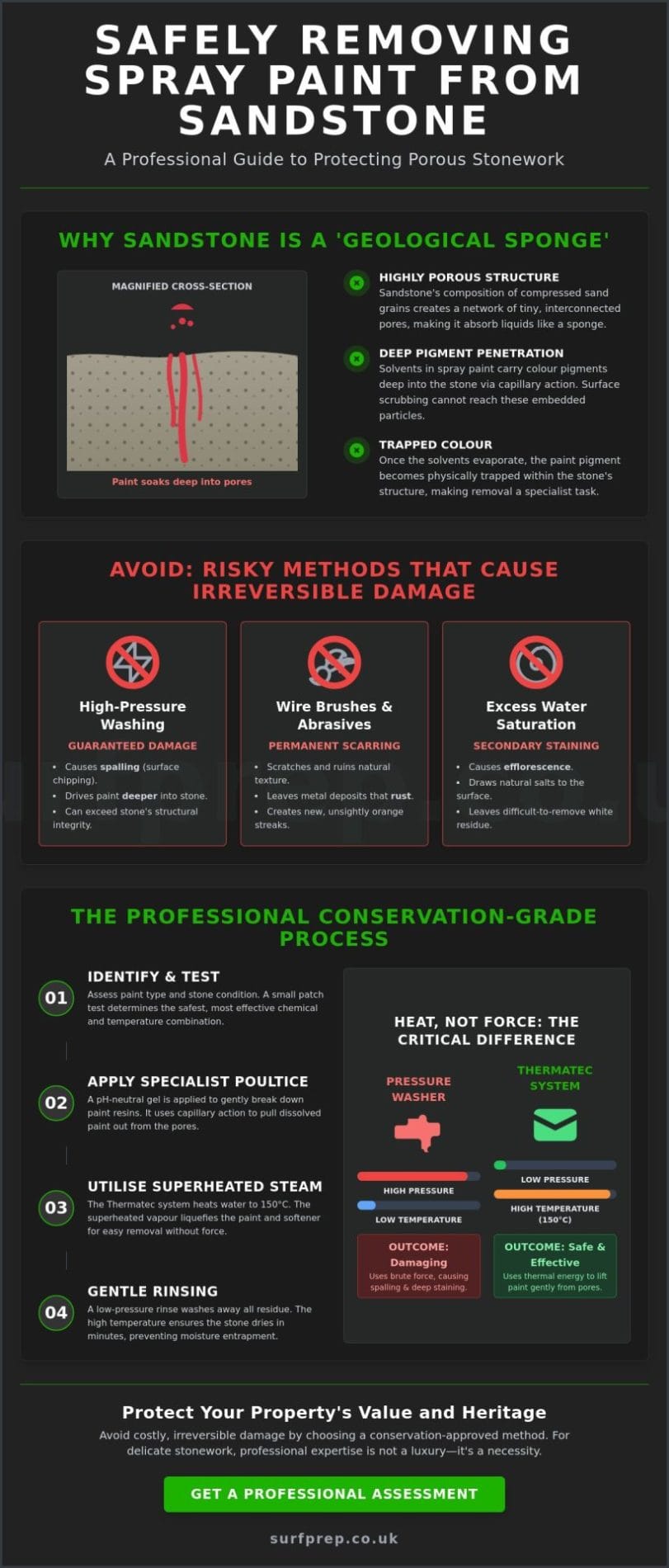
To understand why graffiti is so difficult to remove from sandstone, you must first appreciate the nature of the stone itself. Sandstone is a sedimentary rock, formed from compressed grains of sand. This composition gives it a high level of porosity, meaning it is filled with a network of tiny, interconnected pores.
A Geological Sponge: Think of sandstone as a ‘geological sponge’. When spray paint is applied, the solvents in the aerosol carry the pigment deep into these pores through capillary action. This is why surface-level scrubbing is often ineffective; it only removes the top layer of paint, leaving the rest embedded within the stone.
Deep Pigment Penetration: The solvents are designed to dry quickly, but before they evaporate, they act as a vehicle, driving the colour deep into the stone’s structure. Once the solvents cure, the pigment becomes trapped.
Varying Densities in UK Stone: Sandstone found across Northern England, such as the ubiquitous Yorkstone, has varying levels of density and porosity. Softer, more porous types are particularly vulnerable to aggressive cleaning methods that can dislodge the sand grains and destroy the stone’s face.
The Expert Admission: Whilst a very small, fresh spot of paint might be partially lifted with a soft-bristled brush and a suitable cleaner, any large-scale or dried graffiti almost always requires a change in the stone’s thermal state to break the paint’s bond without using destructive force.
The Hazards of High-Pressure Washing and Wire Brushes
Many property owners unknowingly reach for tools that cause more harm than good. High-pressure water and abrasive scrubbing are the two biggest culprits behind permanently damaged sandstone.
High-Pressure Water Damage: A cold-water pressure washer directs a powerful, focused jet onto the stone. This force can easily exceed the stone’s structural integrity, causing it to ‘spall’—a process where the surface flakes or chips away. Worse still, the pressure can drive the liquefied paint even deeper into the pores, turning a surface problem into a deep-set stain.
Permanent Scarring from Wire Brushes: Using a wire brush is a guaranteed way to ruin a sandstone surface. The metal bristles will not only scratch and alter the natural texture of the stone forever but can also leave behind tiny metallic deposits that rust over time, creating new, unsightly orange and brown streaks.
Risk of Efflorescence: Amateur cleaning often involves over-saturating the stone with water. As this excess water evaporates, it can draw natural mineral salts to the surface, leaving behind a white, powdery deposit known as efflorescence. This staining can be very difficult to remove.
A Step-by-Step Guide to Safe Paint Removal on Sandstone
Professional graffiti removal is a methodical process that prioritises the health of the stone. It relies on chemistry and thermal energy rather than brute force. Here is the proven, conservation-approved approach.
Step 1: Identify and Test: The first step is always to assess the type of paint and the condition of the sandstone. A professional will then perform a small patch test in an inconspicuous area to determine the most effective combination of chemical softener and temperature.
Step 2: Apply a Specialist Poultice or Softener: A pH-neutral chemical gel or poultice, designed specifically for porous masonry, is applied to the affected area. This is left to dwell, allowing it to gently break down the paint’s resins without harming the stone.
Step 3: Utilise Superheated Steam: Using a system like Doff or Thermatec, water is heated to temperatures of up to 150°C. This superheated steam is then applied at extremely low pressure. The heat liquefies the paint and the chemical softener, allowing them to be lifted from the pores without any mechanical force.
Step 4: Gentle Rinsing: Finally, a low-pressure rinse washes away the emulsified paint and cleaning agent, leaving a clean and undamaged surface. The high temperature means the stone dries within minutes, preventing moisture from becoming trapped.
The Role of Chemical Poultices
A poultice is a crucial tool for drawing stubborn stains out of porous materials. It works by reversing the process that put the paint there in the first place.
How Poultices Work: A poultice is a paste-like substance that is applied to the graffiti and covered. As it dries, it uses capillary action to ‘pull’ the dissolved paint out of the stone’s capillaries and into itself. The poultice is then peeled away, taking the stain with it.
A Crucial Warning: It is vital to use the correct chemical. Acidic cleaners can react with iron minerals naturally present in many UK sandstones, causing permanent orange or brown staining. Always opt for pH-neutral solutions. For complex heritage projects, expert advice is essential. You can learn more about our approach to professional stone cleaning services here.
The Thermatec System: Why Superheated Steam is the Gold Standard
For delicate surfaces like sandstone, particularly on historic or listed buildings, superheated steam cleaning (sometimes specified as DOFF) is the preferred method of conservation officers and restoration specialists.
The Process: The Superheated Steam system heats water to 150°C but delivers it as a gentle vapour with the pressure of a handshake. This allows for precise, non-abrasive cleaning.
Heat Over Friction: The high temperature does the work, breaking the bond between the paint and the stone substrate. This is fundamentally different from pressure washing, which uses force. Heat emulsifies the paint, allowing it to be rinsed away easily.
Conservation Approved: This gentle yet highly effective method is frequently specified by conservation bodies for cleaning listed buildings in heritage-rich cities like York and Manchester, making it the benchmark for safe restoration. For those responsible for such properties, understanding the best practices is key, as detailed in our guide to listed building exterior cleaning.
Eliminating Graffiti Ghosting and Protecting the Surface
Even after the main layer of paint is gone, a faint shadow or silhouette can sometimes remain. This is known as ‘ghosting’, and it requires a final, specialist step to fully eradicate.
What is ‘Ghosting’?: Ghosting is caused by the finest pigment particles that have penetrated the deepest pores of the sandstone. These microscopic particles are all that remain after the bulk of the graffiti has been removed.
Specialised Shadow Removers: To tackle this, technicians use dedicated ‘shadow remover’ gels. These products are formulated to break down the final traces of pigment without altering the colour or texture of the stone.
Achieving a Uniform Finish: A skilled professional will also blend the cleaned area with the surrounding masonry. The goal is a clean wall, not a ‘patch’ that looks unnaturally pristine compared to the rest of the building.
Timing is Everything: Fresh graffiti is significantly easier to remove. The longer it is left, especially in direct sunlight, the more the solvents will cure and cross-link with the stone grains, making removal more challenging. Also, graffiti on a wall attracts more…
Anti-Graffiti Coatings: To Seal or Not to Seal?
For properties in high-risk areas, applying a protective coating can make future graffiti removal much simpler. We typically start to recommend coatings after we have returned to the same place two or three times. However, the wrong type of coating can trap moisture and cause severe damage to the sandstone.
‘Sacrificial’ vs. ‘Permanent’ Coatings: A sacrificial coating is a clear, biodegradable layer that sits on the stone’s surface. If the wall is vandalised, the coating is removed using hot water, taking the graffiti with it. It must then be reapplied. A permanent coating creates a non-stick surface from which graffiti can be wiped away multiple times before the coating needs reapplication.
Crucial Warning: Breathability is Non-Negotiable: Any coating applied to sandstone must be ‘breathable’ or vapour permeable. This allows moisture vapour from within the stone to escape. A non-breathable sealer will trap this moisture, which can lead to spalling, salt damage, and mould growth during freeze-thaw cycles.
Maintenance Schedules: We recommend that commercial properties in high-traffic city centres like Leeds or Newcastle establish a regular maintenance schedule for inspecting and reapplying these coatings as needed.
When to Call the Professionals
Whilst the temptation to tackle the problem yourself is understandable, certain situations absolutely require professional intervention to avoid costly mistakes.
Signs a Project is Beyond DIY: If you are dealing with a large surface area, the building has historic or listed status, or the paint is very old and has been baked on by the sun for years, it is time to call in an expert.
Expertise in UK Stone: Surfprep has extensive experience in specialist graffiti removal from sensitive masonry across the North of England. Our technicians understand the unique properties of local bricks and regional sandstones.
Get a Professional Assessment: Don’t risk the integrity of your property. If you are facing a graffiti problem on a sandstone surface, please contact our team today for a professional site assessment and a no-obligation quote.
Frequently Asked Questions
Can I use household bleach to remove spray paint from sandstone?
No, you should never use household bleach on sandstone. Bleach is a harsh, corrosive chemical that can react with the minerals in the stone, leading to permanent discolouration, patchiness, and a weakening of the surface. It is also largely ineffective at dissolving modern aerosol paints.
How long does it take to professionally remove graffiti from a stone wall?
The time required depends on several factors: the size of the graffiti, the type of paint used, the porosity of the sandstone, and its overall condition. However, a professional team can often treat a standard-sized tag or section of graffiti within a few hours to a single day.
Will removing the paint leave a permanent mark or ‘shadow’ on my sandstone?
When using improper methods like aggressive scrubbing or high-pressure washing, permanent marks and shadows are highly likely. Professional techniques using superheated steam and specialist ghosting removers are designed specifically to lift the paint out of the stone’s pores, significantly minimising the risk of a shadow and aiming for a complete, uniform restoration.
Is it possible to remove old, dried spray paint that has been there for years?
Yes, it is possible. Whilst more challenging than fresh graffiti, old and sun-baked paint can be removed. This process typically requires longer dwell times for chemical poultices and the expert application of superheated steam to break down the deeply cured resins; or maybe even the use of our sand jet machine. It is a job best left to experienced restoration specialists.
