
That heavy, black coating on your ceiling timbers isn’t “antique charm”; it’s often just decades of suffocating grime that makes a room feel small and oppressive. We recognise the frustration of sticky surfaces that act as magnets for dust, yet the prospect of applying harsh chemicals to centuries-old structural oak (the heart of your home) is rightly terrifying. Removing wax and polish buildup from old beams is a delicate operation that requires a specialist’s eye to reveal the natural grain whilst protecting the wood. Since November 2000, we’ve seen many homeowners damage their property by using the wrong methods.
This guide explains how to safely strip those dark layers to brighten your space. You’ll learn why we strictly avoid steam or wet sand jets indoors, focusing instead on precise dry grit blasting and the premium option of dry ice blasting (which is effective but can be expensive) for a perfect finish.
Key Takeaways
- Understand how decades of accumulated beeswax and soot “suffocate” historical timbers, masking the natural grain and making your living space feel dark and oppressive.
- Discover the safest professional methods for removing wax and polish buildup from old beams using dry, low-pressure techniques that protect the wood’s structural integrity.
- Learn why we strictly advise against using superheated steam or damp sand-jetting for interior restoration to prevent moisture-related damage like rot or swelling.
- Realise how a precise, moisture-free strip reveals the original “honey” tones of centuries-old oak, providing a clean surface ready for modern, breathable oils.
The Challenge of Historical Wax and Polish Buildup
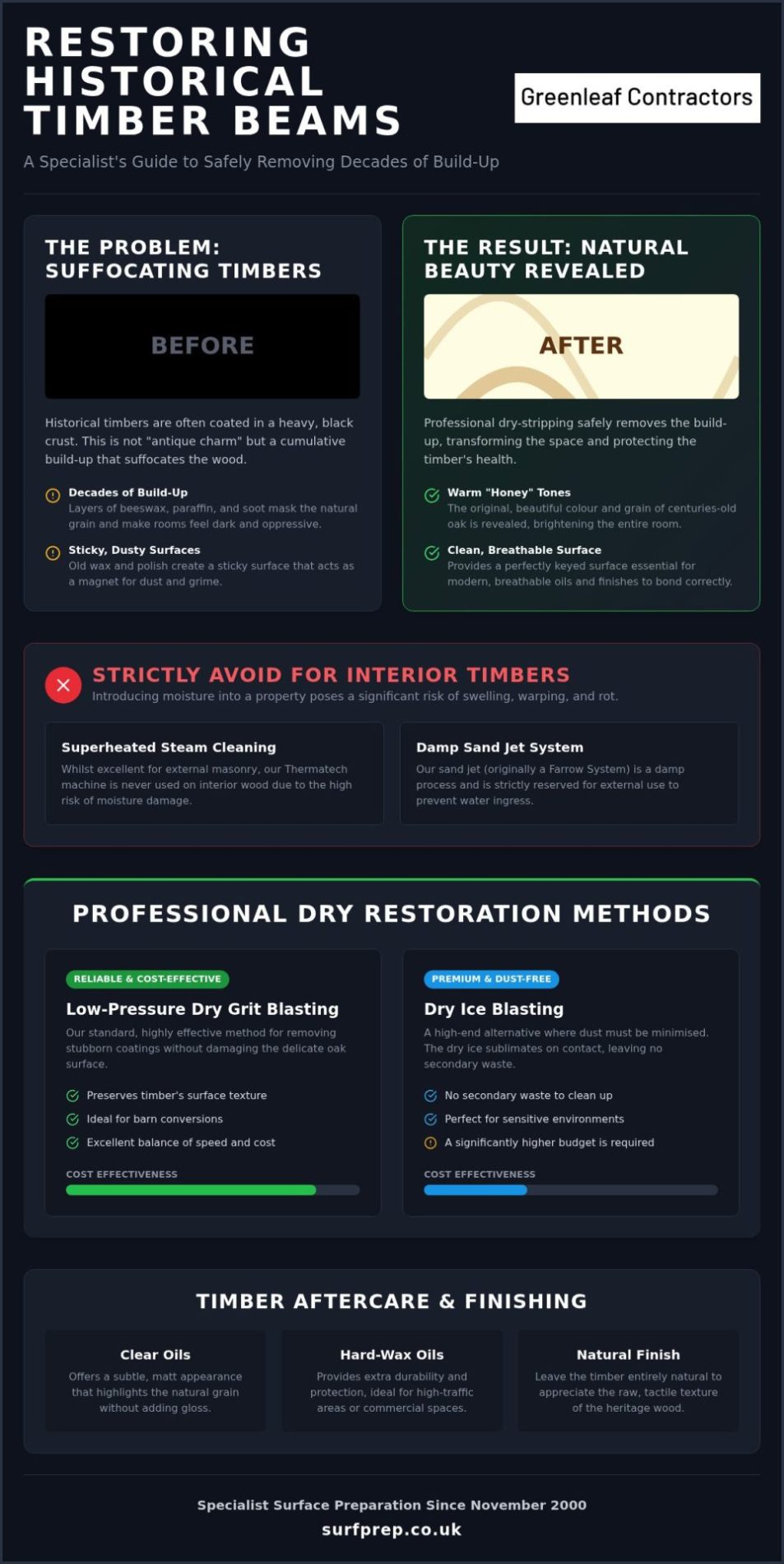
Historical timbers in many UK properties suffer from a heavy, darkened appearance that was once considered desirable but now feels oppressive. This isn’t the natural colour of the oak; it’s the result of decades of beeswax, paraffin, and soot from open fires. Polish buildup is a cumulative layer of oxidised fats and environmental pollutants. This thick crust effectively suffocates the timber, masking the intricate grain and making rooms feel significantly smaller and darker than they should.
Whilst some homeowners attempt removing wax and polish buildup from old beams using wire wool and white spirit, these DIY methods often fail on hardened surfaces. They tend to smear the wax rather than lift it, creating a sticky mess that attracts more dust amongst the rafters. Since our founding in November 2000, we’ve seen how these manual efforts often lead to frustration when faced with industrial-grade historical coatings.
Identifying Different Types of Timber Coatings
Distinguishing between a thin wax finish and heavy professional buildup is crucial before removing wax and polish buildup from old beams. A thin layer might feel slightly tacky to the touch, whereas heavy buildup often looks like a hard, shell-like coating that hides the wood’s texture entirely. Understanding the various types of wood finishes is essential, as different materials require specific pressures and abrasive rates to strip safely without gouging the structural timber.
The Polyurethane Problem
A common issue we encounter is modern polyurethane varnish applied directly over old wax. This creates a brittle, flaky mess because the varnish cannot bond to the greasy substrate. It often results in a patchy, “leopard spot” appearance that is nearly impossible to fix without a professional, dry abrasive approach. We always recommend a complete strip to the bare wood to ensure any new, breathable finish can adhere correctly to the surface.
Professional Methods for Interior Beam Restoration
We take an “Honest Specialist” approach to internal timber. Whilst we utilise Thermatech superheated steam for external masonry, it’s never the right tool for interior wood. Introducing water into an occupied home creates significant moisture risks. Damp timber can swell, warp, or even encourage hidden rot within the structural frame. For removing wax and polish buildup from old beams, we prioritise dry methods that respect the building’s integrity. Since we started in November 2000, we’ve remained transparent about why damp processes like the sand jet (originally acquired as a Farrow System) are strictly for external use.
Our standard methodology involves traditional dry grit blasting at exceptionally low pressures. By carefully controlling the abrasive rate, we can strip decades of grime without damaging the delicate oak beneath. This precision is vital for heritage properties where the timber’s surface texture must be preserved. For projects where dust must be kept to an absolute minimum, dry ice blasting is a premium, albeit expensive, alternative that sublimates on contact, leaving no secondary waste to clear up.
Dry Grit Blasting vs Dry Ice Blasting
Low-pressure dry grit blasting remains the “Reliable Veteran” choice for barn conversions because it offers the best balance of speed and cost. It’s highly effective for removing wax and polish buildup from old beams, cutting through stubborn layers that other methods simply smear. In contrast, dry ice is cleaner but requires a significantly higher budget due to the cost of the media and specialised logistics. You can learn more about our specialised wood cleaning services to see which method suits your specific property and budget. Choosing the right path ensures your beams are restored without risking the structural health of your home.
Restoration Results and Timber Aftercare
Once we finish removing wax and polish buildup from old beams, the transformation is often startling for our clients. The oppressive, black crust that once dominated the room gives way to the warm, “honey” tones of original oak. This isn’t just an aesthetic improvement; it’s a vital step for the timber’s health. A professional dry-strip provides a perfectly keyed, clean surface that is essential for modern, breathable finishes to bond correctly. Since November 2000, we’ve helped homeowners realise that their dark ceilings aren’t a permanent feature but a layer of history waiting to be lifted.
You have several choices for the final finish. Clear oils offer a subtle matt appearance that highlights the natural grain, whilst hard-wax oils provide extra durability. Some clients prefer leaving the timber entirely natural to appreciate the raw, tactile texture of the heritage wood. If you’re unsure which path to take, you can contact us for a professional assessment in York or Leeds. We’ll examine your specific timbers and recommend a solution that balances protection with your desired look.
Lightening Dark Beams Safely
Achieving a lighter look doesn’t require harsh chemical bleaches. These substances can degrade wood fibres and leave a chalky, unnatural residue. Our low-pressure dry grit blasting achieves a bright, clean finish mechanically, which is far safer for the timber’s longevity. In older properties, it’s vital to let the beams “breathe”. By removing wax and polish buildup from old beams and avoiding non-breathable varnishes, you prevent moisture from becoming trapped within the structural frame. This is especially important in occupied houses where internal humidity levels fluctuate daily.
Transforming Your Historical Timbers
Restoring heritage wood is a significant task that requires technical precision and respect for the building’s fabric. We’ve seen how the right dry-stripping approach breathes new life into a room, turning dark, oppressive ceilings into bright architectural features. By prioritising low-pressure dry grit blasting over moisture-heavy methods, you protect your structural oak from the risks of rot or swelling. Since November 2000, we’ve operated as honest specialists across Leeds, York, and the North, ensuring every project benefits from our 25 years of surface preparation expertise. If you’re ready to begin removing wax and polish buildup from old beams to reveal the beautiful honey tones beneath, we’re here to help. Our team uses specialised equipment to deliver results that last for generations. You can request a professional timber restoration quote from Surfprep today. Your home’s original character is waiting to be rediscovered.
Frequently Asked Questions
Is it possible to remove wax from beams without making a mess?
Yes, though any abrasive process produces dust. We use heavy-duty sheeting and extraction to contain the workspace in homes from York to Leeds. For projects requiring a cleaner finish, dry ice blasting is a premium alternative that sublimates into gas, leaving only the removed wax to clear up. We’ve managed these logistics for over 25 years to protect your interior.
Will professional grit blasting damage the original surface of my old beams?
Damage is avoided by using the correct pressures and media. Our specialists use low-pressure dry grit blasting for removing wax and polish buildup from old beams, ensuring the historical surface remains intact. This process reveals the original grain without the aggressive pitting associated with traditional sandblasting. It’s a precise method we’ve perfected since November 2000 to preserve heritage timbers across the North.
How long does it take to strip the wax from a typical room of beams?
A standard room typically takes one to two days to complete. The exact timeframe depends on the thickness of the accumulated wax and the height of the ceilings. A complex barn conversion in Hull or Beverley may require more detailed work than a simple cottage lounge. We assess each project individually to provide an accurate schedule that respects your daily routine.
Can I use steam cleaning to remove wax from my interior timbers?
No, you shouldn’t use superheated steam systems like Thermatech for interior wood. Whilst we use this technology for external masonry in Manchester or Newcastle, moisture causes indoor beams to swell and warp. As honest specialists, we only recommend dry blasting methods for internal works. This avoids introducing water into occupied properties and prevents long-term structural issues like rot or wood movement.
