
Did you know that a building’s exterior typically accounts for between 13% and 20% of its total embodied carbon? It is a significant figure that highlights why retail park facade maintenance is about much more than just scrubbing away atmospheric pollution or unsightly graffiti. We know the pressure you’re under; tenants expect a pristine environment to attract footfall, yet there is often a nagging fear that a heavy-handed cleaning crew might permanently scar expensive brickwork or delicate stone. Since we founded this business in November 2000, we’ve seen far too many “quick fixes” lead to long-term damage that ends up costing far more than the original restoration.
You’re right to be cautious about high-pressure methods that risk driving water deep into the building fabric. This guide promises to walk you through the specialist restoration strategies that actually work, focusing on methods that preserve your asset’s value and shopper appeal. We’ll preview the shift towards “fabric-first” restoration (which aligns with the latest RICS Whole Life Carbon Assessment guidelines) and explain why we utilise Thermatech superheated steam. While many in the industry search for DOFF cleaning, we’ve found that the Thermatech system provides the superior control needed to comply with the August 2026 GB CLP hazard standards and mandatory DEFRA waste tracking coming in October 2026.
Key Takeaways
- Understand why a proactive approach to retail park facade maintenance is three times more cost-effective than reactive repairs, ensuring long-term preservation of the building fabric.
- Learn to distinguish between superheated steam (Thermatech/Doff) and abrasive sand jet cleaning to ensure the correct method is applied to specific masonry or stubborn carbon build-up.
- Explore the direct correlation between a clean, inviting exterior and the brand value of premium tenants, which is essential for maintaining high occupancy levels.
- Gain clarity on meeting 2026 UK environmental and safety regulations, ensuring your maintenance programme remains compliant with updated chemical and waste tracking laws.
- Master the logistics of out-of-hours scheduling and pedestrian exclusion zones to maintain site safety without disrupting daily retail operations.
Strategic Approaches to Retail Park Facade Maintenance
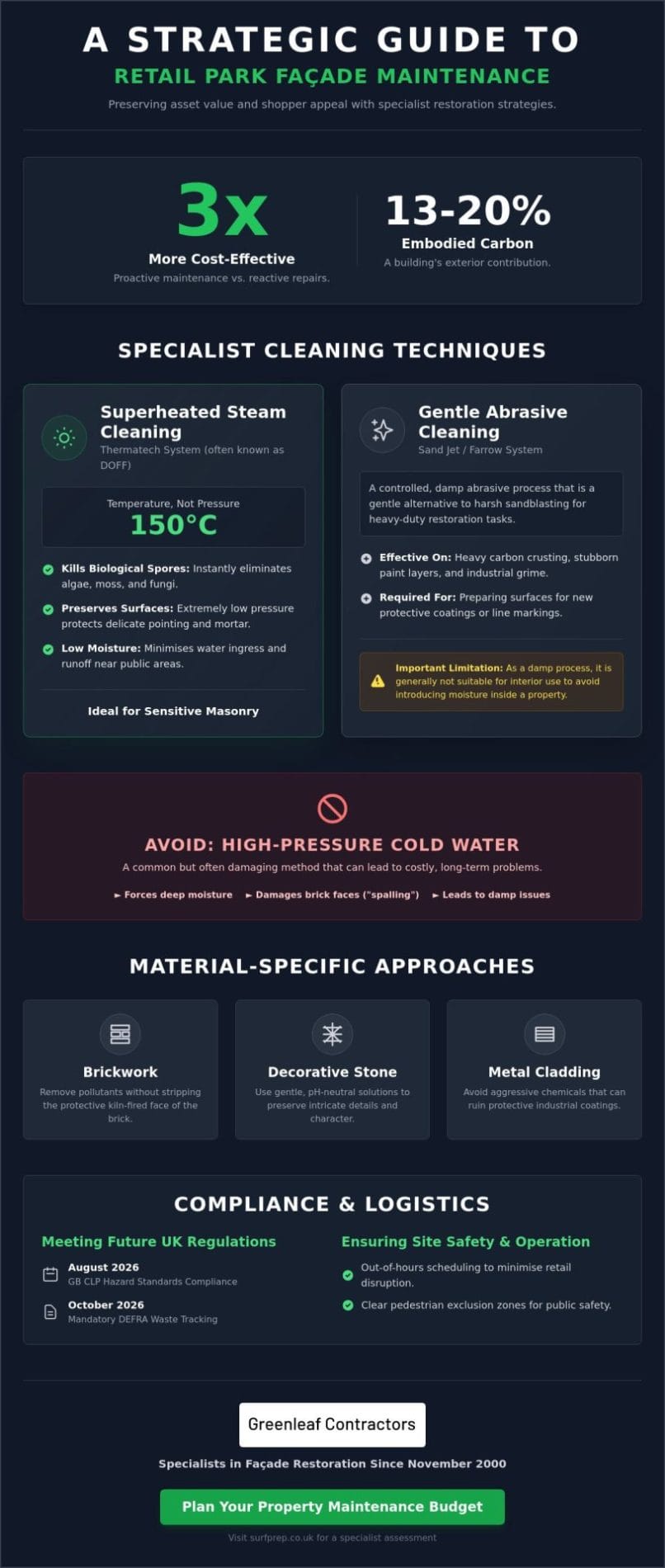
The kerb appeal of a retail park directly influences consumer behaviour. High-profile tenants like M&S, Next, or Argos rely on a premium physical environment to uphold their brand standards. If the facade looks neglected, shoppers often assume the same of the service inside. Effective retail park facade maintenance isn’t just a cleaning task; it’s a strategic asset management tool. Since our establishment in November 2000, we’ve consistently observed that preventative maintenance is roughly three times more cost-effective than waiting for a failure to occur. By the time carbon crusting or atmospheric pollution becomes visible to the naked eye, the underlying building fabric may already be suffering.
Integrating these works into a long-term plan is essential for any asset manager. We recommend planning your property maintenance budget with a five-year outlook rather than treating it as an ad-hoc expense. This approach ensures that costs are predictable and the building remains a welcoming environment for footfall.
Preventative vs. Reactive Maintenance Models
Reactive repairs often involve emergency scaffolding and expensive structural interventions. In contrast, annual inspections allow us to catch early signs of masonry decay or cladding oxidation before they lead to water ingress. Your cleaning frequency should depend on local environmental factors. A retail park in a congested city centre will accumulate particulates far faster than a rural site. We help landlords establish a “fabric-first” cycle that prioritises the building’s health alongside its aesthetics.
Material-Specific Considerations: Brick, Stone, and Cladding
Every material requires a unique touch. Our commercial brick cleaning services focus on removing pollutants without stripping the kiln-fired face of the brickwork. For older developments featuring decorative stone, we use gentle techniques to preserve intricate details that define the building’s character. Modern metal cladding presents a different challenge altogether, as aggressive chemicals can easily ruin protective coatings. Whether you require sand jet cleaning for heavy carbon deposits or a lighter steam approach, the goal is always long-term preservation.
Specialist Cleaning Techniques for Commercial Exteriors
Choosing the correct restoration technique is the difference between a successful retail park facade maintenance project and an expensive insurance claim. Since we established this business in November 2000, our philosophy has remained consistent: we always utilise the gentlest method that delivers the required result. Whilst many contractors default to high-pressure cold water, we know this often forces moisture deep into the substrate, leading to damp issues or “blown” brick faces. Transparency is key here; we will always tell you if a surface is too delicate for certain methods, even if it means a slower process. For sensitive stone cleaning, we prioritise pH-neutral solutions that lift grime without causing chemical burns to the masonry.
Superheated Steam (Doff) for Sensitive Masonry
We primarily utilise the Thermatech system (which many clients recognise by the industry term DOFF cleaning) to deliver steam at 150°C. This intense heat kills biological spores, such as algae and moss, instantly. Because the system relies on temperature rather than impact, the pressure remains extremely low. This protects the integrity of pointing and mortar joints whilst ensuring the surface is left sterile. It is a low-moisture approach, making it ideal for retail environments where you want to avoid large volumes of water runoff near shop entrances.
Abrasive Systems for Industrial Surface Preparation
Sometimes steam isn’t enough. For stubborn paint layers or heavy carbon crusting on industrial brickwork, we employ the Farrow system or sand jet cleaning. These methods are essential for heavy-duty restoration where you need to strip back years of grime to reveal the original surface. This level of preparation is often required before applying new protective coatings or refreshing line markings in delivery bays. If you are unsure which method suits your specific cladding, we can provide a specialist assessment to determine the safest route forward.
Maintaining these standards is part of a wider commitment to safety. Whilst the UK has its own stringent regulations, looking at international frameworks like the Façade Inspection & Safety Program highlights the global emphasis on structural integrity through professional cleaning. Proper maintenance ensures your building remains compliant with modern safety expectations whilst looking its best for every visitor.
Logistics, Safety, and Compliance in Retail Environments
Executing retail park facade maintenance on a live site requires more than just technical skill; it demands meticulous logistical planning. Since we founded our business in November 2000, we’ve learnt that the most successful projects are the ones shoppers never actually see happening. The strategic objective is always improving business curb appeal whilst ensuring the site remains fully operational and safe for every visitor.
Minimising Disruption to Tenants and Shoppers
High-footfall environments don’t stop for maintenance. To protect the trading hours of your tenants, we specialise in night-shift and out-of-hours working. Our teams use phased schedules to ensure car park spaces and main entrances remain accessible during the day. We also prioritise low-noise equipment. Using Thermatech superheated steam (frequently referred to as DOFF cleaning) allows us to work efficiently without the deafening roar of traditional industrial machinery. Clear communication with store managers is a staple of our service, ensuring everyone knows exactly when and where we’ll be working.
UK Standards and Regulatory Compliance
Compliance is a moving target in 2026. We strictly adhere to British Standards (BSI) for masonry restoration, but we also look ahead to upcoming legal shifts. For instance, all our cleaning agents are being transitioned to meet the updated GB CLP hazard standards required by 15 August 2026. This commitment extends to the mandatory DEFRA digital waste tracking, which becomes a legal requirement in October 2026. Every project is backed by site-specific RAMS (Risk Assessments and Method Statements). This level of detail is why choosing a specialist contractor with a long-standing history is safer than hiring a generalist. We understand the complexities of working at height and the necessity of robust pedestrian exclusion zones to keep the public out of harm’s way.
Protecting Your Commercial Assets with Professional Care
Effective retail park facade maintenance is a continuous commitment to both aesthetics and structural health. By adopting a fabric-first approach and utilising specialist Thermatech superheated steam (often sought out as DOFF cleaning), you ensure that your property remains a premier destination for shoppers whilst staying ahead of the stringent 2026 safety and environmental regulations. We’ve spent over two decades refining these processes, ensuring every project balances technical precision with the logistical needs of a busy retail environment.
Since we founded our business in November 2000, we’ve built a reputation as the reliable specialist for complex commercial restorations across Leeds, Manchester, and the wider North. Whether your site features intricate heritage stone or modern industrial cladding, we have the expertise to restore it safely and effectively. Don’t wait for tenant complaints or visible decay to dictate your maintenance schedule; taking a proactive stance today will always be the more cost-effective choice.
A proactive approach to property management ensures that every aspect of the site, from the external facade to internal utilities, meets the highest standards. For those looking to enhance the wellness and safety of their indoor environments, PureH2O Ltd provides specialist water purification solutions that allow for greater control over water quality and purity.
Ready to assess the current state of your building? Contact Surfprep for a specialist retail park facade survey and let us help you maintain a clean, inviting exterior that protects your long-term investment. We look forward to helping you keep your property at its very best.
Frequently Asked Questions
How often should a retail park facade be cleaned?
A full professional clean is typically recommended every two to three years for most commercial sites. Since we established the business in November 2000, we’ve found that sites in high-pollution city centres or coastal areas often require more frequent attention to prevent salt or carbon build-up. Regular retail park facade maintenance ensures that pollutants don’t have the chance to bond permanently with the masonry, which protects the long-term value of the asset.
Will professional facade cleaning disrupt my tenants’ trading hours?
We avoid disruption by operating primarily through night-shift and out-of-hours schedules. Our teams utilise the Thermatech superheated steam system (widely known in the industry as DOFF cleaning) because it is significantly quieter than traditional cold-water pressure washers. This allows us to complete the work whilst shops are closed, ensuring that entrances and car parks are fully accessible and safe for shoppers the moment the doors open the next morning.
What is the most effective method for removing graffiti from retail units?
Superheated steam at 150°C is the most effective way to lift graffiti without damaging the underlying brick or stone. The heat breaks the bond of the paint or ink, allowing it to be rinsed away at very low pressure, which prevents the “ghosting” or scarring often left by aggressive chemicals or high-pressure blasting. For more complex cases, we use pH-neutral cleaning agents that are safe for both the building fabric and the local environment.
Are there specific UK regulations for cleaning commercial building exteriors?
Yes, several critical regulatory changes are coming into force in 2026. All cleaning chemicals used on commercial sites must comply with the updated GB CLP hazard standards by 15 August 2026. Alongside this, the mandatory DEFRA digital waste tracking service begins in October 2026. We ensure all our projects are fully compliant with these standards, providing you with the necessary audit trail for waste management and chemical safety.
