
The most expensive anti-graffiti coating you can apply might be the very one that destroys the masonry beneath it. It’s a counterintuitive thought, but for anyone managing a building that faces repeated graffiti attacks, choosing between sacrificial vs permanent anti-graffiti coatings is rarely as straightforward as the product datasheets suggest. Get it wrong, and you’re not just dealing with the cost of removal; you’re potentially facing ghosting, shadowing, and irreversible damage to the substrate underneath.
If you’ve watched graffiti reappear on the same wall season after season, or winced at the pale shadow left behind after a contractor used the wrong cleaning method on your stonework, you already understand the frustration. The problem isn’t always the graffiti itself. Often, it’s the coating choice that compounds the damage over time.
This guide cuts through the confusion. Drawing on over 25 years of hands-on experience in graffiti removal and surface preparation across Northern England, we’ll walk you through exactly how each coating type behaves on different substrates, which situations call for which approach, and how to protect your building’s long-term integrity without accumulating unnecessary maintenance costs in the process.
Key Takeaways
- Understanding the fundamental differences between sacrificial vs permanent anti-graffiti coatings is the single most important step in protecting your masonry — choose the wrong system and you risk locking in damage rather than preventing it.
- Older and heritage buildings in damp northern climates require particular care: vapour permeability is a critical factor that separates a coating that preserves your substrate from one that quietly destroys it over time.
- Surface preparation is not optional — even the highest-quality coating will fail if applied over contaminated or damp stonework, and the method used to clean the surface matters as much as the coating itself.
- The true cost of any anti-graffiti system only becomes clear over multiple graffiti incidents; a cheaper upfront product can accumulate far greater long-term expense through reapplication, ghosting, and substrate remediation.
- Knowing when each coating type is genuinely unsuitable for your building — not just which one is more popular — is what separates an informed decision from an expensive mistake.
Understanding the Science: How Sacrificial and Permanent Coatings Differ
At a fundamental level, both coating types share the same goal: preventing spray paint, marker ink, and adhesive residues from bonding directly with the substrate beneath. For those dealing with existing tape marks or sticker remnants, Bondrite Adhesives Ltd offers specialist guidance on removing these contaminants safely. Where they diverge is in how they achieve that protection, and what happens to the surface once the graffiti needs removing. Understanding this distinction is the bedrock of any informed decision about sacrificial vs permanent anti-graffiti coatings.
Masonry is porous by nature. Brick, sandstone, and limestone are riddled with microscopic capillaries that draw in liquids through surface tension. Without a protective barrier, aerosol paint penetrates these pores almost instantly, making removal genuinely destructive if the wrong technique is applied. A well-chosen coating intercepts that process by occupying the pore structure or sitting across the surface as a continuous film, giving the graffiti nowhere to anchor itself permanently. You can read more about graffiti and surface protection as a broader phenomenon to understand just how varied the removal challenges can be across different substrates.
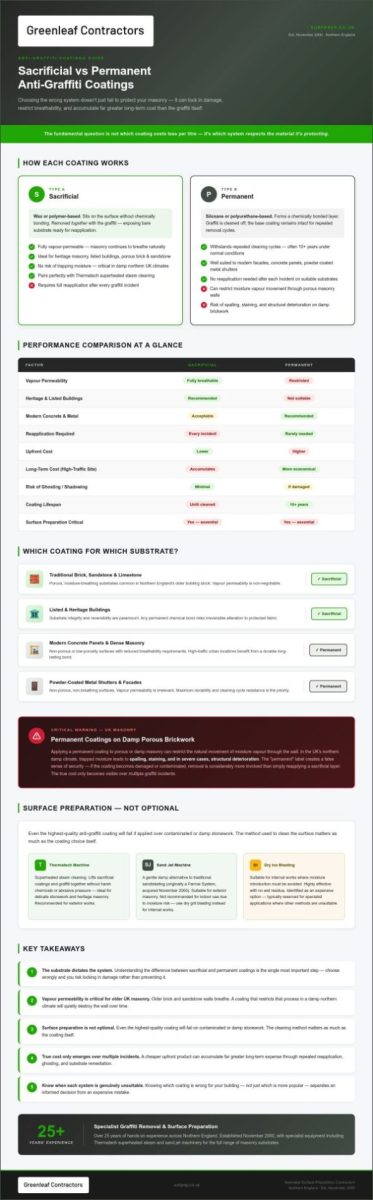
The key difference lies in what survives the cleaning process. Sacrificial coatings are designed to be removed along with the graffiti, leaving the substrate exposed and ready for reapplication. Permanent coatings are engineered to outlast the cleaning agent, allowing repeated removals without stripping the base layer each time.
Sacrificial Coatings: The Low-Impact Choice
Typically wax or polymer-based, sacrificial coatings sit on the surface rather than chemically bonding with it. That characteristic makes them the preferred choice for heritage masonry, listed buildings, and any substrate where vapour permeability is non-negotiable. Because the coating is removed during cleaning, there’s no risk of trapping moisture within the wall structure, which is a serious concern in the damp northern climate across much of the UK.
The trade-off is straightforward: every graffiti incident requires reapplication of the coating once cleaning is complete. Think of it as a disposable shield that does its job and steps aside. This system pairs particularly well with superheated steam cleaning using a Thermatech machine, which lifts the coating and graffiti together without introducing harsh chemicals or abrasive pressure that could erode delicate stonework over time.
Permanent Coatings: High-Traffic Durability
Siloxane and polyurethane-based permanent coatings form a chemically bonded layer that resists solvents and withstands repeated cleaning cycles, often for ten years or more under normal conditions. They’re well suited to modern facades, powder-coated metal shutters, concrete panels, and other non-porous surfaces where breathability isn’t a primary concern. For industrial-scale projects requiring such robust finishes, BIS Group provides high-quality coating and lining solutions that ensure long-term structural protection.
Here’s the expert admission that many product datasheets quietly sidestep: permanent coatings are not always the right fit for traditional UK brickwork. Applied to porous or damp masonry, they can restrict the natural movement of moisture vapour through the wall, leading to spalling, staining, and in severe cases, structural deterioration. The “permanent” label also creates a false sense of security; if the coating itself becomes damaged or contaminated, removal can be considerably more involved than simply reapplying a sacrificial layer.
Choosing between the two systems isn’t simply a question of sacrificial vs permanent anti-graffiti coatings on a cost-per-litre basis. It’s a question of which system respects the material it’s protecting.
Performance Comparison: Durability, Breathability, and Cost-Effectiveness
When evaluating sacrificial vs permanent anti-graffiti coatings on a performance basis, the instinct is to reach straight for durability figures. That’s understandable, but it’s also where most property managers make their first mistake. Durability only tells part of the story. What the substrate does to the coating over time, and what the coating does to the substrate, matters considerably more across a ten-year horizon.
The Breathability Factor in UK Masonry
Older brick and sandstone walls don’t just sit there passively. They breathe, drawing in atmospheric moisture and releasing it as conditions change. In cities like Manchester and Leeds, where rainfall is frequent and winters are reliably damp, this movement of moisture vapour through the wall structure is what keeps the masonry stable. Apply a coating that restricts that process and you’re not protecting the wall; you’re trapping water inside it.
The consequences play out slowly but are difficult to reverse. Trapped moisture expands when temperatures drop below freezing, forcing apart the crystalline structure of the stone or brick face in a process known as freeze-thaw spalling. Pointing begins to fail. Faces pop. What started as a graffiti prevention measure becomes a masonry repair bill. The NPS guidance on graffiti removal and protective coatings makes this point clearly: the choice of protective system must account for the substrate’s physical properties, not just the coating’s resistance to paint.
Sacrificial wax and polymer coatings sit above the pore structure rather than sealing it, which means vapour can still escape freely. For brick and stone buildings constructed before the mid-twentieth century, this breathability isn’t a nice-to-have; it’s a structural requirement. Permanent siloxane or polyurethane systems, applied to the same substrates, risk creating exactly the conditions that accelerate decay rather than prevent it.
On concrete panels and modern facades, the calculation shifts. These substrates are denser, less porous, and engineered to tolerate a sealed surface. In those contexts, a permanent coating’s superior chemical resistance and multi-cycle durability genuinely earn their higher upfront outlay.
ROI for Property Portfolios
The cost conversation around sacrificial vs permanent anti-graffiti coatings is more nuanced than most product literature acknowledges. Permanent coatings carry a higher initial application cost, but on a surface that’s hit with graffiti four or five times a year, that investment can be recovered relatively quickly through reduced reapplication labour. For a retail unit on a high-footfall street in a city centre, a permanent system on a concrete or render facade often makes sound financial sense.
The picture reverses for buildings that experience graffiti infrequently. A sacrificial coating applied to a heritage stone facade that gets tagged once every eighteen months represents a far lower total cost than a permanent system that may not even be appropriate for the substrate. Reapplication after each incident is straightforward, particularly when removal is carried out using a Thermatech superheated steam machine, which lifts the coating and graffiti together cleanly without chemical residues or abrasive pressure.
Substrate suitability, in brief, breaks down like this:
- Brick: Sacrificial coatings strongly preferred for pre-1970s stock; permanent coatings only where breathability has been confirmed as non-critical.
- Stone: Sacrificial systems are almost always the safer choice; consult a specialist before applying any permanent system to limestone or sandstone.
- Concrete: Permanent coatings are well suited here, offering durability across repeated cleaning cycles without breathability concerns.
Getting this balance right sits within a broader property maintenance strategy. If you’re already thinking about how your building presents to clients and customers, the improving business curb appeal guide covers how surface restoration decisions feed into long-term commercial property value, which is a useful wider context for any portfolio manager working through these choices.
Professional Application and Removal: Ensuring Substrate Integrity
The coating itself is only as good as the surface it goes onto. This is where the gap between a professional application and a DIY attempt becomes impossible to ignore, and it’s a point that product datasheets consistently underplay. Apply any anti-graffiti system, whether sacrificial or permanent, over contaminated, damp, or inadequately cleaned masonry, and you’re essentially sealing in the problem rather than preventing the next one.
Carbon staining, old graffiti residue, biological growth, and previous coating remnants all compromise adhesion. On porous brick and sandstone, uneven coverage is particularly damaging because the coating migrates into the pore structure inconsistently, leaving exposed patches that graffiti paint will find almost immediately. This is precisely why the “brush it on yourself” advice that circulates online fails so reliably on real-world masonry.
Thermatech superheated steam is the preferred preparation method for most masonry substrates before coating application. Operating at high temperatures with minimal water volume, it lifts biological matter, loosens old paint residues, and kills spores without saturating the stone. That last point matters enormously: a surface cleaned with superheated steam dries significantly faster than one treated with cold pressure washing, which means the substrate reaches the dry, stable condition required for coating adhesion far more quickly. There’s no chemical residue to interfere with bonding, and no risk of driving contaminants deeper into the pore structure.
For stubborn ghosting or shadowing where pigment has already penetrated the masonry, the sand jet system (originally acquired as a Farrow System when Surfprep was established in November 2000) provides a gentle abrasive alternative. Unlike traditional sandblasting, it operates as a damp process at low pressures, abrading only the very surface layer without eroding the face of the brick or stone beneath. It’s worth noting that because it introduces moisture, sand jetting is suited to exterior surfaces only; it’s not appropriate for indoor applications where water ingress would be problematic.
Removal Protocols: Protecting the Face of the Brick
When a sacrificial coating has done its job and graffiti needs removing, Thermatech superheated steam is again the right tool. The heat melts the wax or polymer layer whilst simultaneously lifting the paint above it, and both come away together cleanly. Cold high-pressure washing is the method to avoid here: it drives pigment further into the substrate rather than extracting it, and the mechanical force can erode pointing and surface detail on older brick and stone buildings. The damage from repeated cold-wash removal often costs more to remediate than the original graffiti incident.
Ongoing Management Plans
Speed of response is one of the most effective deterrents available. Graffiti removed within 24 to 48 hours of application significantly reduces the likelihood of repeat targeting on the same surface; visible tags that persist send a different signal entirely. Building a straightforward response protocol, with a specialist contact ready to mobilise quickly, is a more practical long-term investment than any coating system used in isolation.
For barn conversions, listed structures, and heritage sites where the choice between sacrificial vs permanent anti-graffiti coatings intersects with planning constraints and conservation requirements, specialist advice is essential before any product is applied. The variables involved, substrate age, moisture behaviour, existing treatments, and local authority requirements, make a one-size approach genuinely counterproductive. Getting a specialist assessment at the outset is considerably cheaper than correcting a substrate compatibility problem after the fact.
Make the Right Coating Choice Before Graffiti Forces Your Hand
The decision between sacrificial vs permanent anti-graffiti coatings isn’t one to make in the aftermath of a graffiti attack, when pressure to act quickly tends to override careful judgement. The substrate beneath your coating matters as much as the coating itself, and breathability remains the factor most often overlooked until the damage is already done.
Three things are worth carrying forward from this guide: substrate compatibility determines suitability, not price point; surface preparation is what makes any coating perform as intended; and speed of response after each incident is one of the most effective deterrents available.
Surfprep has been working across Northern England since November 2000, using specialist Thermatech and sand jet equipment to protect and restore masonry that deserves more than a rushed solution. If you’re unsure which system is right for your building, getting a professional assessment at the outset is considerably cheaper than correcting a compatibility problem later.
Contact Surfprep today to arrange a graffiti management consultation and protect your building with a system that’s genuinely suited to it.
Frequently Asked Questions
Do anti-graffiti coatings change the colour of the brickwork?
Most sacrificial wax-based coatings are applied in very thin layers and dry to a clear, matt finish that doesn’t noticeably alter the appearance of brick or stone. Permanent siloxane coatings can occasionally darken the substrate slightly, particularly on absorbent sandstone or pale limestone, because they partially fill the pore structure. If colour retention is a concern, always request a test patch on an inconspicuous area before committing to full coverage.
On heritage or listed facades where the original character of the masonry must be preserved, this is a practical consideration rather than a cosmetic one. A specialist assessment before application is the most reliable way to confirm how a specific product will behave on your particular substrate.
Can I apply anti-graffiti coatings to a listed building in the UK?
Listed building consent may be required before applying any surface treatment, including anti-graffiti coatings, to a Grade I or Grade II listed structure in England. The requirement depends on whether the work is considered to affect the character of the building, and local planning authorities interpret this differently. Contacting your local conservation officer before any application is the correct first step, not an optional one.
Where consent is granted, sacrificial coatings are almost always the preferred system for listed buildings because they don’t chemically alter the substrate or restrict vapour movement. Permanent coatings are rarely approved for historic masonry, and applying one without consent could create a compliance problem that’s considerably more complicated than the original graffiti.
How long does a sacrificial anti-graffiti coating last if no vandalism occurs?
On a surface that isn’t attacked, a well-applied sacrificial coating typically remains effective for between one and three years, depending on the product formulation, substrate porosity, and exposure to weathering. UV degradation and rainfall gradually break down the wax or polymer layer over time, even without any cleaning cycle. In the damp northern climate across much of the UK, annual inspection is a sensible practice to confirm the coating is still performing as intended.
This is worth factoring into the broader comparison of sacrificial vs permanent anti-graffiti coatings: the reapplication interval isn’t solely driven by graffiti incidents. A building that’s rarely targeted still needs its sacrificial layer refreshed periodically to maintain meaningful protection.
Is it better to use a permanent coating on metal shutters and street furniture?
For metal shutters, bollards, and street furniture, permanent coatings are generally the more practical choice. Metal surfaces don’t have the porosity or vapour permeability concerns that make sacrificial systems preferable on brick and stone, and the chemical resistance of a polyurethane or siloxane coating holds up well against repeated solvent-based cleaning. High-footfall locations where shutters are targeted regularly benefit most from a system that doesn’t require reapplication after every incident.
The one caveat worth raising is surface condition before application. Corroded, flaking, or contaminated metal won’t hold any coating reliably, regardless of how durable the product is rated. Proper surface preparation remains the non-negotiable foundation of any effective anti-graffiti system, on metal just as much as on masonry.
