
Most project managers assume that stripping industrial coatings from steel requires aggressive, high-pressure blasting, but that brute force often leaves thin metal shells warped and useless. If you’ve ever seen a substrate buckle under the heat of friction, you know that traditional dry blasting isn’t always the answer (especially when dealing with delicate structural elements). You’re likely also concerned about the health risks associated with lead-based paint dust, which can turn a standard restoration into a compliance nightmare. It’s a difficult balance to strike when you need a perfectly keyed surface but can’t risk damaging the underlying metal.
We understand these frustrations because we’ve been solving them since November 2000. This guide demonstrates why sand jet cleaning for steel preparation is the most effective method for creating a clean, keyed surface without the risk of distortion or airborne contamination. We’ll walk you through how this gentle, damp-process technology (utilising our original Farrow System) provides the ideal profile for coating adhesion whilst keeping your site safe and your steel straight.
Key Takeaways
- Understand why traditional high-pressure blasting risks warping thin steel through heat friction and how a low-pressure approach preserves structural integrity.
- Discover how sand jet cleaning for steel preparation utilises the original Farrow System to suppress hazardous dust whilst providing a precise profile for new coatings.
- Learn the technical requirements for achieving an Sa 2.5 (Near-White Metal) finish to eliminate mill scale and ensure long-term corrosion resistance.
- Identify the correct methodology for your specific environment, including why damp processes are reserved for external works whilst dry grit or dry ice is preferred indoors.
Why Traditional Sandblasting Often Fails Modern Steel Preparation Requirements
Traditional dry blasting is undeniably fast. If you’re stripping heavy-gauge industrial beams in a remote yard, it’s often the go-to choice. However, we’ve learned since establishing Surfprep in November 2000 that speed isn’t everything. For many modern projects, Abrasive blasting using dry methods is simply too aggressive. The main culprit is heat friction. When dry grit hits a surface at high velocity, it generates significant thermal energy. On thin steel shells or delicate cast iron, this heat causes the metal to expand unevenly. This results in permanent warping or structural distortion that ruins the substrate before you’ve even applied a primer.
Beyond structural damage, the environmental toll of dry blasting is a constant challenge. Managing a massive dust plume in a public space or a sensitive industrial environment requires extensive logistical planning. It often leads to site shutdowns or expensive third-party cleaning. For those working across Leeds, Hull, or Manchester, keeping the peace with neighbours and local authorities is just as vital as the finish itself.
The Critical Safety Aspect: Lead-Based Paint and Dust Suppression
When dealing with older UK infrastructure, lead-based paint is a frequent and dangerous reality. Stripping these coatings using dry methods requires complex, airtight containment systems to prevent toxic particles from migrating across your site. Our approach to sand jet cleaning for steel preparation changes this dynamic entirely. By introducing a controlled amount of water into the blast stream, we capture lead particles in water droplets at the moment of impact. Whilst traditional blasting creates a hazardous dust cloud, the sand jet encapsulates lead-based residues at the source. This damp process significantly reduces the need for expensive tenting whilst ensuring your project remains compliant with current health and safety regulations.
The Sand Jet Advantage: Precision Cleaning for Structural and Thin Steel
Since November 2000, we’ve used the original Farrow System to ensure our sand jet cleaning for steel preparation remains the most reliable choice for thin-gauge metal. It’s a delicate balance of physics. By mixing a controlled amount of water with the abrasive media, we create a “sand jet” that cleans without the aggressive force of dry grit. The water acts as a vital coolant. It absorbs the thermal energy that would otherwise cause thin steel shells or cast iron to buckle under friction. This methodical approach ensures we meet rigorous international surface preparation standards without compromising the substrate’s structural integrity.
Achieving the perfect surface profile is the cornerstone of any industrial project. If the metal is finished too smoothly, the primer won’t bond effectively; conversely, deep scratches can lead to “peaks” that compromise the paint film. Our specialised sand jet cleaning for steel preparation creates a uniform, “frosted” texture. This provides the ideal mechanical key for high-performance primers whilst avoiding the aggressive pitting often seen with traditional dry blasting.
Comparing Damp Sand Jetting with Dry Blasting Methods
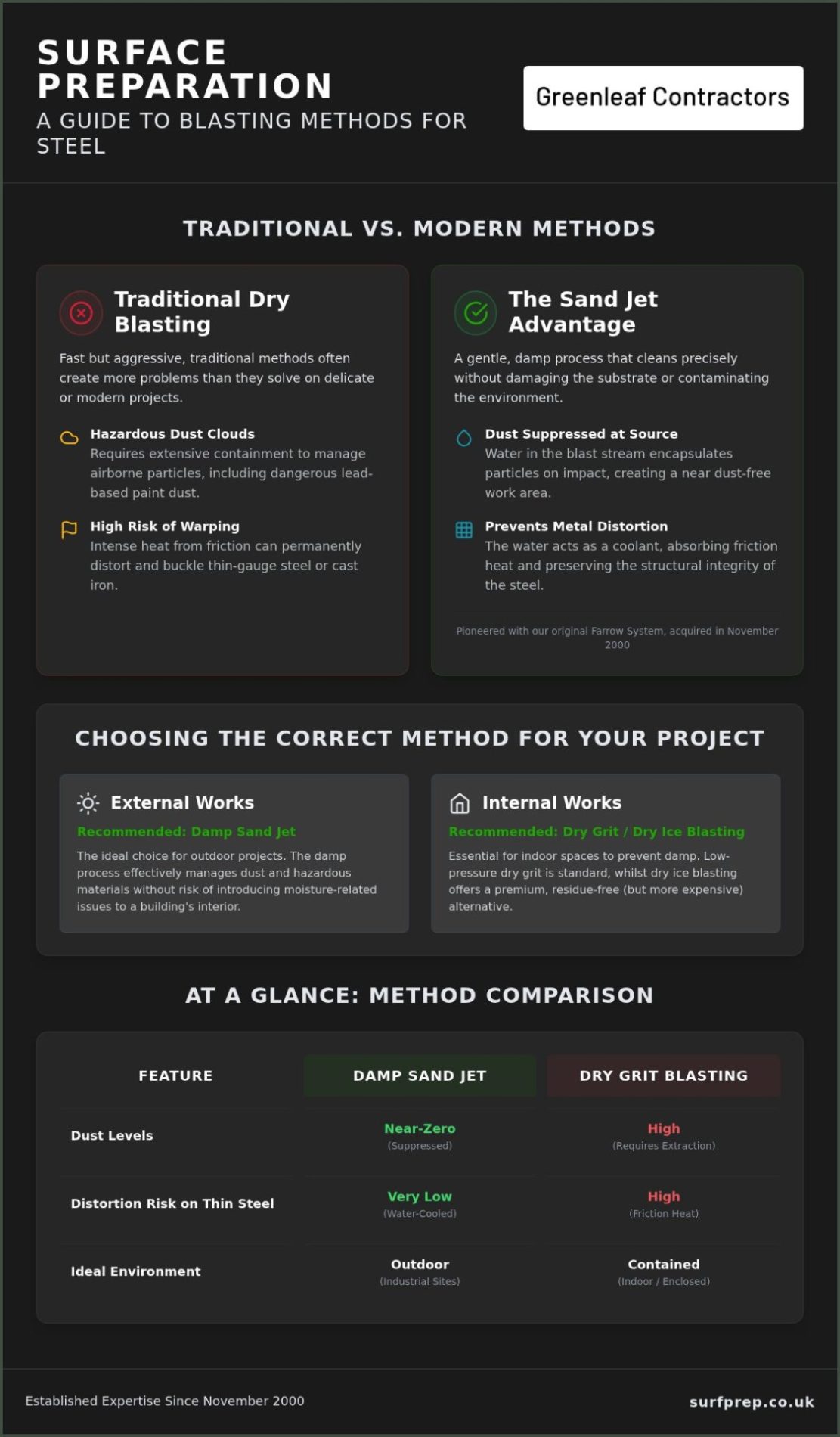
Choosing the right tool depends entirely on your environment and the material’s thickness. The table below outlines the primary differences between these two common approaches.
| Feature | Damp Sand Jet | Dry Grit Blasting |
|---|---|---|
| Environment | Outdoor / Industrial | Indoor / Contained |
| Dust Levels | Near-Zero (Suppressed) | High (Requires Extraction) |
| Distortion Risk | Very Low (Cooled) | High (Friction Heat) |
We’re transparent about where our tools work best. Damp sand jetting is strictly an external process. We don’t recommend it for indoor use because introducing moisture into a building’s interior can lead to long-term damp problems. For internal steel restoration, we prefer low-pressure dry grit blasting. For high-end projects where residue must be minimised, dry ice blasting is a superb, moisture-free alternative, even though it’s a more expensive investment. If you’re planning a restoration, view our sand jet services to see how we handle delicate substrates.
Achieving Professional Standards in Industrial Restoration
Establishing a professional finish on industrial steel isn’t just about removing old paint; it’s about achieving a specific cleanliness grade. In the world of industrial coatings, Sa 2.5 (Near-White Metal) is the recognised gold standard for ensuring long-term paint adhesion. This level of preparation ensures that the surface is free of all visible oil, grease, dirt, mill scale, and rust. By adhering to NACE/SSPC Joint Surface Preparation Standards, we provide a substrate that’s perfectly primed for high-performance protective coatings. Our sand jet cleaning for steel preparation is specifically designed to reach this grade whilst stripping away stubborn residues that otherwise lead to premature corrosion.
Mill scale is particularly troublesome for steel restoration. It’s a thin, brittle oxide layer formed during the manufacturing process that will eventually flake off, taking your new coating with it. Removing this layer is essential for creating a stable base. For a deeper look at these requirements, you can explore our guide to Understanding Surface Preparation Standards.
Expert Surface Preparation Across Northern England
Our mobile specialist teams bring this level of precision directly to your site. Whether you’re based in Leeds, Hull, Manchester, or across the wider Yorkshire region, we have the logistical capability to handle large-scale structural steel projects. Choosing a contractor established in November 2000 means you’re working with veterans who understand the nuances of complex industrial machinery and thin-gauge metal. We don’t just blast surfaces; we restore them with the care they require to last for decades. To discuss your project requirements, Contact our specialists for a site assessment.
Secure the Longevity of Your Steel Restoration
Effective steel restoration demands a method that respects the substrate’s integrity whilst ensuring safety compliance. By choosing sand jet cleaning for steel preparation, you eliminate the risk of thermal distortion on thin metal and effectively suppress hazardous lead-based dust. Since establishing our business in November 2000, we’ve remained committed to these precision standards, utilising our original Farrow System and Thermatech expertise to deliver Sa 2.5 results across Northern England.
Whether managing complex industrial machinery or structural steel, our fully mobile teams provide the technical grit required for a professional finish. Don’t risk the structural health of your assets with aggressive dry blasting. Request an Expert Site Survey for Your Steel Preparation Project today and let us help you achieve a surface that’s perfectly primed for the future.
Frequently Asked Questions
Is sand jet cleaning safe for thin steel car shells?
Yes, sand jetting is ideal for thin steel car shells because the water in the damp-process acts as a vital coolant. Unlike traditional dry blasting, which generates significant friction heat, sand jet cleaning for steel preparation prevents the metal from expanding and warping. We’ve used this original Farrow System since November 2000 to restore delicate automotive substrates across Yorkshire.
What is the difference between sand jetting and traditional sandblasting?
The primary difference lies in the introduction of a controlled amount of water. Traditional sandblasting is a dry, high-pressure method that creates massive dust clouds and risks surface distortion. Sand jetting uses lower pressures and suppresses dust at the source. This makes it a far gentler alternative, especially in sensitive urban environments like York, Hull, or Newcastle where airborne debris must be strictly controlled.
Can sand jet cleaning be used for indoor steel preparation?
We don’t recommend sand jetting for indoor work because it is a damp process that introduces moisture into the property. To avoid damp issues or water damage to internal fixtures in sites across Manchester or Lincoln, we utilise low-pressure dry grit blasting or dry ice blasting instead. Dry ice is a residue-free option, whilst our dry grit methods are carefully calibrated for internal works.
What surface preparation grade is required for industrial steel painting?
For most industrial applications, Sa 2.5 (Near-White Metal) is the required standard for ensuring long-term coating adhesion. This grade requires the removal of all visible rust, mill scale, and old paint, leaving only minor shadows. Achieving this profile through sand jet cleaning for steel preparation ensures modern protective primers bind effectively to the substrate, preventing premature corrosion on structural elements.
