
If you are looking at a historic York stone facade, does it really matter whether the badge on the cleaning machine says DOFF or Therma-Tech? You have likely heard conflicting advice from various contractors, each claiming their preferred system is the only safe option, whilst you are left worrying about abrasive scarring or moisture ingress. It is a common frustration; you want the grime gone but cannot risk the structural integrity of your property. Choosing the right steam cleaning for heritage masonry setup is less about the brand name and more about the technical precision required for sensitive UK substrates.
We agree that the safety of the stone should always come before a quick result. This guide provides a professional technical comparison of the UK’s leading superheated steam systems to help you choose the safest restoration method for your specific building. We’ll explain how these systems meet BS 8221-1:2012 standards and why the real value lies in an operator’s ability to balance heat and water flow. By the end, you’ll know exactly what to ask a specialist to ensure your stone, brick, or timber is treated with the respect it deserves.
Key Takeaways
- Understand how superheated steam at 150°C effectively breaks paint bonds and kills biological spores without the need for abrasive chemicals or high pressure.
- Learn why superheated steam cleaning for heritage masonry is widely regarded as the gold standard for protecting fragile stone whilst ensuring a thorough, conservation-approved clean.
- Discover the technical differences between DOFF’s mechanical reliability and Therma-Tech’s modular design to determine which suits your project’s specific scale and material.
- Ensure your restoration project remains compliant with British Standard BS 8221-1:2012 by selecting the correct heat-to-water ratio for your specific masonry substrate.
Table of Contents
The Science of Superheated Steam: Why DOFF and Therma-Tech Lead the Market
Therma-Tech vs DOFF: A Direct Comparison of Performance and Precision
The Science of Superheated Steam: Why DOFF and Therma-Tech Lead the Market
Understanding the mechanics of superheated steam is essential for anyone responsible for a listed building. At its core, Superheated steam is water heated to 150°C, creating a high-temperature but low-pressure medium that works differently from any other cleaning method. Whilst a standard pressure washer relies on kinetic force, superheated systems use thermal energy to melt contaminants at pressures as low as 30 bar. This distinction is vital; it’s the reason why superheated steam cleaning for heritage masonry is often the only method conservation officers will sanction for Grade I and II listed structures.
The process relies on the "thermal shock" principle. When the high-temperature steam hits a colder surface, it instantly breaks the bond of brittle coatings like oil-based paints or heavy carbon deposits. Because the pressure remains low, the steam doesn’t drive moisture deep into the masonry or shatter the delicate surface of the stone. It effectively melts the grime away whilst leaving the underlying substrate completely intact. While these systems are incredibly versatile, they aren’t magic; the success of the clean depends entirely on the operator’s control of the temperature-to-pressure ratio.
The Heritage Standard in the UK
Stonehealth (the makers of DOFF) and Restorative Techniques (who produce Therma-Tech) have set the benchmark for professional heritage stone cleaning. Their systems are designed to handle the specific challenges of UK architecture, such as the soft Northern red bricks and porous limestone found across York and Durham. These materials are easily scarred by traditional grit blasting, making non-abrasive steam the safest choice for long-term preservation.
Common Heritage Contaminants Removed
Biological growth: The 150°C heat doesn’t just wash away moss or algae; it kills deep-seated spores on contact. This prevents the rapid regrowth often seen after cold-water washing on damp garden walls. In our experience, using steam cleaning for heritage masonry ensures a cleaner surface for longer because the biological cycle is actually broken rather than just suppressed.
Atmospheric pollution: These systems are particularly effective at removing the stubborn "black crust" of carbon that plagues city centre buildings in Leeds and Manchester, restoring the original colour without eroding the stone’s face.
Therma-Tech vs DOFF: A Direct Comparison of Performance and Precision
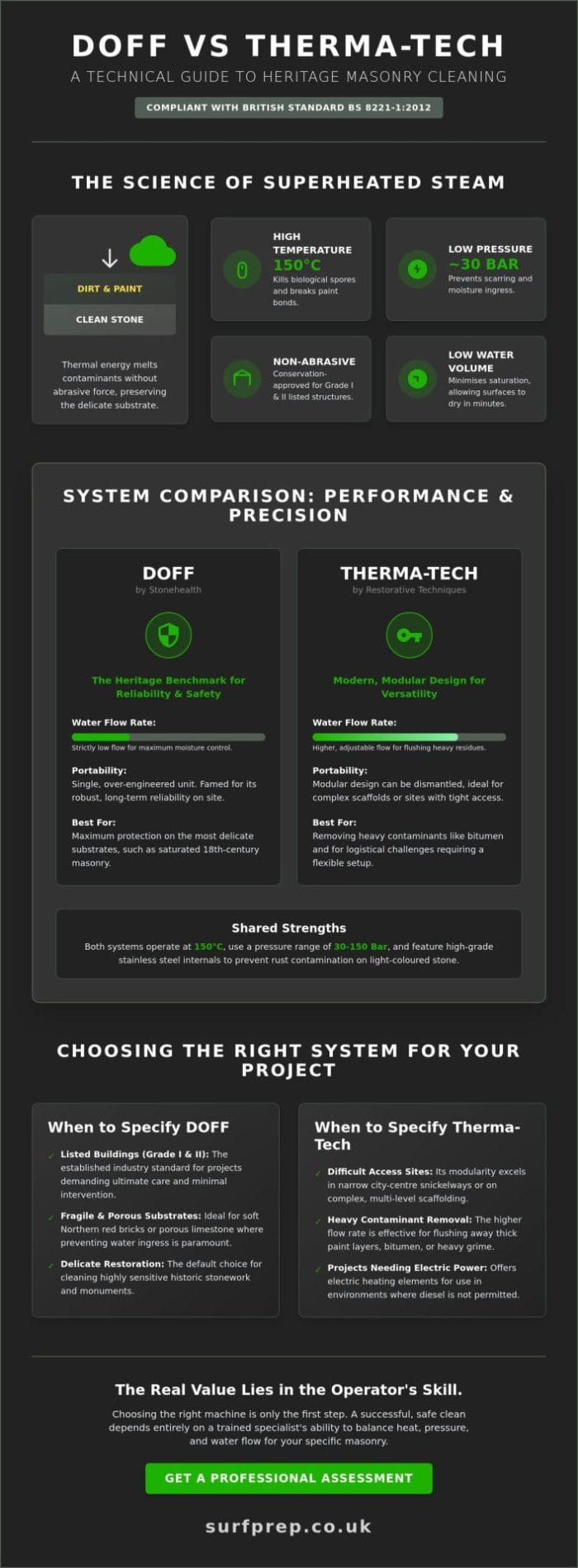
Choosing between these two systems isn’t about which one is better in a vacuum; it’s about which one fits the logistical constraints of your site. DOFF has built a reputation for over-engineered reliability over several decades, making it the most recognised name in the industry. In contrast, Therma-Tech offers a modular, modern design that can be dismantled into smaller components. This is a significant advantage when navigating the narrow snickelways of York or setting up on a complex scaffold in Hull city centre where space is at a premium.
Water flow is where the technical nuance really shows. Therma-Tech allows for a slightly higher flow rate, which we find incredibly useful for flushing away heavy paint residues. DOFF maintains a strictly low flow, which acts as a safety barrier for fragile, saturated masonry. This approach is widely considered a gentle and effective method for cleaning stone, as it prevents the substrate from becoming waterlogged.
Technical Specifications at a Glance
Both systems operate within the 30 to 150 bar pressure range, ensuring they never cross into the abrasive territory of standard pressure washers. They utilise high-grade stainless steel for all internal pipework and nozzles. This prevents rust contamination, which is a common risk when cleaning light-coloured Portland or York stone with inferior equipment. Whilst DOFF is often the "default" on heritage tenders, Therma-Tech provides identical thermal parameters (150°C) with additional control over the water volume.
Choosing the Right System for Your Restoration Project
From our perspective as an honest specialist, the choice between machines often depends more on the specific paint coating than the stone itself. If you’re dealing with multiple layers of modern masonry paint, you need different heat and water parameters than if you’re simply rinsing away light carbon soiling. The machine is merely a tool; the operator’s skill in adjusting that tool is what prevents a restoration project from turning into a costly repair job.
We favour Therma-Tech because its modular setup allows for a slightly more aggressive water volume when needed to flush away thick residues, and can also be tuned down for lower flow rates for delicate work. This adherence to the gentlest possible means is a core principle reflected in the NPS Preservation Brief on Masonry Cleaning, which prioritises substrate safety over speed.
Heritage Brick and York Stone Considerations
York stone facades, particularly in West Yorkshire, have a unique porosity that makes them prone to holding moisture. Using superheated steam cleaning for heritage masonry allows us to clean these surfaces whilst ensuring the stone dries out quickly, preventing salt crystallisation. We also use these systems to strip modern plastic-based masonry paints from Victorian brickwork. This is a delicate process; if the heat isn’t perfectly calibrated, you risk "blowing" the brick faces or eroding the lime mortar joints.
The Final Verdict: Operator over Equipment
At Surfprep, we use Therma-Tech systems and ensure we never "force" a machine to do a job it isn’t suited for. We always recommend a site trial on a discreet area before committing to a full building clean. This allows us to ensure no "ghosting" or shadowing occurs and gives you a clear picture of the final result. If you’re ready to see what’s possible for your property, contact our specialist team for a site survey.
Restoring the Original Character of Your Heritage Property
Since 2000, we’ve served clients across Leeds, York, Manchester, and the wider North, providing conservation-approved expertise across brick, stone, and timber restoration. We understand that doff steam cleaning for heritage masonry is a precise science that requires a steady hand and a deep understanding of masonry porosity. If you’re ready to move past conflicting advice and see a clear path forward for your building, we’re here to help. Request a Professional Site Survey and Quote today and let’s discuss the safest method for your restoration project. We look forward to helping you reveal the true beauty of your property.
Frequently Asked Questions
Is superheated steam cleaning safe for Grade I and II listed buildings?
Superheated steam is widely regarded as the safest method for Grade I and II listed buildings because it avoids the abrasive impact of grit or high-pressure water. Most conservation officers specifically recommend superheated steam cleaning for heritage masonry because it meets the strict criteria for non-destructive restoration. It effectively cleans without eroding the fire face of bricks or the delicate patina of aged stone.
How does Therma-Tech differ from a standard industrial pressure washer?
The primary difference lies in the reliance on heat over force. A standard industrial pressure washer uses high-velocity water to blast dirt away, which can easily shatter porous masonry or drive water deep into the structure. Therma-Tech uses superheated water at 150°C to melt contaminants, allowing us to work at pressures as low as 30 bar, which is roughly the same as a domestic garden hose.
Can DOFF or Therma-Tech remove graffiti without the use of harsh chemicals?
Yes, these systems are exceptionally effective at removing graffiti from porous surfaces without needing harsh chemical strippers. The intense heat breaks down the molecular bond of the spray paint, allowing it to be rinsed away safely. This is a significant advantage for heritage sites where chemical runoff could damage the surrounding environment or soak into the ground.
Will steam cleaning damage the lime mortar joints between my heritage bricks?
When operated by a specialist, superheated steam won’t damage sound lime mortar joints. Because the pressure is kept extremely low, the steam cleans the surface of the mortar without raking it out. However, if the mortar is already failing or blown, the process may reveal the extent of the decay, which is actually helpful for identifying where repointing is necessary.
How much does professional DOFF or Therma-Tech cleaning cost in the UK?
The cost of professional steam cleaning varies significantly based on the building’s size, the type of coating being removed, and the access requirements, such as scaffolding or cherry pickers. We don’t provide flat rates because every heritage project has unique challenges. Instead, we recommend a site survey to assess the substrate and provide a transparent, fixed-price quote based on the specific work required.
Is superheated steam effective for removing ivy suckers and deep-rooted moss?
Superheated steam is the most effective way to deal with biological growth because the 150°C temperature kills the spores and root systems on contact. Whilst ivy suckers may still require some careful manual assistance if they’ve turned woody, the steam makes the removal much easier. It also ensures that superheated steam cleaning for heritage masonry prevents the rapid regrowth of moss and algae that usually follows cold-water cleaning.
