
Did you know that 80% of industrial floor coating failures are caused by poor surface preparation for warehouse floor painting? It’s a frustrating reality for managers who watch expensive finishes peel under forklift traffic just months after application. You need a high-adhesion surface that doesn’t compromise operations with dust or moisture. Since Surfprep was established in November 2000, we’ve provided the grounded, technical expertise required to get the substrate right the first time.
In this guide, you’ll discover how to select the correct mechanical method whilst meeting 2026 HSE silica dust safety standards. We’ll explain why dry grit blasting is our preferred internal method (avoiding moisture from steam systems like Thermatech, which we reserve for masonry) and how to navigate UK standards like BS 8204-6. From considering dry ice blasting as an expensive alternative to managing mechanical profiling, we’ll ensure your next project is built on a solid, professional foundation.
Key Takeaways
- Understand why removing laitance is critical to preventing coating failure and how to achieve the mechanical profile necessary for a lasting chemical bond.
- Learn why dry grit blasting is the superior method for surface preparation for warehouse floor painting, providing a dust-managed finish without the risks of indoor moisture.
- Discover how to maintain a clean working environment using vacuum-sealed equipment to meet 2026 HSE silica dust regulations whilst protecting your stock and machinery.
- Recognise why avoiding damp preparation methods indoors is essential for floor longevity and how specialist expertise ensures compliance with current British Standards.
The Science of Adhesion: Why Surface Preparation is Non-Negotiable
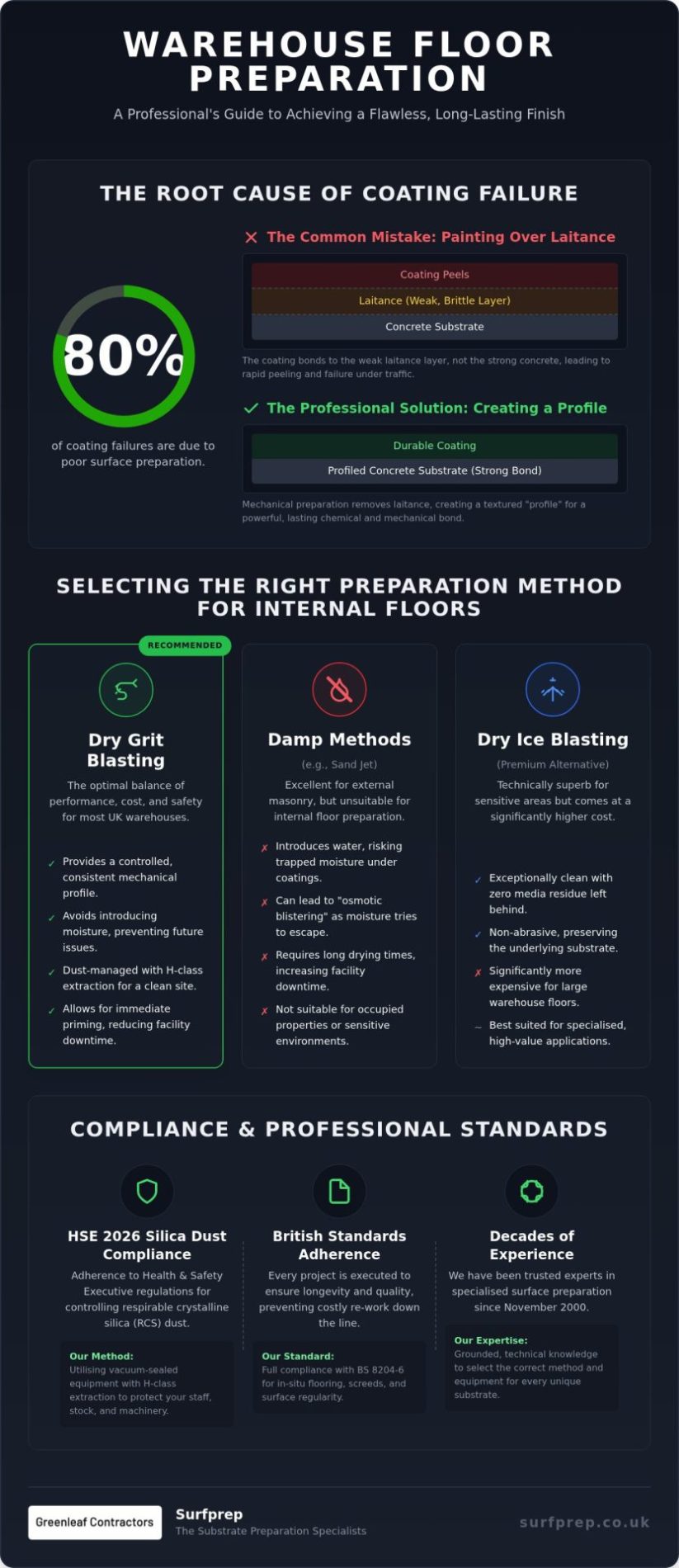
Surface preparation for warehouse floor painting isn’t about making the floor look clean; it’s about engineering a “profile.” This profile is a microscopic texture that allows epoxy or PU resins to achieve both a mechanical and chemical bond. Without it, your coating is simply sitting on top of the concrete, waiting to be ripped up by the first heavy pallet truck. It’s a sobering fact that 80% of coating failures stem from inadequate preparation, specifically the failure to reach the sound substrate beneath.
I’ll be honest with you. Whilst some suppliers suggest a quick mop or a DIY chemical wash is enough, industrial environments demand more. If your floor handles constant forklift traffic, mechanical profiling is the only way to ensure longevity. We also prioritise the complete removal of old line markings and stubborn rubber deposits, as these act as significant barriers to adhesion.
Understanding Laitance and Substrate Contaminants
The biggest culprit in floor failure is laitance. This is the weak, milky layer of cement and sand that rises to the surface during the curing process. It looks solid, but it has no structural integrity. If you paint over it, the paint sticks to the laitance, and the laitance eventually pulls away from the concrete. Traditional pressure washing cannot remove this layer effectively. Instead, methods similar to mechanical grinding and polishing or dry grit blasting are required to strip back to the sound aggregate. Contaminants like oils and greases also act as bond-breakers, requiring deep mechanical removal to reveal a porous, high-adhesion surface.
Selecting the Right Preparation Method for Industrial Concrete
Choosing the right mechanical approach is where industrial projects are won or lost. Whilst shot blasting is a common industry standard, it can be too aggressive for some slabs or fail to reach tight edges. Our preferred method is traditional dry grit blasting at low pressures. It provides a controlled, dust-managed finish that prepares the substrate without unnecessary damage. Understanding the science of coating adhesion highlights that a consistent mechanical profile is vital for long-term bonding.
I’ll offer an expert admission here: dry ice blasting is technically superb. It leaves zero residue and is exceptionally clean. However, for a large warehouse footprint, it remains a significantly more expensive option that many commercial budgets don’t support. We often find that traditional grit blasting provides the best balance of cost and performance for most UK facilities.
I must also issue a strict warning regarding our sand jet cleaning system. Originally acquired as a Farrow System in November 2000, it’s a brilliant tool for external masonry. But because it’s a damp process, we never recommend it for indoor floors. Introducing water into an enclosed warehouse creates long drying times and risks trapped moisture under your new coating.
Dry Grit Blasting vs Damp Methods
Using dry methods for surface preparation for warehouse floor painting is about operational speed and structural safety. Damp methods risk rising damp or “osmotic blistering” once the epoxy is sealed. By staying dry, we allow for immediate priming, which slashes facility downtime. We use low abrasive rates to protect the structural slab whilst still achieving the required profile. If you’re planning a refurbishment, our specialist team can help you determine the most efficient mechanical route for your floor.
Managing the Logistics and Standards of a Warehouse Floor Project
Executing surface preparation for warehouse floor painting across the North of England, from Hull to Manchester, involves more than just bringing in the right machines. It requires a logistical plan that accounts for your ongoing operations. We utilise high-capacity dust extraction and vacuum-sealed equipment to ensure that nearby stock or machinery remains uncontaminated. This setup is essential for meeting the 2026 HSE requirements for controlling respirable crystalline silica dust, which currently mandates H-class extraction for concrete grinding and blasting. For those looking to maintain high hygiene standards across their entire facility, Distribution Hygiene Services Limited offers the specialist industrial cleaning expertise required to keep distribution hubs safe and operational.
Our team has been a reliable veteran in this field since November 2000, ensuring that every project adheres to BS 8204-6:2008+A1:2010 standards. We’ve seen the results of “quick fix” prep far too often; it usually leads to costly rework that dwarfs the initial investment. By prioritising a clean, profiled substrate from the start, you protect the longevity of your industrial floor whilst minimising disruption to your daily warehouse workflow in cities like Leeds.
Once the mechanical work is complete, we perform rigorous checks to verify the surface is ready for the resin team. A common but effective method is the “tape test,” where industrial-grade adhesive tape is applied to the floor and inspected for any residual dust or laitance. If the tape comes up clean, the surface preparation for warehouse floor painting is considered successful and ready for chemical bonding.
Timing is equally critical. The first coat of primer should be applied shortly after preparation is finished. Leaving a freshly prepared slab exposed for too long risks “flash contamination” from settling dust or operational spills. Investing in professional industrial surface preparation ensures these fine details aren’t missed, providing the maximum possible return on your flooring investment.
Securing Your Industrial Flooring Investment
Whether you are constructing a new facility using pre-engineered metal buildings for sale or refurbishing an older site, the quality of the floor preparation remains the single most important factor in the success of your industrial coating.
Successful surface preparation for warehouse floor painting requires a shift in focus from simple cleaning to engineering a precise mechanical profile. By prioritising dry grit blasting and high-capacity dust extraction, you ensure compliance with 2026 HSE silica dust standards whilst avoiding the moisture risks inherent in damp systems. It’s about building a foundation that can withstand years of relentless forklift traffic and chemical exposure.
Established in November 2000, Surfprep has spent over two decades as a reliable veteran in the industry. We serve Leeds, York, Hull, and the wider North, specialising in dust-managed dry grit blasting that delivers a high-adhesion substrate. Don’t leave your project’s success to chance or settle for inadequate preparation that leads to peeling. Contact Surfprep for an honest assessment of your warehouse floor. We’re ready to help you achieve a finish that lasts.
Frequently Asked Questions
Can I paint directly over old warehouse floor paint?
You shouldn’t paint directly over old coatings if you want a lasting finish. Existing paint, especially if it’s peeling or oil-stained, acts as a bond-breaker that prevents new resins from adhering to the concrete. Proper surface preparation for warehouse floor painting involves mechanically removing old line markings and failed layers to expose the sound aggregate beneath, ensuring your new investment doesn’t lift under traffic.
What is laitance and why must it be removed from concrete?
Laitance is a weak, friable layer of cement and fine sand that rises to the surface during concrete curing. It may look solid, but it has very little structural strength. If you apply a high-performance coating over it, the paint will eventually pull the laitance away from the slab. We use mechanical profiling to strip this layer back, revealing a porous, high-adhesion surface.
How long does industrial floor preparation usually take?
Most warehouse projects take between two and five days, depending on the floor’s condition and total area. Since our establishment in November 2000, we’ve refined our process to minimise disruption. Because we use dry grit blasting rather than damp methods, there’s no need to wait for water to evaporate. This allows for immediate priming and a faster overall turnaround for your facility.
Is dry grit blasting suitable for warehouses with sensitive machinery?
It’s perfectly suitable when managed by a specialist using H-class dust extraction. We utilise vacuum-sealed equipment to contain debris, ensuring surface preparation for warehouse floor painting doesn’t compromise your stock. Whilst dry ice blasting is an expensive option, our dry grit blasting is safer than steam systems like Thermatech, which are reserved for masonry and never used on internal warehouse floors.
