
You’ve spent your entire weekend on a ladder with a hired pressure washer, only to wake up the next morning to find your home’s exterior covered in unsightly orange streaks and permanent wand marks. It’s a common frustration for many UK homeowners who realise, perhaps too late, that masonry is far more delicate than it looks. If you’re currently staring at white “ghosting” or acid burns on your walls, you’re likely wondering what to do after failed DIY brick cleaning to save your property’s kerb appeal. We understand that sinking feeling when a home improvement project goes wrong, but it’s important to remember that most masonry damage can be professionally corrected before it impacts your property value.
At Surfprep, we’ve been the “honest specialists” since November 2000, stepping in to restore brickwork that’s been compromised by incorrect chemical use or excessive pressure. In this guide, you’ll discover how to accurately assess the depth of the damage and why specialist equipment, like our Thermatech superheated steam system or the gentle Sand Jet, originally the Farrow System, is the key to a successful recovery. We’ll walk you through a professional plan to remediate staining and restore the aesthetic of your brickwork, giving you the confidence that your home’s structural integrity remains intact whilst bringing back its original character.
Key Takeaways
- Learn how to recognise the tell-tale signs of masonry damage, from orange acid burns to the physical scarring caused by high-pressure washing.
- Discover what to do after failed DIY brick cleaning to neutralise harmful chemical residues using specialist Thermatech superheated steam technology.
- Understand how the gentle abrasive action of a Sand Jet can help blend and level “wand marks” without further damaging the brick’s protective fire-skin.
- Gain a deeper understanding of masonry porosity and why professional assessment is vital to prevent permanent loss of property value.
- Trust in restoration methods refined since November 2000 to safely return your home’s exterior to its original, intended appearance.
Identifying the Aftermath: Common DIY Brick Cleaning Failures
Walking out to your driveway and seeing your masonry covered in strange orange streaks or white powdery patches is a disheartening experience. Most homeowners start with the best intentions, but without the right equipment or technical knowledge, it’s easy to cause more harm than good. Knowing what to do after failed DIY brick cleaning begins with a clinical assessment of the damage. Whether it’s a chemical reaction or physical erosion, the remediation plan depends entirely on identifying the specific failure at hand.
The Chemistry of Acid Damage
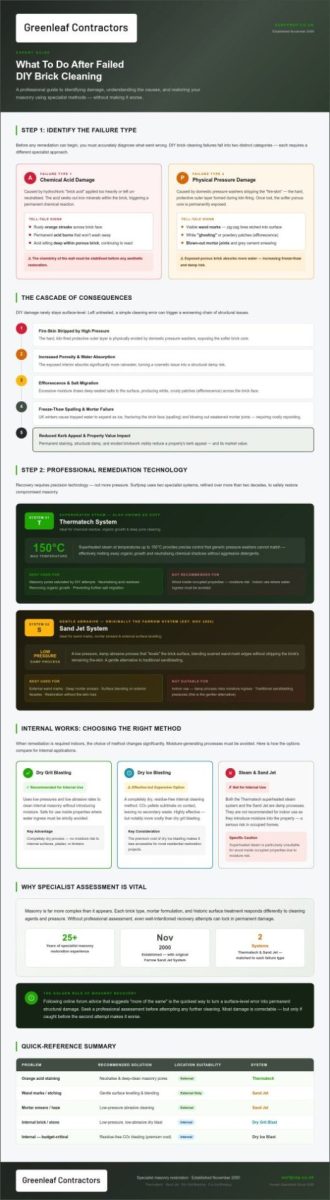
An acid burn is a chemical reaction between masonry minerals and unbuffered cleaning agents. When hydrochloric acid (often sold as “brick acid” in hardware stores) is applied too heavily or isn’t neutralised, it seeks out iron minerals within the brick. This results in a permanent, rusty orange hue that won’t simply wash away with water. Because bricks are porous, this acid can sit deep within the structure, continuing to react long after the surface appears dry. It’s a mistake we’ve seen frequently since we established Surfprep in November 2000, and it requires a methodical approach to stabilise the chemistry of the wall before the aesthetic can be restored.
Physical Erosion from High Pressure
Domestic pressure washers are often the primary culprit behind “wand marks,” those visible zig-zag lines etched into the surface. High-pressure jets strip away the “fire-skin,” which is the hard, protective outer layer formed during the kiln-firing process. A foundational understanding brickwork reveals that once this skin is compromised, the softer, more porous interior of the brick is exposed. This increase in porosity leads to higher water absorption, making the building more susceptible to damp and freeze-thaw damage. Beyond the bricks themselves, aggressive pressure can easily blow out weathered mortar joints, leading to costly repointing requirements. It’s why we always advocate for low-pressure, high-heat systems like Thermatech or our gentle Sand Jet over standard power washing.
Another common issue is mortar smearing, where attempting to clean “green” or wet pointing spreads grey cement dust across the brick face, creating a permanent haze. Excessive water saturation from DIY attempts can also trigger efflorescence, pulling deep-seated salts to the surface as white, crusty patches. Identifying these issues early is the only way to prevent long-term structural deterioration whilst planning a professional recovery.
For those who have recently moved into a new-build property, identifying such defects is often the first step in a wider quality check. Specialist providers like Snag My Home offer professional snagging lists that can highlight masonry failures and other construction issues, ensuring they are rectified before they impact the property’s long-term value.
Professional Remediation: Fixing the Damage with Specialist Technology
Once the extent of the damage is understood, the focus shifts to recovery. If you’re currently researching what to do after failed DIY brick cleaning, the solution lies in precision technology rather than aggressive manual labour. Following advice from online forums that suggests “more of the same” is usually the quickest way to turn a surface-level error into permanent structural damage. Understanding the dangers of improper cleaning is the first step toward a professional recovery that respects the masonry’s integrity.
The Thermatech Advantage
Whilst “DOFF” is a widely recognised industry term that many customers search for, we specifically utilise the Thermatech system. This machine allows us to produce superheated steam at temperatures up to 150°C, providing exceptional temperature and pressure control that generic pressure washers simply can’t match. This high heat effectively melts away organic growth and neutralises chemical shadows without the need for further aggressive detergents. It’s the safest method for deep-cleaning masonry pores that have been saturated by improper DIY attempts, ensuring no further salts are drawn to the surface.
The Sand Jet: A Gentle Alternative
For those visible “wand marks” or deep mortar smears, we employ the Sand Jet. Originally acquired as the Farrow System when we started in November 2000, we present this machine as a gentle alternative to traditional sandblasting. It uses a low-pressure, damp abrasive process to “level” the surface of the brick, blending scarred edges without stripping the brick’s remaining fire-skin. It’s particularly effective for external restoration because it avoids the harsh, destructive impact of standard grit blasting on exterior faces. However, because this is a damp process, it isn’t suitable for internal use where moisture ingress must be avoided. For interior brickwork, we prefer traditional dry grit blasting at low pressures or dry ice blasting, though dry ice remains a more expensive option. We also never recommend superheated steam for internal wooden beams due to moisture risks in occupied houses. If you’re unsure which method fits your property, our team can provide an honest specialist assessment of your masonry.
Choosing the Right Path: Why Specialist Expertise is Vital for Masonry
Selecting a professional partner is the final, most critical step in determining what to do after failed DIY brick cleaning. Unlike a ‘man with a van’ outfit or a general builder, a specialist understands that masonry isn’t a uniform material. The porosity of a soft red brick found in Manchester differs vastly from the dense Accrington bricks of Leeds or the weathered stone seen in York and Hull. Since establishing Surfprep in November 2000, we’ve seen how a ‘one size fits all’ approach amongst DIYers inevitably leads to the dangers of abrasive cleaning, where the physical damage caused by the process is often worse than the original stain.
True restoration is about more than just a quick wash. It’s a methodical process designed to preserve the aesthetic and structural value of your property. Sometimes, our ‘Expert Admission’ is telling a client that a specific stain cannot be removed further without risking the integrity of the brick. We prioritise the long-term health of the building over a temporary, cosmetic fix that might lead to crumbling faces in three years’ time. This honesty is what has allowed us to support homeowners across the North of England for over two decades.
Reliable maintenance extends beyond the walls of your home. Just as specialist masonry care preserves your property, ensuring your vehicle receives expert attention is crucial; for motorists in the East Midlands, a professional timing chain replacement Leicester from a trusted garage ensures your car remains as robust as your newly restored brickwork.
Restoration vs. Cleaning
While cleaning is often a surface-level task, restoration involves a deep understanding of the building’s history and material composition. For period properties, maintaining the original colour and texture is essential for preserving the home’s market value. Professional brick restoration ensures that the remediated areas blend seamlessly with the untouched masonry, avoiding the unsightly ‘patchwork’ look that often follows an unsuccessful DIY attempt.
Preparing for a Professional Quote
To help us provide an accurate assessment, it’s useful to gather a few details about the project. Knowing the approximate age of the property, the specific brick type, and exactly which chemicals were used during the initial attempt allows us to choose the correct neutralising agents. If you’re ready to move past the frustration of a botched job and want to know exactly what to do after failed DIY brick cleaning, we encourage you to contact us for a specialist assessment. We’ll provide a clear, technical plan to restore your masonry’s character safely.
Taking the First Step Toward Professional Recovery
Failed DIY attempts often leave homeowners feeling as though their masonry is beyond repair, but identifying the specific failure is the first stage of a successful restoration. Whether you’re dealing with stubborn acid burns or physical scarring from a pressure washer, the key is to move away from aggressive “all-purpose” solutions and toward precision technology. Since November 2000, we’ve specialised in helping clients navigate what to do after failed DIY brick cleaning by using controlled systems like Thermatech superheated steam and the gentle Sand Jet, originally the Farrow System.
We serve Leeds, York, Hull, and the wider North, bringing decades of experience to every project. We understand the unique properties of regional brickwork and ensure that every remediation plan prioritises the long-term integrity of your building. You don’t have to live with the visible marks of an unsuccessful weekend project; professional restoration can bring back the original character of your home whilst protecting its market value. Contact Surfprep for a Professional Brick Restoration Assessment today and let our honest specialists find the right path for your property.
Frequently Asked Questions
Can acid-burnt bricks be restored to their original colour?
Yes, in most instances, acid-burnt bricks can be restored by neutralising the ongoing chemical reaction and professionally treating the resulting iron-oxide staining. This process involves using superheated steam from a Thermatech machine to stabilise the masonry’s pH levels and lift the rusty hue from deep within the pores. It’s a delicate chemistry problem that requires a specialist’s touch to ensure the brick isn’t further degraded by additional unbuffered chemicals.
How do I remove pressure washer lines from my brickwork?
Removing pressure washer lines, commonly known as “wand marks,” requires a controlled abrasive process to blend the scarred edges into the surrounding masonry. We utilise the gentle Sand Jet (originally the Farrow System) to level these physical indentations without stripping away the remaining protective fire-skin of the brick. This is a vital step in what to do after failed DIY brick cleaning to prevent permanent visual damage and increased water absorption in the future.
Is it possible to fix mortar smears after they have dried?
It is certainly possible to fix dried mortar smears, though the process requires lifting the cement residue without scouring the underlying brick face. We employ precise, low-pressure methods to dissolve the “ghosting” effect whilst preserving the original texture and colour of the masonry. Since establishing our business in November 2000, we’ve refined these techniques to ensure that even stubborn, aged mortar smears can be remediated without the need for aggressive, damaging tools.
Why has my brickwork turned white after I cleaned it?
White powdery patches on your brickwork are typically caused by efflorescence, a process where excessive water saturation from cleaning pulls natural salts to the surface. This often happens after DIY attempts where too much pressure or volume was used. To resolve this, the masonry must be allowed to dry thoroughly before a specialist uses a low-moisture Thermatech clean to remove the salt deposits safely, ensuring they don’t simply soak back into the wall.
