
Vandalism is an unwelcome reality for commercial property managers. When graffiti appears, the immediate instinct is to search for a graffiti removal service, driven by a legitimate fear of permanent staining and damage to brand reputation. Whilst speed is a factor, the true priority for protecting valuable assets—especially the historic brick and stone common across the North of England—is the method of removal.
An incorrect or overly aggressive approach, often performed in haste, can cause more irreversible harm than the graffiti itself. This guide explains why a specialist, substrate-first approach is the key to effective graffiti removal, preserving the integrity of your commercial property for the long term.
Table of Contents
-
The Criticality of Prompt Graffiti Removal for Asset Preservation
-
Substrate-Safe Removal Techniques: Doff Steam and Specialist Media
-
Implementing a Graffiti Management Strategy for Northern Businesses
The Criticality of Prompt Graffiti Removal for Asset Preservation
While we prioritise a methodical, safe approach over a purely rapid one, the science behind why you should act promptly remains valid. Understanding the chemistry involved highlights why leaving graffiti untreated is a significant risk to your property’s material health and commercial value.
-
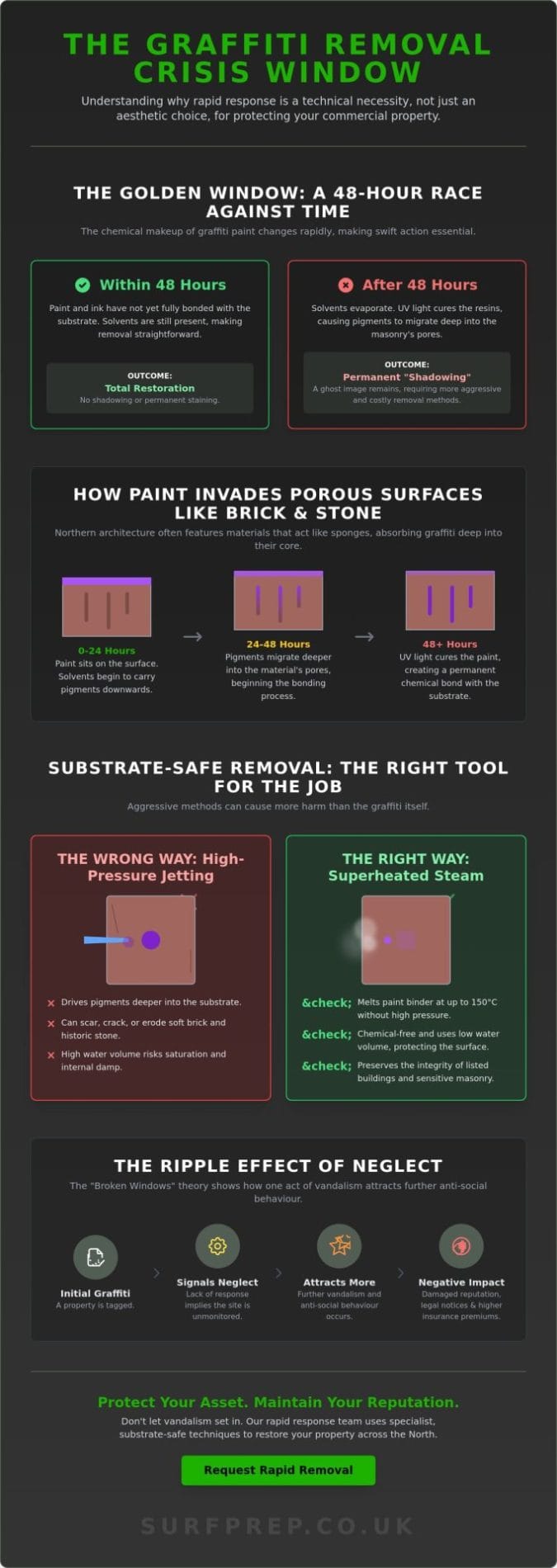
The ‘Golden Window’: The first 24-48 hours are crucial. During this time, aerosol paint and marker ink are still curing. Removing them is far less intensive than after they have fully bonded with and migrated into the substrate.
-
Understanding the ‘Broken Windows’ Theory: A property that appears neglected can attract further vandalism and anti-social behaviour. Promptly restoring a facade sends a clear message that the building is actively managed and maintained.
-
The Risk of ‘Shadowing’: When graffiti is left on a surface, particularly in direct sunlight, the UV light can ‘bake’ the pigments into the material. Even after the paint is removed, a faint ‘ghost’ image can remain, a permanent reminder of the vandalism.
-
Legal and Insurance Implications: For commercial landlords, maintaining a property’s appearance is often part of tenancy agreements and insurance policies. Neglecting vandalism can have contractual consequences beyond the aesthetic damage.
Why Porous Surfaces Require Immediate Intervention
Materials like brick and sandstone, common in the architecture of Leeds, York, and Manchester, are notoriously porous. They act like sponges, not just for water, but for the solvents found in spray paint. Whilst the paint pigment may initially sit on the surface, these solvents carry dyes deep into the masonry’s core. Over time, UV light accelerates this process, curing the paint and making its complete removal exponentially more difficult without resorting to aggressive techniques that can damage the substrate itself. (graffiti removal methods)
Maintaining Brand Reputation in City Centres
For a business, a clean and well-maintained facade is a direct reflection of its brand. Vandalism can deter customers, lower footfall, and create a negative perception of the area. In busy retail and commercial hubs, maintaining the aesthetic integrity of your building is essential. This is why professional graffiti removal should be viewed as a component of a broader maintenance strategy, much like professional brick cleaning, designed to uphold your asset’s value and public image.
Substrate-Safe Removal Techniques: Superheated Steam (DOFF etc) and Specialist Media
The greatest risk in graffiti removal isn’t the paint; it’s the potential for permanent damage caused by an improper cleaning method. High-pressure jet washing can scar brickwork, shatter delicate pointing, and drive pigments deeper into porous stone. Our philosophy is built around using the most effective, least aggressive method possible, tailored to the specific material of your facade.
-
Superheated Steam: Operating at 150°C but at a surprisingly low pressure is the gold standard for removing paint from delicate surfaces. It melts the graffiti, allowing it to be gently rinsed away without saturating the substrate or using abrasive force.
-
The ‘Honest Specialist’ View: Sometimes, steam alone isn’t enough for deeply ingrained shadowing. In these cases, specialist chemical poultices may be necessary. However, their use must be carefully managed, particularly amongst historic masonry, to avoid causing salt damage or discolouration.
-
Avoiding the ‘Pressure Washer Trap’: We cannot overstate the danger of using high-pressure cold water on graffiti. It often forces paint particles further into the brick’s pores and can cause spalling and erosion, leading to costly future repairs.
-
Substrate-Specific Protocols: Our approach is never one-size-fits-all. We have specific, tested protocols for removing graffiti from metal cladding, glass, timber, and of course, the delicate heritage facades found across the North.
The Superheated Steam Advantage for Graffiti Removal
These high temperature systems melt the paint’s binder (the ‘glue’ that makes it stick) without relying on brute force. Because it uses a low volume of water which evaporates quickly, it is a chemical-free, low-moisture system that protects the substrate’s natural ability to breathe. This makes steam the preferred choice for listed building exterior cleaning and conservation projects in cities like York and Durham, where preserving original materials is paramount. (Substrate-Safe Removal Techniques)
Chemical-Free and Environmentally Conscious Options
In modern urban environments, environmental responsibility is key. We prioritise biodegradable, non-toxic removal agents where possible and implement careful containment strategies. Our teams are trained to manage all run-off and waste, ensuring full compliance with UK environmental regulations and protecting the surrounding public spaces.
Implementing a Graffiti Management Strategy for Northern Businesses
The most effective way to deal with graffiti is to have a plan. Rather than reacting to each incident as an emergency, a proactive management strategy can minimise both the cost and the impact of vandalism over the long term. This involves understanding your vulnerabilities and investing in protective measures where appropriate.
-
Proactive vs Reactive: The application of anti-graffiti coatings in high-risk areas can transform removal from a complex restoration job into a simple cleaning task.
-
Regional Logistics: Our specialist teams are equipped to coordinate and deliver methodical cleaning services across major Northern hubs, including Hull, Sheffield, and Nottingham, ensuring a consistent, high-quality result.
-
Integrated Maintenance: We work with facilities managers to integrate graffiti management into broader building maintenance schedules, ensuring your property remains in pristine condition.
-
The Cost-Benefit of Professional Removal: The cost of a DIY attempt gone wrong—resulting in scarred brickwork or permanent shadowing—far outweighs the investment in a professional, specialist service that guarantees the protection of your facade.
Anti-Graffiti Coatings: Sacrificial vs Permanent
Choosing the right coating depends on the surface and the level of risk.
Sacrificial coatings are typically clear, wax-based layers applied to porous surfaces like brickwork. When graffiti occurs, the coating is gently removed using hot water, taking the paint with it, before being reapplied.
Permanent coatings create a durable, non-stick barrier, usually on metal or other non-porous surfaces. Graffiti can then be wiped off with a simple cleaning agent, without affecting the coating itself. (best practices for removing graffiti from historic masonry)
Commercial Service Agreements and Rapid Deployment
For businesses in high-traffic areas like Manchester and Newcastle, organising a priority service agreement can provide peace of mind. We can establish pre-approved risk assessments and method statements (RAMS) for your property, allowing for more efficient deployment when an incident occurs. All work is preceded by a site-specific assessment to ensure public safety and minimal disruption, particularly in busy city centres.
Protect your property with a professional, substrate-safe approach. Contact Surfprep for an expert graffiti removal quote today.
Frequently Asked Questions
-
How quickly can you remove graffiti from a commercial property?
Our focus is on providing the correct, most effective treatment rather than an instant response. We schedule a site assessment as soon as possible to analyse the substrate and the type of graffiti, allowing us to deploy the right team and equipment for a safe and thorough removal. -
Will professional graffiti removal damage my original brickwork or stone?
Not when done correctly. Our primary goal is asset preservation. We use low-pressure, high-temperature systems like superheated steam specifically to avoid the physical damage, abrasion, and saturation caused by traditional jet washing. -
Is it possible to remove graffiti from listed or historic buildings safely?
Absolutely. We specialise in heritage work and use non-aggressive, conservation-approved methods. The DOFF systemis frequently specified by architects and conservation officers for its gentle yet effective action on delicate historic masonry. -
What is an anti-graffiti coating and do I really need one?
An anti-graffiti coating is a transparent protective layer that prevents paint from bonding with the surface beneath. If your property is in a high-risk area and subject to repeated vandalism, a coating is a highly effective, long-term investment that makes future cleanup faster, cheaper, and less invasive.
