
For a facilities director or commercial property manager overseeing a diverse portfolio, graffiti is more than an aesthetic nuisance—it’s an operational risk. Unmanaged tagging can devalue assets, deter high-quality tenants, and create a perception of neglect that invites further anti-social behaviour. A reactive, site-by-site approach often leads to inconsistent results, spiralling costs, and potential damage to historic or delicate building façades.
The solution is to move from reactive cleaning to proactive management. A formalised Graffiti Management Plan (GMP) transforms graffiti from an unpredictable problem into a managed operational line item. This guide provides a strategic framework for creating a robust GMP for your UK property portfolio, helping you protect your assets, control costs, and maintain curb appeal across all your sites in 2026.
The Foundation of a Graffiti Management Plan for UK Portfolios
A Graffiti Management Plan (GMP) is a formalised strategy that outlines how a property portfolio will prevent, manage, and remove graffiti to minimise its visual and financial impact. It’s a proactive document that standardises procedures, sets clear expectations, and ensures a consistent brand image across all assets, from industrial parks in Nottingham to city-centre offices in Leeds.
In the UK, the legal landscape adds a layer of urgency. Under the Anti-social Behaviour Act 2003, local authorities have the power to issue Graffiti Removal Notices to property owners. Failure to comply can result in the council carrying out the work and billing you for it, often at a premium and without the specialist care your building’s substrate might require.
This links directly to the “Broken Windows Theory” in a commercial context. A single, unaddressed tag acts as an invitation for more significant vandalism. It signals that a property isn’t being closely monitored, which can reduce tenant confidence, deter customers, and ultimately lower the property’s market value. In competitive commercial hubs like Manchester, maintaining pristine curb appeal is crucial for tenant retention and attracting investment.
Why Portfolios Need Centralised Strategies
Managing graffiti on a case-by-case basis across multiple properties is inefficient and fraught with risk. A reactive approach often results in:
- Inconsistent Results: Different contractors or in-house teams may use varying methods, leading to a patchwork of quality and potential surface damage.
- Unpredictable Costs: Emergency call-out fees and a lack of negotiated rates make budgeting impossible.
- Slow Response Times: Without a clear protocol, graffiti can linger for weeks, increasing the likelihood of re-tagging and making the paint harder to remove.
A unified, portfolio-wide plan allows for streamlined budgeting, faster response times through pre-vetted contractors, and consistently high standards of removal that protect the underlying fabric of your buildings.
The Financial Impact of Neglect
Ignoring graffiti has long-term financial consequences beyond potential council fines. Its presence can suggest a lack of security, making tenants and their customers feel unsafe. Furthermore, the cumulative cost of using incorrect cleaning methods—such as high-pressure jet washing or harsh chemicals on soft brick—can cause irreversible substrate damage. This leads to far more expensive restoration work, like repointing or stone replacement, down the line.
A 5-Step Template for Your Portfolio Graffiti Strategy
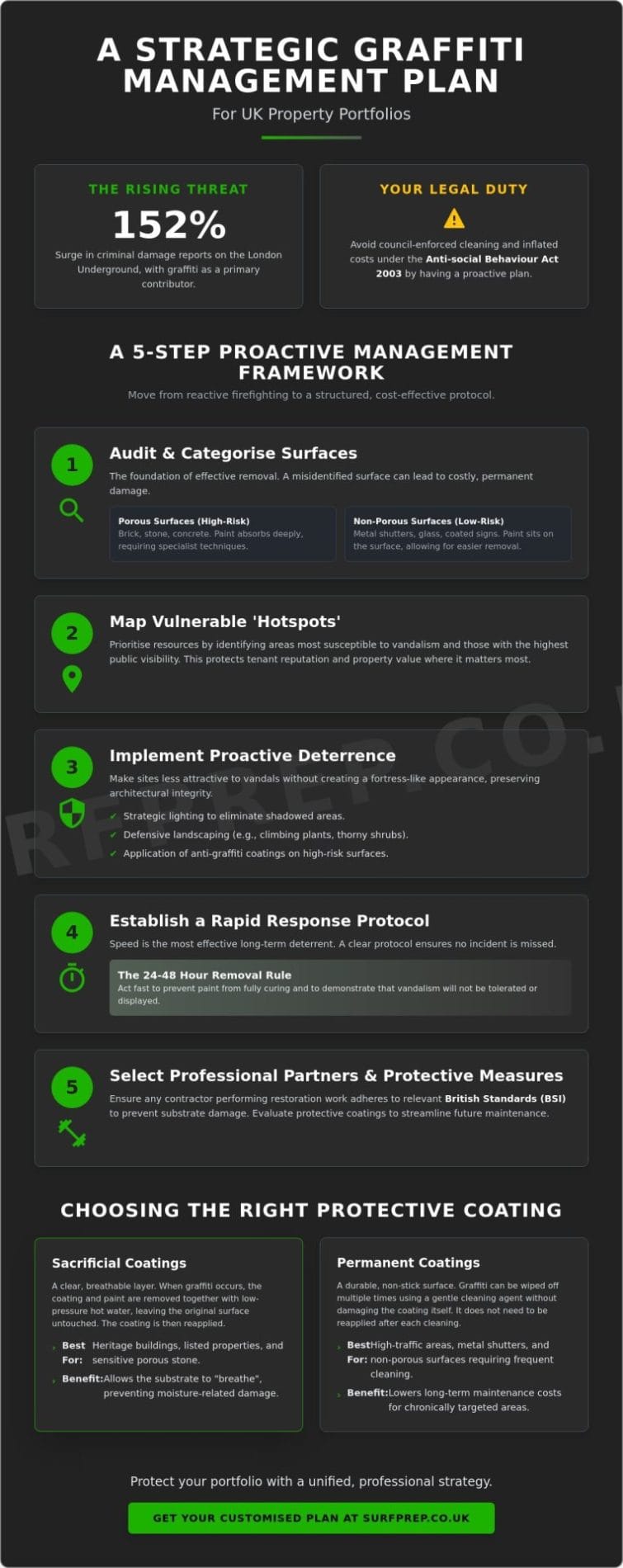
A successful GMP is a living document built on a continuous cycle of auditing, prevention, rapid response, and review. This five-step template provides a practical framework for any UK property portfolio.
- Asset Audit & Risk Mapping: Identify “hotspot” properties and vulnerable surfaces.
- Prevention & Deterrence: Implement measures to make your properties less attractive targets.
- The Rapid Response Protocol: Establish a clear, time-bound process for removal.
- Substrate-Specific Methodology: Define approved cleaning methods for different materials.
- Partner Selection & Performance Review: Choose the right contractor and set clear KPIs.
Step 1: Audit and Risk Assessment
The first step is to understand your vulnerabilities. Walk every property and categorise its surfaces and risk level.
- Categorise Surfaces: Differentiate between porous surfaces (brick, sandstone, concrete) and non-porous surfaces (metal shutters, glass, coated cladding). Porous materials absorb paint, making removal far more complex and delicate.
- Identify High-Risk Areas: Note areas with low visibility, poor lighting, or easy public access. Pay special attention to high-visibility zones like main entrances, ground-floor walls, and prominent signage, where graffiti causes the most reputational damage.
- Map Your Hotspots: Use this data to create a risk map of your entire portfolio, highlighting which sites require the most robust preventative measures.
Step 2: Prevention & Deterrence
While removal is essential, prevention is always more cost-effective. Consider implementing a combination of the following:
- Hostile & Defensive Landscaping: Planting thorny shrubs or climbing plants (e.g., Pyracantha) along ground-floor walls creates a natural barrier.
- Improved Lighting: Motion-activated security lights are a powerful deterrent in secluded alleyways or rear service yards.
- CCTV Surveillance: Visible cameras not only deter vandals but also provide evidence for prosecution if an incident occurs.
- Anti-Graffiti Coatings: Applying a clear sacrificial or permanent coating to high-risk surfaces makes removal faster, cheaper, and less damaging. We discuss these in more detail below.
Step 3: Implementing the Rapid Response Protocol
Speed is your greatest weapon against repeat tagging. When graffiti is removed quickly, it denies the vandal the recognition they seek. Your protocol should establish a “24-48 hour removal rule” to prevent paint from fully curing into the substrate.
Define a clear reporting chain: Who is responsible for spotting and reporting an incident (e.g., security staff, tenants, site managers)? Who logs the report? Who authorises and deploys the cleaning team? This streamlined process eliminates delays and ensures accountability. For a deeper dive into protecting your assets, see our guide on graffiti removal for commercial properties in the North.
Selecting Professional Partners and Protective Measures
The success of your GMP hinges on the technical expertise of your chosen partners. Using a general cleaning company without specialist knowledge of surface restoration can be a costly mistake. A professional contractor will not only remove the graffiti but will also protect the long-term integrity of your property’s façade.
Ensure any contractor you engage follows British Standards (BSI) for surface cleaning, such as BS 8221-1:2012 for cleaning and surface repair of buildings. This is particularly critical for heritage or listed properties where improper techniques can lead to irreversible damage and legal issues.
A key element of this is choosing the right protective measures. Anti-graffiti coatings are an excellent preventative tool for hotspot areas. They come in two main types:
- Sacrificial Coatings: These are clear, biodegradable coatings that form a protective film. When graffiti occurs, the coating is removed along with the paint using hot water, and a new layer is then reapplied. Ideal for sensitive or historic surfaces.
- Permanent Coatings: These are typically polyurethane or silicone-based coatings that create a non-porous surface. Graffiti can be wiped off multiple times with a special remover without damaging the coating. Best for durable, high-traffic areas like metal shutters or concrete walls.
Technical Standards: Superheated Steam Cleaning (Thermatech & Doff)
For removing graffiti from porous surfaces like brick and stone, the industry gold standard is superheated steam cleaning. This method is often known by the popular brand name DOFF, but other advanced systems like Thermatech operate on the same principle, delivering exceptional results without resorting to harsh chemicals or abrasive blasting.
A superheated steam system uses a combination of high temperature and low pressure, heating water to 150°C to melt paint, grease, and biological matter away from the surface. Because the volume of water is low and pressure is gentle, the substrate is not saturated or damaged, making it the favoured method for conservation-grade work on historic buildings. Here at Surfprep, we utilise the Thermatech system, a market-leading piece of equipment that gives us precise control for outstanding, safe results. For more on the specifics, read our comparison: Therma-Tech vs DOFF System.
Vetting Your Cleaning Contractor
When selecting a specialist partner for your portfolio, look for “Expert Admission.” A good contractor will be honest about a surface’s limitations and will tell you when a particular method isn’t suitable. Ask them directly:
- Do you have specific experience with heritage masonry and industrial surface preparation?
- Can you demonstrate your ability to scale services across multiple cities, from Hull and Bradford to Newcastle?
- What are your procedures for adhering to BSI standards and environmental regulations?
A proven track record is non-negotiable. Surfprep, for example, has been delivering specialist surface restoration services since our founding in November 2000, giving us decades of hands-on experience. A long-established specialist provides the reliability and expertise needed to manage a high-value property portfolio.
By implementing a structured GMP and partnering with a qualified specialist, you can protect your assets, control maintenance budgets, and ensure your properties remain a credit to your portfolio.
Frequently Asked Questions (FAQs)
Is graffiti removal a legal requirement for UK property owners?
Yes, it can be. While there is no blanket law forcing immediate removal, local authorities can serve a “Graffiti Removal Notice” under the Anti-social Behaviour Act 2003. This legally requires the property owner to remove the graffiti within a specified timeframe (usually 28 days). If the owner fails to act, the council can perform the work and recover the costs from them.
How much does it typically cost to remove graffiti from a commercial building?
The cost varies significantly based on the size of the graffiti, the type of surface (porous brick is more expensive than smooth metal), accessibility, and the removal method required. A small tag on a metal shutter might cost £150-£300, whereas a large mural on a historic stone façade could run into thousands. A portfolio-wide contract with a specialist provider can offer more predictable rates and better value than one-off emergency call-outs.
Do anti-graffiti coatings actually work on porous brickwork?
Yes, they are highly effective. A breathable, transparent sacrificial coating can be applied to brickwork without altering its appearance. When the brick is tagged, the coating is washed off with hot water, taking the paint with it. The coating is then simply reapplied to the clean area. This prevents paint from soaking into the brick, avoiding the need for potentially damaging chemical or abrasive cleaning methods on future incidents.
What is the best way to remove spray paint from historic stone buildings?
The safest and most widely recommended method for historic or listed stone buildings is superheated steam cleaning (such as that from a Thermatech or DOFF system). This technique uses steam at 150°C at very low pressure to melt the paint without abrading or saturating the delicate stone. It is a non-chemical, non-abrasive process that is compliant with conservation standards and effectively removes graffiti without causing harm to the historic fabric.
