
That high-pressure washer or bottle of household bleach in your shed might be the single biggest threat to your property’s structural heritage. Whilst the immediate results look satisfying, aggressive “blasting” often opens the stone’s pores, creating a perfect habitat for even more stubborn regrowth. You’ve likely seen the green algae or black lichen creeping across your masonry, making surfaces dangerously slippery and masking the natural beauty of the building. If you’re wondering how to remove biological growth from stone without causing permanent damage, you aren’t alone; many property owners find themselves trapped in a cycle of failed DIY attempts that eventually scour the surface.
We believe in a more considered approach that balances clinical effectiveness with material preservation. In this specialist UK guide, you’ll discover the safest methods for restoring your masonry, from the precision of Thermatech superheated steam to our gentle sand jet system (a damp process we first mastered as a Farrow System back in November 2000). We will move beyond the “quick fix” mentality to explore how managing moisture and pH levels provides long-term protection. We’ll show you how to achieve a clean, restored appearance whilst maintaining the integrity of the original stone, giving you total confidence in your chosen restoration project.
Key Takeaways
- Learn to identify common UK organisms like algae and lichen to prevent “spalling,” where organic roots penetrate and fracture the stone surface.
- Discover how to remove biological growth from stone using Thermatech superheated steam, which kills spores at source without damaging the masonry.
- Understand why the sand jet is a gentle, damp alternative to traditional sandblasting for removing stubborn organic matter from external walls.
- Recognise the “Indoor Rule” that prohibits damp cleaning methods inside a property to protect structural integrity and prevent moisture ingress.
- Compare dry grit blasting and dry ice blasting as precision-controlled, water-free methods for restoring delicate internal stone and timber.
Identifying Biological Growth on UK Masonry
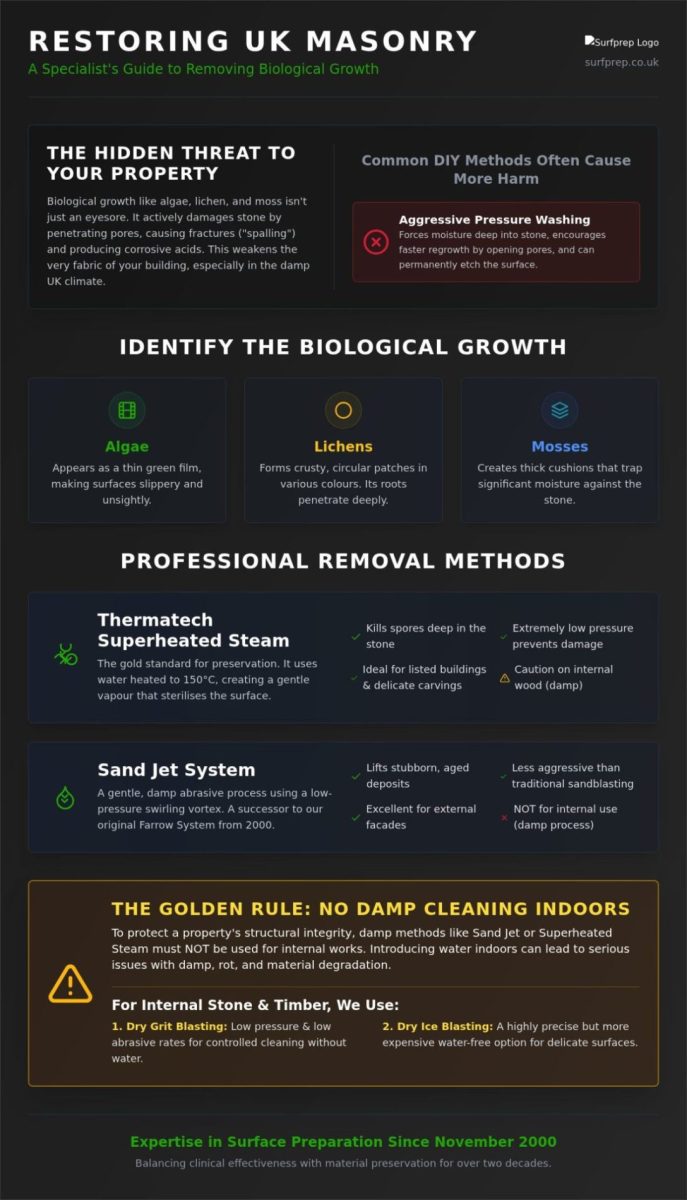
Walking past a damp, north-facing wall in the UK, you’ll likely notice a spectrum of green, grey, and orange hues. These aren’t just aesthetic blemishes; they are active biological colonies. To understand how to remove biological growth from stone effectively, you must first identify what is actually living on your masonry. Most common are algae, which appear as a thin green film; lichens, which form crusty, circular patches; and mosses, which create thick, water-retaining cushions.
Scientifically, many of these organisms are classified under the term What is a lithophyte?, referring to plants or organisms that grow on or in rocks. The real danger lies beneath the surface. These organisms use microscopic roots called hyphae to penetrate the natural pores of the stone. Over time, this root system expands, causing “spalling,” a process where the stone’s surface layers crack and flake away. This structural decay is accelerated by the UK’s increasingly wet winters and humid summers, which keep masonry saturated for months at a time.
Beyond physical root damage, these colonies produce acidic metabolic byproducts. These acids slowly lower the pH at the stone’s surface, chemically dissolving the calcium carbonate in limestone and the binders in sandstone. This doesn’t just dull the appearance; it weakens the very fabric of the building, making the surface more friable and susceptible to further erosion.
To prevent this type of chemical and structural degradation, it is advisable to explore cleaning and sealing of all Natural stone finishes with experts like Sealwerx, who focus on preserving the substrate’s integrity while restoring its aesthetic appeal.
Why “Just Pressure Washing” is Often the Wrong Answer
It’s tempting to reach for a standard high-pressure washer to “blast” the green away. We’ve seen the results of this approach since we started in November 2000, and it’s rarely pretty. High-pressure water often forces moisture deep into the stone’s core, which can lead to internal damp issues or frost heave. Aggressive pressure can also etch the stone, stripping away the protective “fire skin” and creating thousands of tiny new anchor points. This effectively provides a more hospitable environment for future growth, making the problem return faster and more aggressively than before. Gentle, controlled methods are essential to ensure the stone face remains intact whilst achieving a thorough clean.
Professional Removal Methods: Superheated Steam vs Sand Jetting
Moving from identification to action requires a shift in mindset from “cleaning” to “sterilising.” Whilst many people search for DOFF cleaning, we utilise the Thermatech system. It’s a high-specification machine that offers precise control over both heat and pressure. This distinction is vital when discussing how to remove biological growth from stone, as the goal isn’t just to strip the surface but to treat the underlying cause. By adjusting the balance of temperature and pressure, we can tailor the process to the specific density and condition of the masonry.
Thermatech: The Gold Standard for Biological Kill
The Thermatech system works by heating water to 150°C, producing a superheated vapour that is applied at remarkably low pressures. This heat is the secret to its success. It effectively cooks the biological matter, killing the spores that reside deep within the stone’s pores without the need for harsh chemical biocides. This makes it the preferred choice for listed buildings and delicate carvings where the structural integrity of the stone is the top priority. Killing the spores is far more important than just removing the visible growth; if the spores remain active, the green film or black spotting will return within months rather than years.
The Sand Jet Alternative for Stubborn Deposits
Some biological growth, particularly heavy lichen or aged carbon crusts, requires a bit more physical persuasion. This is where we deploy the sand jet. We’ve been specialists in this technology since November 2000, when we first acquired our Farrow System. Unlike traditional sandblasting, which can be incredibly destructive, the sand jet is a gentle, damp process. It uses a swirling vortex of low-pressure air, a small amount of water, and a fine abrasive to lift stubborn deposits without scarring the stone. It’s an excellent solution for external facades when considering how to remove biological growth from stone that has been left untreated for decades. You can learn more about our sand jet cleaning process to see if it suits your specific masonry type.
Choosing between these methods depends entirely on the stone’s condition and the type of growth present. We always adjust our parameters to suit the substrate, ensuring we never use more pressure than is strictly necessary. If you’re unsure which path to take, contacting a specialist for a technical assessment is often the safest first step.
Specialist Considerations for Heritage and Internal Stone
When dealing with period properties or internal masonry, the operational rules change significantly. Whilst Thermatech and sand jetting are excellent for external facades, they shouldn’t be used inside occupied houses or barn conversions. This is what we call the “Indoor Rule.” Introducing water into an enclosed space can lead to long-term damp issues, salt migration, or damage to nearby joinery. Instead, we look at dry grit blasting using low pressures and minimal abrasive rates. For particularly sensitive interiors, dry ice blasting is a moisture-free alternative, though it’s an expensive option that requires careful budget consideration.
Protecting Structural Integrity in Period Properties
Avoiding moisture ingress is critical in heritage restoration. If you’re working on a barn conversion, for instance, the risk of soaking structural elements is simply too high. Here is an Expert Admission: despite the popularity of superheated steam for external work, a dry method is often superior for internal stone restoration. It prevents water from being trapped behind plaster or within the core of the wall. If you’re also dealing with wooden elements, you might find our specialist guide to cleaning structural timbers useful. Working within UK conservation officer guidelines ensures that the historical character is preserved without compromising the building’s health.
Long-term Maintenance and Prevention
Once you understand how to remove biological growth from stone, the focus shifts to prevention. Regrowth is usually a symptom of poor air circulation or faulty drainage. Fixing leaky gutters and ensuring walls can “breathe” will discourage algae and moss naturally. We also avoid irrelevant industrial benchmarks like Sa 2.5; these metal-specific surface preparation standards have no place in masonry restoration. Our goal is always to restore the stone to its natural state using our professional stone cleaning services whilst ensuring the property remains dry and protected for the future. By combining the right technical method with improved site conditions, you can enjoy a clean, biological-free finish that lasts for years.
Securing the Future of Your Property’s Masonry
Effective restoration is a matter of technical precision and patience rather than brute force. We’ve explored how identifying the specific organisms, from green algae to crusty lichens, is the first step in stopping structural decay like spalling. Whether you utilise Thermatech superheated steam to kill spores at 150°C or the gentle damp abrasion of a sand jet (a system we have refined since November 2000), the goal remains the same: total removal without substrate damage. Understanding how to remove biological growth from stone also requires knowing when to stop; we never recommend damp processes for internal works, preferring dry grit or ice blasting to protect your property’s core.
As specialist contractors with over two decades of experience, we pride ourselves on being honest advisors for our clients. We serve Leeds, York, Hull, and the wider North, ensuring that every project benefits from our technical expertise and commitment to heritage standards. If you’re ready to restore your building’s natural character, you can request a professional stone cleaning assessment from Surfprep. Taking the right approach today ensures your masonry remains clean, stable, and beautiful for decades to come.
Frequently Asked Questions
Is biological growth on stone actually harmful or just an aesthetic issue?
Biological growth is far more than an aesthetic problem; it is a primary driver of masonry decay. Organisms like moss and lichen use microscopic roots to penetrate the stone’s surface, leading to “spalling” where the outer layers crack and fall away. Additionally, their metabolic processes produce acids that chemically dissolve the binders in sandstone and limestone. Ignoring these growths can lead to structural damage that is far costlier to repair.
Can I use household bleach to remove algae from my stone walls?
You should avoid using household bleach on stone because it introduces harmful salts into the masonry. When bleach dries, these salts can crystallise within the pores, causing efflorescence or physical “blowing” of the stone face. Professional methods like Thermatech superheated steam are much safer; they kill the spores with heat rather than relying on reactive chemicals that might cause long-term staining or damage the natural pH of the stone.
What is the difference between DOFF and Thermatech cleaning?
Whilst both systems use superheated steam, Thermatech is the specific equipment we have chosen for its superior temperature and pressure control. DOFF is a well-known industry term, but we find the Thermatech machine offers the precision needed for delicate heritage work. Both methods reach 150°C to ensure you know how to remove biological growth from stone at a biological level, effectively sterilising the surface without using harsh chemicals.
How much does professional biological growth removal cost in the UK?
The cost of professional cleaning in the UK varies based on technical factors including the stone type, building height, and the severity of the growth. Every project is unique, so we provide formal quotes based on a technical assessment rather than a flat rate. Factors like the requirement for scaffolding or the use of specialist biocides for stubborn black spots will also influence the final investment required for your property; to learn more about the chemistry behind these treatments, you can visit Patio Black Spot Removal Australia.
Will the sand jet method damage the mortar joints in my stone wall?
Our sand jet method is a gentle alternative to traditional sandblasting and won’t damage sound mortar joints when operated by a specialist. Because it uses a swirling vortex of low-pressure air and water, it lifts the biological matter without the aggressive “scouring” action of older systems. We’ve used this Farrow System technology since November 2000 to ensure that delicate masonry and its original pointing remain entirely intact during the stone restoration process.
How long will it take for the algae or lichen to return after professional cleaning?
Regrowth depends on the local environment, but professional sterilisation keeps stone clean significantly longer than standard pressure washing. Because systems like Thermatech kill the spores deep within the pores, the biological cycle is completely broken. If you improve site drainage and air circulation after the clean, you can expect the stone to remain clear for several years. Regular inspections help catch any new growth before it takes hold in damp, shaded areas.
