
Your local hire shop’s most powerful pressure washer is likely the greatest threat your period property faces. If you’re researching how to clean yorkstone, you probably want to see that vibrant, honey-hued buff return to your flags, yet you’re rightly terrified of stripping away two centuries of character. We understand that hesitation. Since we established our restoration business in November 2000, we’ve seen far too many historic surfaces scarred by aggressive, high-pressure water, which often does more harm than good by saturating the masonry.
This guide explains the safest professional techniques for removing stubborn carbon and organic growth without damaging the stone’s integrity. We’ll explore why we favour the Thermatech superheated steam system for external restoration and how our specialised sand jet provides a gentle alternative to traditional blasting. Crucially, we’ll also detail why internal projects (like soot-stained fireplaces) require a strictly dry approach to keep your home’s interior protected from moisture.
Key Takeaways
- Discover why Thermatech superheated steam is the preferred specialist method for restoring external masonry without the erosion risks of standard high-pressure washing.
- Understand the critical importance of using dry processes for internal stonework to avoid introducing moisture that can damage structural wooden beams or plasterwork.
- Learn how to clean yorkstone using a methodical professional approach that prioritises test patches and preserves the stone’s natural historic patina.
- Explore the benefits of the sand jet as a gentle abrasive alternative for stubborn carbon deposits, whilst identifying when premium options like dry ice blasting are the better choice.
The Nature of Yorkstone and the Challenge of Carbon Buildup
Yorkstone is a famously durable, carboniferous sandstone, yet its high porosity means it effectively “breathes” by absorbing moisture and atmospheric gases. In our Northern industrial heartlands like Leeds and Bradford, this characteristic has led to centuries of soot and carbon deposits bonding deeply into the stone’s mineral structure. We often have to make an expert admission: whilst that dark, “aged” look is part of our local heritage, heavy carbon crusts aren’t just an aesthetic issue. These deposits trap moisture against the surface, which can lead to accelerated decay or “spalling”, where the stone’s face begins to delaminate and flake away in layers.
Understanding the specific variant of sandstone you own is the first step in learning how to clean yorkstone safely. Without a proper assessment of the stone’s condition and density, you risk causing irreversible damage to your stone. Professional restoration always begins with identifying these vulnerabilities to ensure the chosen method preserves the stone’s integrity rather than stripping it away.
Why Traditional Pressure Washing Often Fails
A common mistake is reaching for a domestic pressure washer. High-pressure water jets often scour the surface of softer sandstone, leaving permanent “wand marks” or stripes that ruin the stone’s natural appearance. More critically, high pressure forces water deep into the stone’s pores. As this moisture eventually evaporates, it brings soluble salts to the surface, resulting in unsightly white efflorescence that is difficult to remove. Aggressive jetting also risks blowing out historic lime mortar joints, which are significantly softer than modern cement. This creates new pathways for water ingress, potentially leading to damp issues within the property’s structural fabric.
Professional Methods for Cleaning Exterior Yorkstone
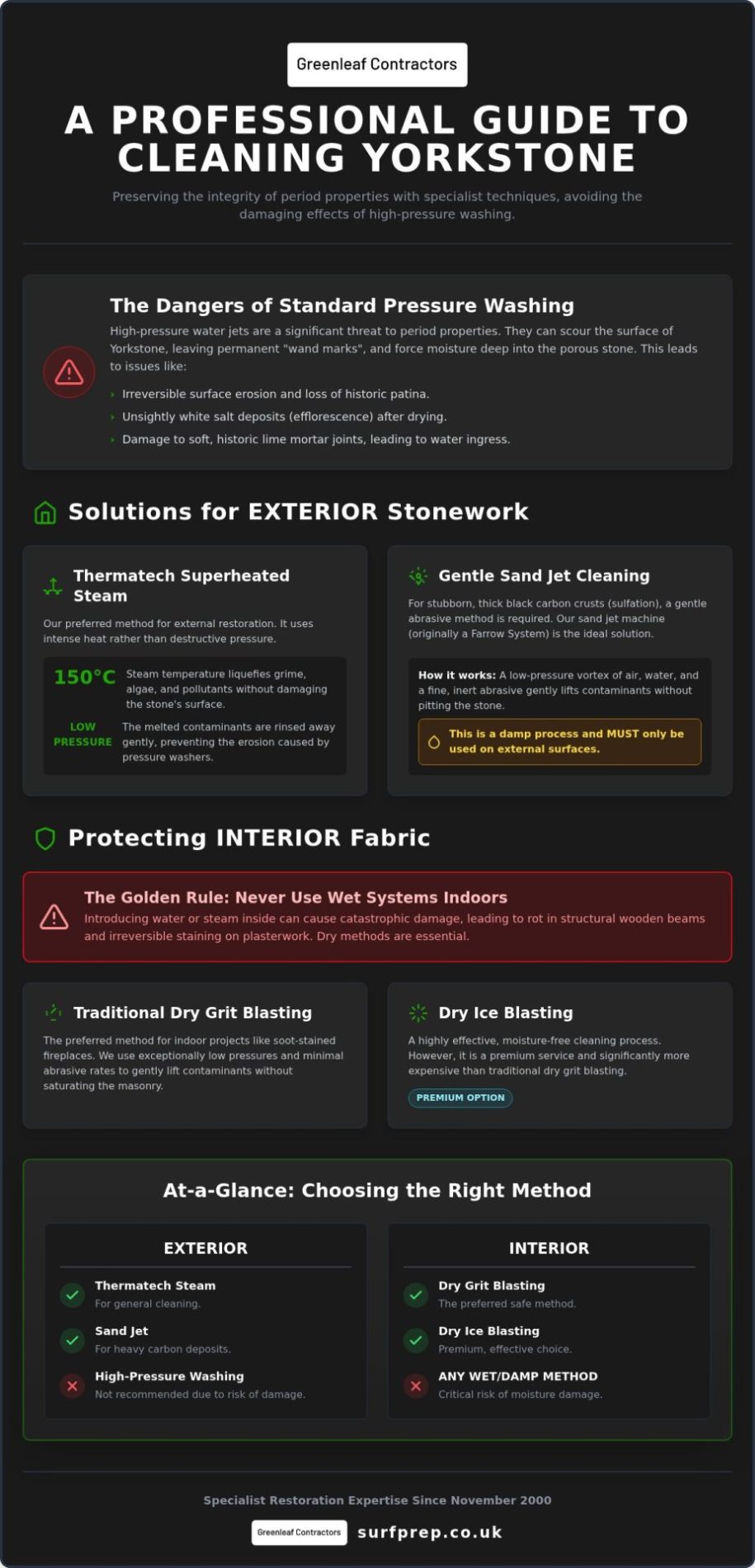
When deciding how to clean yorkstone on a building’s exterior, we favour the Thermatech superheated steam system as the premier non-chemical solution. Unlike domestic washers that rely on brute force, Thermatech produces steam at temperatures reaching 150°C. This intense heat liquefies the biological and chemical binders holding soot, lichen, and algae to the stone. Because the grime is essentially melted, we can rinse it away at very low pressure, which prevents the surface erosion typical of high-pressure alternatives. This gentle approach mirrors the conservation standards highlighted in this National Park Service video on historic masonry care.
Our professional process is always methodical. It begins with a detailed site assessment followed by discreet test patches to ensure the stone responds correctly. We then move to controlled cleaning and allow for natural drying. If you’re unsure about the best approach for your property, our team can provide specialist stone cleaning advice based on over two decades of experience.
The Sand Jet: A Gentle Alternative to Sandblasting
Stubborn “sulfation” crusts (thick, black deposits common in urban centres) often require more than steam alone. When professionals evaluate how to clean yorkstone with heavy buildup, the sand jet is often the preferred solution. We utilise a specialised sand jet machine, a system we’ve operated since November 2000 when it was originally acquired as the Farrow System. This machine uses a low-pressure vortex of air, water, and fine abrasive to gently lift contaminants. It’s a far safer alternative to traditional dry sandblasting, which often leaves stone permanently pitted. However, because this is a damp process, it must only be used for external restoration. For heritage projects in York or Hull, our sand jet cleaning service provides the precision needed to restore detail without introducing moisture into the building’s interior.
Cleaning Yorkstone Indoors: Protecting the Interior Fabric
Restoring internal Yorkstone, especially within occupied homes or sensitive barn conversions, requires a fundamentally different philosophy than exterior work. When considering how to clean yorkstone in a domestic setting, the priority shifts from speed to the long-term preservation of the building’s fabric. We maintain a strict professional rule: never use superheated steam or damp processes indoors. Introducing moisture into the stone via wet systems risks significant damage to structural wooden beams and adjacent plasterwork, which can lead to rot or staining far worse than the original soot.
Instead, we recommend traditional dry grit blasting. By utilising exceptionally low pressures and low abrasive rates, we can lift contaminants without saturating the masonry. For highly sensitive internal areas where dust management is the primary concern, dry ice blasting is a specialised, expensive alternative. It’s highly effective and leaves no secondary waste, making it ideal for high-end interiors where a “dry” finish is non-negotiable.
Low-Pressure Dry Grit Blasting and Specialist Aftercare
This dry technique is particularly effective for removing centuries of soot or layered paint from fireplaces without wetting the stone’s core. We’ve refined this approach since November 2000, specifically during complex barn conversion restoration projects where timber and stone intersect. It’s vital to remember that Yorkstone is a natural, breathing material. Once cleaned, we advise letting the stone settle naturally rather than immediately applying non-breathable sealants. Trapping residual moisture with modern coatings often leads to surface failure, so we always prioritise the stone’s ability to “breathe” over a quick-fix finish.
Restoring the Character of Your Period Property
Restoring Yorkstone is a delicate balance of removing centuries of grime whilst protecting the porous mineral structure underneath. Whether you’re revitalising a soot-stained fireplace or a weathered garden wall, the secret to how to clean yorkstone safely lies in choosing the right methodology for the specific environment. Our team has been specialist stone cleaners since November 2000, utilising advanced Thermatech superheated steam and the gentle sand jet (originally the Farrow System) to achieve vibrant results without the risks of high-pressure washing. We always advocate for dry processes indoors to prevent moisture damage to your home’s structural timbers. Serving Leeds, York, Hull, and the wider North, we pride ourselves on being honest specialists who prioritise the long-term integrity of your masonry. Contact Surfprep for a specialist Yorkstone cleaning quote and let us help you reveal the natural beauty of your property’s stonework.
Frequently Asked Questions
Can I use a pressure washer to clean my Yorkstone patio?
You should avoid using a standard domestic pressure washer on Yorkstone. High-pressure jets often scour the relatively soft sandstone surface, leaving permanent wand marks and stripping away the natural patina. Forcing water deep into the stone’s pores can also lead to efflorescence, or salt staining, as it dries. For a safe result, we recommend superheated steam, which cleans effectively at much lower pressures.
What is the difference between DOFF and Thermatech for stone cleaning?
Whilst DOFF is a well-known industry term for superheated steam cleaning, we specifically utilise Thermatech technology. Both systems achieve the 150°C temperatures required to liquefy biological growth and atmospheric pollutants without chemicals. We’ve found Thermatech to be exceptionally reliable for delicate restoration work since we began our specialist stone cleaning services in November 2000; it ensures a consistent, gentle finish on historic masonry.
Is it safe to clean a Yorkstone fireplace in an occupied house?
It’s perfectly safe to clean a Yorkstone fireplace indoors, provided you use a strictly dry method. We never recommend superheated steam or damp sand jetting for internal work. Introducing moisture can damage structural timbers and plaster in occupied homes. Instead, we use low-pressure dry grit blasting or dry ice blasting. These professional techniques effectively remove soot and paint whilst keeping your home’s interior fabric dry.
How long does professional Yorkstone restoration take?
The duration depends on the surface area and the level of carbon buildup. A typical domestic patio or large fireplace usually takes one to two days to complete. When we assess how to clean yorkstone for a specific project, we account for the time needed for test patches and controlled cleaning. Larger heritage facades requiring the sand jet may take longer to ensure a uniform, gentle restoration.
