
You might think that scrubbing away decades of soot requires the most aggressive pressure possible, but the opposite is often true for historic masonry. It’s frustrating to see beautiful Yorkshire stone or heritage brickwork hidden under a thick, black crust of pollution that domestic cleaners won’t touch. We understand the fear that a heavy-handed approach might cause more harm than good, leading to long-term decay. Since November 2000, we’ve focused on removing carbon buildup from stone using methods that respect the material’s integrity. This guide explores how to achieve a natural, ‘not over-cleaned’ finish using specialist technology. We’ll examine why our sand jet system is ideal for exterior work, whilst explaining the dry processes required to keep internal living spaces safe and moisture-free. You’ll gain expert advice tailored to UK heritage standards from a team with a quarter-century of practical experience.
Key Takeaways
- Learn why Thermatech superheated steam and the specialised Sand Jet (Farrow System) provide a gentle but effective solution for heavy exterior carbon crusts.
- Understand why dry processes are vital for internal stone to prevent moisture ingress, with options ranging from low-pressure grit blasting to the more expensive dry ice blasting method.
- Discover the technical balance of temperature and pressure required for removing carbon buildup from stone whilst ensuring the underlying masonry remains completely unharmed.
- Draw on expertise established in November 2000 to ensure your restoration project meets UK heritage standards and achieves a natural, professional finish.
Understanding Carbon Buildup and Stone Integrity
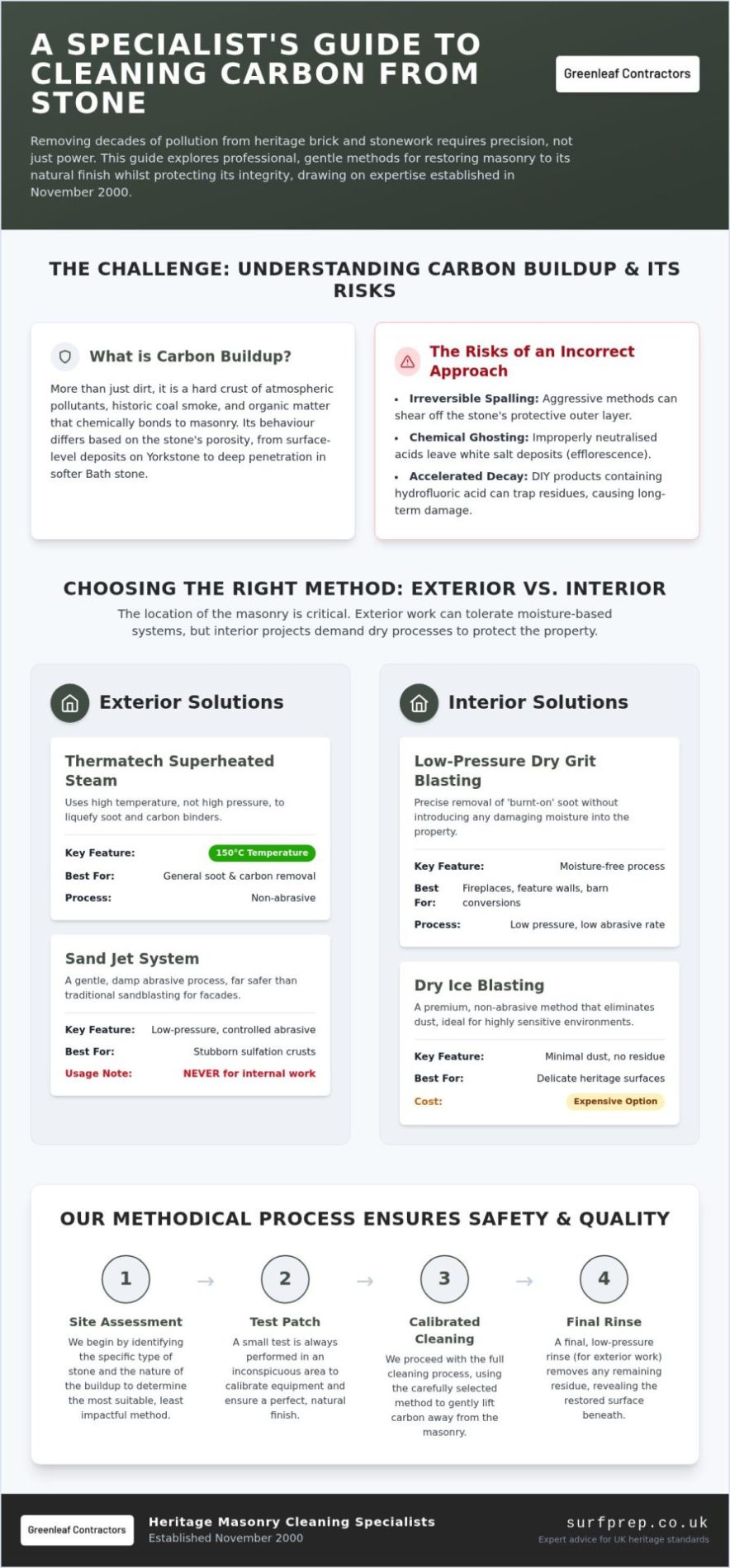
Carbon buildup isn’t just surface dirt; it’s a complex crust of atmospheric pollutants, historic coal smoke, and organic matter that bonds to porous masonry over decades. The way this layer behaves depends entirely on the substrate. Harder materials, such as Yorkstone, typically retain the deposit on the outer face, whilst softer stones like Bath stone allow pollutants to migrate deeper into the pores. Identifying the exact stone type is a non-negotiable first step in removing carbon buildup from stone. If the method is too aggressive for the material, you risk irreversible ‘spalling’, where the protective outer layer of the masonry simply shears off.
To be perfectly transparent, whilst chemical cleaners can be effective, they often come with a hidden cost. If these substances aren’t professionally neutralised, they frequently leave behind ‘ghosting’ or white salt deposits, known as efflorescence. These marks can be just as difficult to rectify as the original carbon crust, potentially leaving the stone looking patchy and unnatural.
The Risks of DIY Chemical Carbon Removal
Many off-the-shelf products contain hydrofluoric acid, which is exceptionally hazardous to both the operative and the stone’s mineral structure. Improper rinsing often traps acidic residues deep within the masonry, leading to accelerated decay that doesn’t show up until years later. We always advise that you consult a stone cleaning expert before attempting to use concentrated acids. For highly sensitive or heritage surfaces, professionals might consider Carbon dioxide cleaning as a non-abrasive alternative. Since establishing our business in November 2000, we’ve consistently found that a methodical, low-pressure approach preserves the building’s history far better than any ‘quick fix’ chemical solution.
Professional Methods for Removing Carbon Buildup
Professional stone restoration requires a delicate balance of heat and volume. We’ve found that traditional sandblasting is often too aggressive, stripping away the stone’s ‘face’ and leaving it vulnerable to the elements. Instead, our approach to removing carbon buildup from stone relies on controlled systems like Thermatech superheated steam. This technology reaches temperatures of 150°C, effectively liquefying the binders in carbon and soot without the need for high-pressure impact.
Every project follows a methodical sequence to ensure safety. We begin with a site assessment, followed by a test patch in an inconspicuous area. This allows us to calibrate the equipment before proceeding with the full cleaning and a final low-pressure rinse. These Best Practice Recommendations for Cleaning Headstones and historic masonry emphasise that the least impactful method should always be used first.
Superheated Steam vs. Sand Jetting for Exteriors
While steam handles most soot, stubborn ‘sulfation’ crusts, common on historic buildings in cities like Leeds and Manchester, may require more grit. Our specialised sand jet cleaning system, which we first adopted as a Farrow System in November 2000, offers a gentle abrasive alternative. It’s a damp process that softens the impact of the abrasive media, making it far safer than dry sandblasting for exterior facades. However, because it introduces water, we never recommend the sand jet for internal work; for those projects, dry methods are essential to keep your property dry. If you’re unsure which method fits your building, we can provide an expert assessment to find the right path.
Safe Carbon Removal for Internal Masonry and Heritage Projects
Internal restoration presents a unique set of logistical and physical challenges compared to external facades. When removing carbon buildup from stone inside a domestic property, such as a soot-stained fireplace or a feature wall in a barn conversion, moisture control is the primary concern. We advise against using superheated steam systems indoors; the high moisture levels can cause significant damage to surrounding wooden beams and delicate plasterwork. Instead, we utilise traditional dry grit blasting at exceptionally low pressures. This method allows for precise removal of ‘burnt-on’ soot without introducing water into the building fabric. For highly sensitive environments where dust must be kept to an absolute minimum, dry ice blasting is a highly effective option, though it’s important to recognise this as a more expensive, premium service.
Low-Pressure Dry Grit Blasting and Specialist Aftercare
Our team has refined these techniques since November 2000, specifically in the context of barn conversion cleaning where stone and timber meet. Dry grit blasting provides the control needed to strip away carbon crusts without eroding the mortar joints or the stone’s delicate patina. This precision is vital when removing carbon buildup from stone that has been exposed to open fires for generations. Once the carbon is removed, the stone’s appearance is restored to its natural state. A common mistake is to seal the masonry immediately. We recommend letting the stone ‘breathe’ for several weeks. This allows any deep-seated moisture to evaporate naturally, preventing future issues with trapped salts or damp. This patient approach ensures the restoration lasts for years rather than just months.
Restoring Your Masonry with Specialist Care
Successful restoration hinges on matching the cleaning method to the stone’s specific environment. Whether you’re tackling an exterior facade in Leeds or a soot-stained fireplace in a heritage home, the goal is always a natural finish that preserves the building’s character. Thermatech superheated steam and the specialised Sand Jet excel outdoors, whilst low-pressure dry grit blasting remains the safest choice for sensitive internal projects. Since November 2000, we’ve provided heritage-approved cleaning across York and the wider North, ensuring every project respects the integrity of the underlying masonry.
If you’re ready to begin removing carbon buildup from stone on your property, our team is here to provide an honest, professional assessment. Contact Surfprep for a specialist stone cleaning quote today. Your property has stood for generations; with the right specialist care, it will continue to look its best for many more to come.
Frequently Asked Questions
Can I use a pressure washer to remove carbon from stone?
You shouldn’t use a standard domestic pressure washer, as the high-pressure water stream can easily strip the protective ‘face’ off the masonry. This leads to accelerated weathering and erosion. For removing carbon buildup from stone in areas like Leeds or Hull, we prefer superheated steam or our specialised sand jet. These professional systems use temperature and gentle, damp abrasion to lift pollutants safely.
Is superheated steam cleaning (Thermatech) safe for listed buildings?
Thermatech is a heritage-approved method frequently used on listed buildings throughout York, Newcastle, and Manchester. It’s considered one of the safest options because it relies on 150°C steam to dissolve carbon binders rather than aggressive mechanical force. This ensures the stone’s historical patina remains intact whilst the harmful pollutants are removed, satisfying the strict requirements of most local conservation officers.
How long does it take to clean a stone fireplace of soot buildup?
A typical stone fireplace can usually be restored within four to eight hours. Because we prioritise keeping your home dry, we don’t use steam or damp processes like the sand jet indoors. Instead, our low-pressure dry grit blasting method provides a quick, controlled clean. This approach is particularly effective for barn conversions or period properties where moisture could damage nearby plasterwork.
What is the difference between DOFF and Thermatech for stone cleaning?
The primary difference lies in the manufacturer rather than the cleaning process itself. DOFF is a widely recognised brand name that has become a generic term for superheated steam cleaning. However, we specifically use the Thermatech system. We’ve found this equipment offers the precise temperature control needed for removing carbon buildup from stone during the restoration work we’ve performed since November 2000.
