
The cheapest quote for exterior cleaning might actually be the most expensive mistake you ever make for your property. We’ve seen it time and again since we started back in November 2000; a well-meaning homeowner hires a “man with a van” only to find high-pressure water has been forced into their delicate Victorian brickwork. When you’re researching the cost of professional pressure washing UK, it’s easy to get lost in a sea of conflicting rates and promises. You likely want a fair price, but more importantly, you want the peace of mind that comes from knowing your masonry won’t be scarred or saturated in the process.
We’re here to provide the transparency you need to budget effectively whilst explaining why the “how” matters just as much as the “how much.” In this guide, we’ll break down the factors that influence realistic 2026 pricing and explore why specialist methods (like our gentle sand jet machine, originally a Farrow System, or Thermatech superheated steam cleaning, often called DOFF) are the industry standard for restoration. You’ll learn which methods are safe for listed buildings, why we pivot to dry grit blasting for internal works to protect your interiors, and how to avoid the hidden costs of surface damage.
Key Takeaways
- Understand how the cost of professional pressure washing UK is calculated, moving beyond basic estimates to transparent square metre or fixed day rate models for complex restoration.
- Learn why the specific material of your property—from delicate stone window sills to industrial concrete—is the primary factor in determining the safest and most effective cleaning method.
- Discover the benefits of utilising Thermatech (widely known as DOFF) for superheated steam cleaning and our gentle sand jet machine as non-destructive alternatives to aggressive traditional sandblasting.
- Identify the critical importance of moisture management, specifically why we prioritise dry grit blasting for internal works to prevent water ingress in occupied buildings.
- Gain professional insights into how matching the right technology to your substrate safely removes paint and biological growth whilst protecting the long-term integrity of your masonry.
Understanding the Cost of Professional Pressure Washing in the UK
A professional service is defined by much more than just the pressure of the water. Since we established our business in November 2000, we’ve focused on the marriage of industrial-grade equipment and deep material expertise. Determining the cost of professional pressure washing UK involves more than a simple quote per driveway; it requires an understanding of the substrate being treated. True professionals don’t just “blast” surfaces. We assess the age of the brickwork, the porosity of the stone, and the nature of the contaminants before a single drop of water is sprayed.
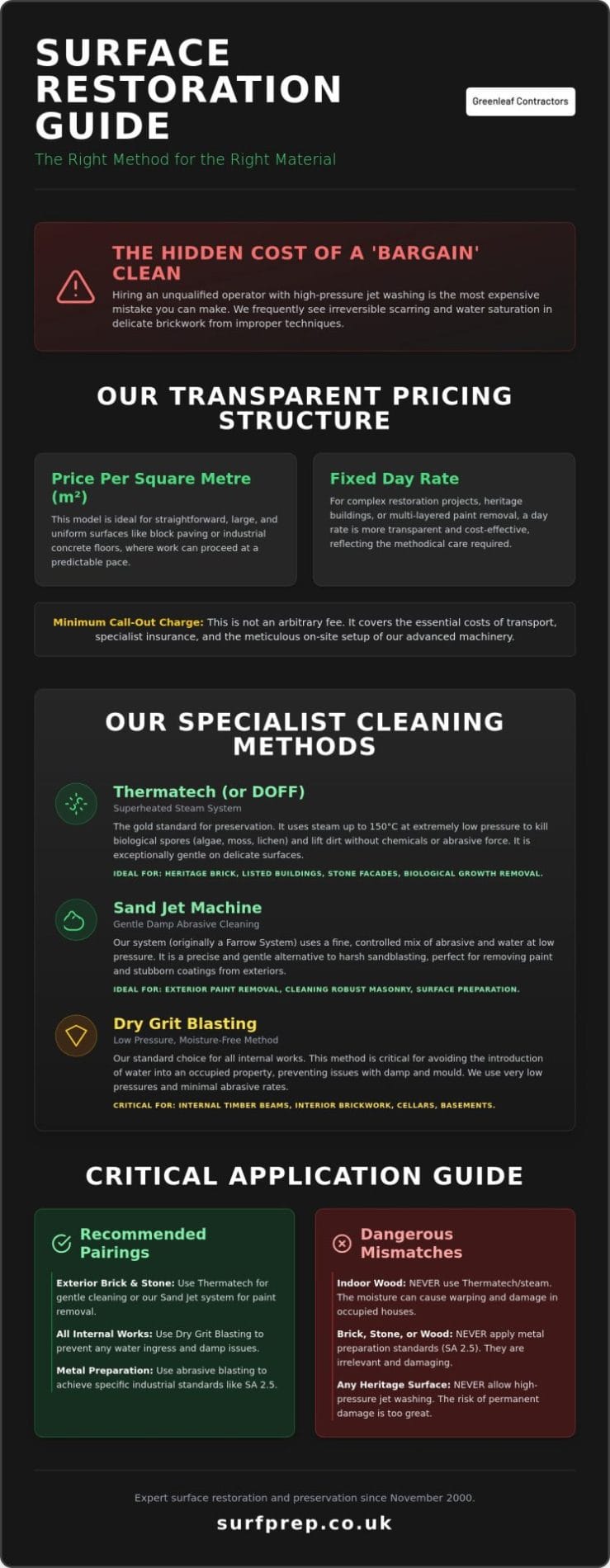
Most reputable contractors in the UK operate on two primary pricing models. For straightforward, repeatable areas like standard block paving or large concrete slabs, a price per square metre is common. However, for complex restoration projects where we’re using our sand jet machine or tackling multi-layered paint removal, a fixed day rate is often more transparent. You should also expect a minimum call-out charge. This isn’t an arbitrary fee; it covers the logistical costs of transport, high-level insurance, and the meticulous setup of specialist machinery on-site.
Average Price per Square Metre vs. Day Rates
Standard surfaces often carry a lower m² rate because they allow for a faster, more automated workflow. Conversely, delicate heritage brickwork or carved stone requires a slower, methodical pace to ensure no damage occurs. In cities like Newcastle, Manchester, and Leeds, you might notice slight variations in these rates based on local access requirements and disposal regulations. Whilst m² rates are great for budgeting domestic patios, day rates become far more cost-effective for larger commercial sites where the scale allows us to settle into a steady, productive rhythm.
Why Specialist Restoration Carries a Premium
Specialist restoration is about preservation as much as it’s about cleaning. Operating advanced systems like Thermatech or Doff requires significant investment in training and maintenance. These superheated steam systems are the gold standard for masonry because they kill biological spores without the need for aggressive chemicals. We often employ an “Expert Admission” approach; if we believe a certain pressure level will damage your property, we’ll tell you. We prioritise the long-term integrity of the building over a quick, cheap result. For example, professional brick cleaning involves understanding the firing of the clay, a process far more nuanced than simple jet washing. To understand the evolution of these methods, one can look at how Abrasive blasting techniques have shifted from aggressive industrial applications to the refined, low-pressure restoration methods we use today.
Factors That Influence Your Cleaning and Restoration Quote
Whilst pricing models provide a basic framework, the actual cost of professional pressure washing UK is heavily dictated by the physical challenges of the site. A flat concrete warehouse floor is a high-speed operation, but restoring intricate stone window sills or removing heavy carbon crusting requires a far more surgical approach. The level of staining is a primary driver; peeling back five layers of old paint from a heritage facade involves significantly more time and abrasive media than a standard wash. We also have to account for the thickness of the biological growth, as stubborn black lichen requires specific dwell times and temperature control to eradicate completely.
Access and environment are the next critical factors. In historic centres like York or industrial hubs like Hull, reaching high-level masonry often necessitates the use of mobile towers or scaffolding. We also take our “duty of care” under the Environmental Protection Act 1990 seriously. This means the cost may include water containment systems or dust-free methods to protect the public and ensure wastewater doesn’t enter local streams or groundwater. If you’re unsure which factors apply to your property, you can contact us for a transparent assessment of your specific site requirements.
Material Considerations: Brick, Stone, and Timber
Substrate sensitivity is why we don’t believe in a “one size fits all” price. For example, stone cleaning usually involves low-pressure steam via our Thermatech system to avoid “pitting” the delicate surface. When we pivot to industrial metal preparation, we adhere strictly to Sa 2.5 standards to ensure perfect coating adhesion; however, we never apply these aggressive industrial standards to brick or wood. For those tackling barn conversions, our specialist guide on cleaning structural timbers explains how we preserve the character of the wood whilst removing decades of grime.
Indoor vs. Outdoor Applications
Moisture management is the most important distinction between internal and external work. For outdoor projects, the damp process of our sand jet machine is often preferred. However, we never recommend superheated steam for indoor wood due to the risk of introducing moisture into occupied houses. For internal restoration in properties across Derby and Nottingham, we favour dry grit blasting at low pressures and low abrasive rates. This keeps the environment dry and protects the building’s fabric. Whilst dry ice blasting is a moisture-free alternative for sensitive environments, it’s worth noting it is a significantly more expensive option.
Choosing the Right Method: From Thermatech to Sand Jet Cleaning
Selecting the correct technology is the final factor in determining the cost of professional pressure washing UK. It isn’t just about the price quoted; it’s about the long-term health of your property. Since we established our business in November 2000, we’ve carefully selected equipment that tackles the unique atmospheric staining found across Yorkshire and Manchester. We prioritise Thermatech (widely known as the DOFF system) for superheated steam cleaning because it offers a non-destructive way to lift decades of grime. Before hiring a contractor, ask them about their pressure settings and temperature control; if they can’t explain why they’ve chosen a specific method for your substrate, they may be relying on “brute force” that could scar your masonry.
Outdoor Restoration: Steam and Gentle Abrasives
For exterior masonry, superheated steam is the premier choice for removing biological growth. The high temperature kills spores instantly, ensuring a cleaner finish for longer without the need for saturated chemicals. When we need to strip paint or heavy carbon from brickwork, we use our sand jet machine. This system, with its Farrow System heritage, provides a damp-process abrasive clean that is far more sympathetic than aggressive traditional sandblasting. For those seeking a deeper understanding of masonry care, our guide to brick cleaning offers a deep-dive into how we manage these delicate surfaces whilst preserving the underlying material.
Internal Works: Dry Methods for Moisture Control
Indoor environments demand a strict approach to moisture management to avoid damaging the building fabric. We never recommend superheated steam cleaning for indoor wood due to concerns about introducing water into the structural timbers of an occupied home. Instead, our standard for internal restoration is traditional dry grit blasting at low pressures and low abrasive rates. This method allows us to clean amongst structural timbers with surgical precision whilst keeping the building envelope dry. You can explore our wood restoration services to see how we handle these sensitive internal projects without the mess and humidity of water-based systems. Whilst dry ice blasting is a moisture-free alternative for sensitive environments, it is a significantly more expensive option that we only suggest when the project requirements strictly dictate its use.
Investing in Your Property’s Long-Term Restoration
Understanding the cost of professional pressure washing UK requires looking beyond a simple hourly rate to the value of specialised expertise. Since we established our business in November 2000, we’ve focused on the technical nuances that separate a quick wash from a professional restoration. We’ve explored how different pricing models reflect the complexity of your project, from straightforward patio cleaning to the delicate removal of carbon crusting on heritage stone. Our experience has taught us that matching the right technology, such as Thermatech (DOFF) or our gentle sand jet machine, is the only way to ensure a lasting finish whilst protecting your building’s integrity.
Whether you require dry grit blasting for internal timber restoration or superheated steam for external masonry, our team brings over 25 years of practical knowledge to every site. We’re proud to serve Leeds, York, Manchester, and the wider North and Midlands with reliable, transparent solutions. If you’re ready to restore your property’s exterior or interior surfaces safely and effectively, Request a professional restoration quote from our Yorkshire specialists. We look forward to helping you achieve a clean, professional result that stands the test of time.
Frequently Asked Questions
Is professional pressure washing worth the cost for my home?
Professional pressure washing is worth the investment because it avoids the structural damage often caused by domestic machines. When considering the cost of professional pressure washing UK, homeowners should account for the preservation of their property’s fabric. High-pressure cold water can easily force moisture into old masonry or strip the “fire-skin” from bricks. By using our specialist equipment, you ensure the removal of contaminants whilst preserving the material’s integrity.
What is the difference between DOFF, Thermatech, and standard jet washing?
Thermatech and DOFF are superheated steam systems that clean surfaces using temperatures up to 150°C at very low pressure. This is the gold standard for heritage restoration because it removes biological matter and grease without the mechanical force of a standard jet wash. In contrast, standard jet washing relies on high-pressure cold water; this is often far too abrasive for delicate stone or historic brickwork.
Can professional pressure washing damage my brickwork or mortar?
It only causes damage if the wrong method is applied to the wrong material. We use a “sand jet machine” (originally a Farrow System) to provide a gentle, swirling abrasive action that cleans without scarring. Our technical expertise allows us to adjust pressure and media flow to suit the specific hardness of your mortar and brickwork, ensuring the substrate remains healthy and intact throughout the process.
How much does it cost to remove paint from a brick house in the UK?
The cost of professional pressure washing UK for paint removal is dictated by the complexity of the project. Removing multiple layers of stubborn masonry paint is a methodical process that requires more time and specialist media than a standard surface clean. We provide transparent pricing based on the specific requirements of your property, typically following a site assessment to ensure the most cost-effective and safe method is selected.
Do I need to be home whilst the professional cleaning is taking place?
You don’t necessarily need to be home for external cleaning as long as we have clear access to the work area and a reliable water connection. We ask that you ensure all windows and doors are firmly closed to prevent water or damp ingress. For internal restoration projects, we’ll need someone to let us in so we can organise the necessary dust protection and discuss the dry grit blasting process.
What is Sa 2.5 and does it apply to my stone cleaning project?
Sa 2.5 is an industrial standard specifically for metal preparation and should never be used for stone cleaning. It refers to a high level of cleanliness required for steel to ensure new coatings adhere properly. If a contractor mentions these standards for your brick or stone project, they’re using inappropriate industrial logic. We reserve these technical standards strictly for our industrial surface preparation works on metal substrates.
