
Discovering original wooden beams in a period property is a moment of pure joy for many homeowners. Whether in a Yorkshire barn conversion or a historic terraced house, these timbers are a direct link to the building’s past. The question that immediately follows, however, is often a daunting one: how do you restore them? The temptation to tackle the job yourself is strong, fuelled by visions of saving money and the satisfaction of a weekend project. But the reality of DIY vs professional wooden beam restoration is far more complex.
Whilst sanding or chemical stripping might seem straightforward, these methods can inflict irreversible damage on historic timber, compromise structural integrity, and create significant health hazards in your home. This is where a professional, specialist approach becomes not just an alternative, but an essential consideration for preserving the value and character of your property.
Evaluating Restoration Methods: DIY vs Professional Abrasive Cleaning
The core difference between a DIY and a professional approach lies not just in the tools, but in the understanding of the material itself. An ancient oak beam is not a simple piece of wood; it’s a historical artefact whose texture, tool marks, and patina tell a story. The goal of restoration should be to clean and reveal this character, not obliterate it.
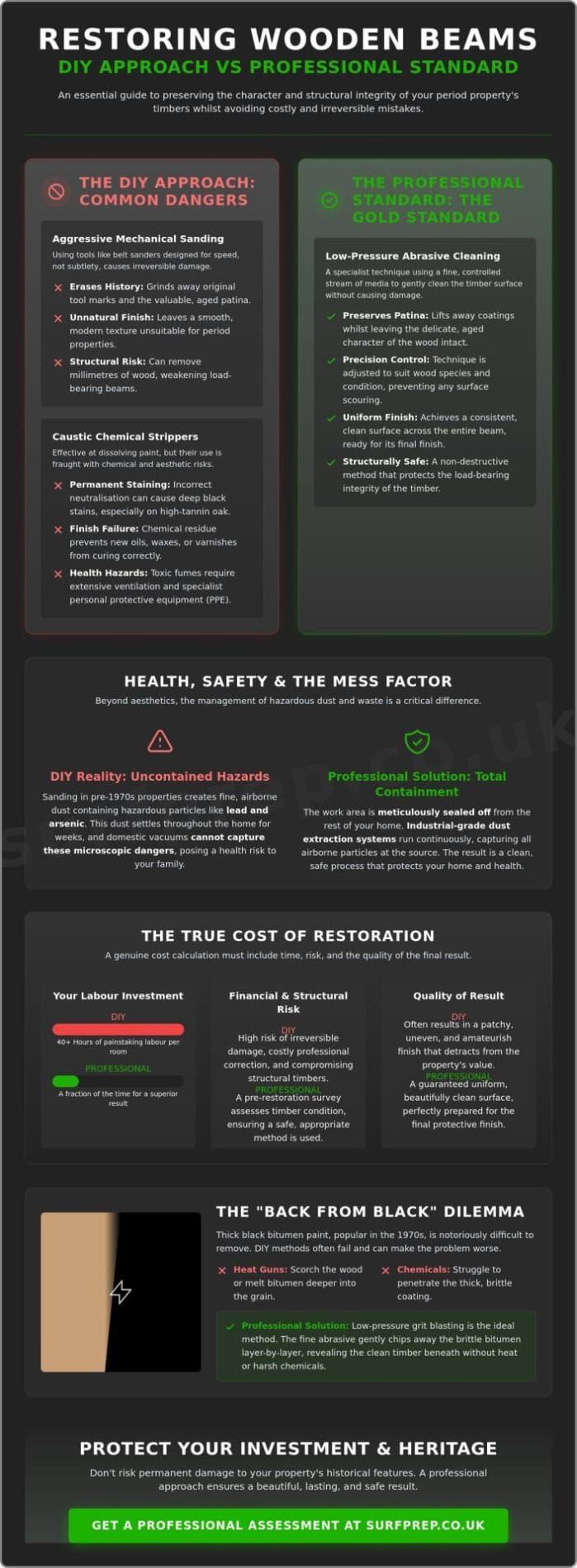
- The Mechanical Reality of DIY Sanding: Aggressive tools like belt sanders are designed for speed, not subtlety. On an old beam, they don’t just remove paint; they grind away the original adze marks and the weathered surface, leaving an unnaturally smooth, modern texture that looks entirely out of place in a period home.
- The Perils of Chemical Strippers: Caustic chemical strippers can be effective at dissolving paint, but they come with a critical catch. The neutralisation phase is frequently misunderstood or rushed in DIY projects. Any remaining chemical residue can prevent new finishes from curing properly and, on woods like oak, can react with natural tannins to cause deep, permanent black staining.
- The Professional Alternative: A true specialist eschews brute force. We use careful, low-pressure grit blasting (often called sand jet cleaning). This technique uses a fine, controlled stream of abrasive media to gently lift away coatings. It’s precise enough to remove layers of paint or varnish without scouring away the delicate patina and character of the wood underneath.
The Hidden Dangers of Dust and Chemical Residues
Beyond the aesthetic risks, DIY restoration poses genuine health concerns. Sanding beams in older homes, particularly those built before the 1970s, can release hazardous particles into your living space. This includes lead from old paint, arsenic from historic woodworm treatments, and other toxic residues that become airborne and easily inhaled. Domestic vacuums lack the HEPA filtration necessary to capture these microscopic dangers, putting your family at risk. Furthermore, chemical strippers must be carefully matched to the wood species; a product suitable for pine could cause disastrous discolouration on oak due to its high tannin content.
Preserving the Patina: Why Aggressive DIY Methods Fail
The “patina” on a 300-year-old beam is its most valuable feature. It’s the subtle combination of the original woodworker’s tool marks, the gentle darkening from centuries of exposure, and the unique grain texture. This cannot be replicated. Aggressive DIY sanding acts like a plane, shearing off this top layer and erasing the history with it. In contrast, professional low-pressure abrasive cleaning works more like a brush, gently sweeping away the accumulated grime and modern coatings whilst leaving the original, character-rich surface intact. It’s the difference between wiping a canvas clean and scraping it back to white.
The True Cost of Restoration: Time, Risk, and Result Quality
The primary driver for DIY is often cost, but a true calculation must include your time, the cost of tools and materials, and the significant financial risk of causing permanent damage. The savings can quickly evaporate when you factor in the bigger picture.
- Calculating the Labour Hours: A single room with several beams can easily consume over 40 hours of manual, painstaking labour for a DIYer. That’s an entire working week spent on a ladder, often in uncomfortable conditions. A professional team can achieve a superior result in a fraction of that time.
- The Risk of “Over-Thinning” Structural Timbers: This is a critical danger in barn conversions and older properties. Aggressive sanding or blasting can remove several millimetres of wood. On a structural timber, this isn’t just an aesthetic issue; it can genuinely compromise the load-bearing capacity of the frame.
- Achieving a Uniform Colour: Removing decades of different paints, stains, and varnishes often leads to a patchy, amateurish finish when done by hand. Professionals have the experience to adjust their technique across the beam to ensure a consistent, clean surface, ready for its final finish.
- For a deeper look at professional techniques, see our guide on how to remove paint from structural wooden beams.
When DIY Becomes a Structural Risk
Some beams are simply not candidates for any form of aggressive intervention. If you see signs of heavy “frass” (the fine dust left by woodworm) or deep, historic cracks (known as “shakes”), the timber may be too fragile. A professional will conduct a thorough survey first. This assessment is crucial; it prevents the removal of essential structural material and ensures the chosen restoration method is appropriate for the beam’s condition. It’s an engineering decision, not just a cleaning one.
The “Back from Black” Dilemma
Many period properties suffer from beams painted with thick, black bitumen paint, a trend from the 1970s. This coating is notoriously difficult to remove. DIY methods like heat guns often scorch the wood or melt the bitumen, driving it deeper into the grain and making the problem worse. Chemical strippers struggle to penetrate its thickness. Professional low-pressure grit blasting is the ideal solution. The fine abrasive media gently chips away at the brittle surface of the bitumen, removing it layer by layer without the heat or chemicals that can cause further damage.
Why Professional Low-Pressure Grit Blasting is the Gold Standard for Timber
When it comes to internal wooden beams, particularly in heritage settings, controlled abrasive cleaning is the preferred method for leading specialists. It offers a level of precision and safety that other techniques simply cannot match.
- Precision and Control: Unlike high-pressure, uncontrolled blasting, a professional sand jet system allows the operator to precisely regulate the pressure and the type of media used. This means we can remove a layer of varnish from a delicate oak beam as carefully as a surgeon, without damaging the underlying wood.
- Approved for Heritage Work: Because it is a non-damaging and highly controllable process, professional low-pressure cleaning is often the only method approved by Conservation Officers for work on Listed buildings. The focus is on preservation, and our methods align with that principle.
- Speed and Efficiency: A skilled team can restore the woodwork in an entire property in a matter of days, a task that could take a homeowner months to complete. This minimises disruption and allows you to move forward with your renovation project.
- The Perfect Preparation for Finishing: The process leaves the pores of the wood clean and open, creating the ideal surface for absorbing finishing oils or waxes. This ensures the final treatment penetrates deeply and evenly, protecting the wood for years to come.
Restoring Heritage Beams in Period Homes and Barn Conversions
We see the transformative power of this process across the North, from barn conversions in the Manchester suburbs to historic pubs in Leeds and York. In one recent project, a barn’s primary trusses were hidden under layers of dark, grimy varnish. After careful restoration, the beams were revealed in their original honey-coloured glory, completely changing the feel of the space. Property owners in these areas prioritise professional methods because they understand that preserving these original features is a direct investment in the building’s resale value and historical integrity. For particularly delicate tasks, our sand jet cleaning services offer unparalleled precision.
The Surfprep Approach: Expertise Across the North
Our teams in Leeds, York, and Hull provide a straightforward, no-nonsense assessment of your timber’s condition. We believe in honest advice—it’s the cornerstone of our reputation. This includes our “Expert Admission”: if we believe a beam is better left alone, or if a different approach is required, we will tell you. We have a range of tools at our disposal, but our expertise lies in choosing the right one for your specific situation. For internal beams, that choice is almost always careful, low-pressure abrasive cleaning.
If you’re weighing the options for your property, don’t risk the heart of your home. Contact Surfprep today for a professional timber restoration quote and let our specialists help you make the right choice.
Frequently Asked Questions (FAQs)
- Is it cheaper to restore wooden beams myself?
Initially, it may seem cheaper as you are not paying for labour. However, when you factor in the cost of hiring sanders, buying quality chemical strippers, personal protective equipment, and the sheer number of hours required, the gap narrows. Crucially, the cost of rectifying a mistake—such as permanent staining or structural damage—can be thousands of pounds, far outweighing any initial savings. - Will professional beam cleaning create a lot of mess in my house?
No. A key part of our professional service is comprehensive containment. We use heavy-duty sheeting to completely seal the work area from the rest of your house and employ powerful, HEPA-filtered dust extraction systems to capture particles at the source. Our goal is to leave your home as clean as we found it. - Can you remove black paint from old oak beams without damaging them?
Yes, absolutely. This is a classic restoration challenge that our low-pressure grit blasting systems are perfectly designed for. The controlled abrasive stream can effectively remove stubborn bitumen or modern paints from oak without causing the black chemical staining associated with strippers or the surface damage from aggressive sanding. - Do I need to move out of the house whilst the beams are being restored?
You will not need to move out of the house entirely. However, for safety and cleanliness, the specific room or area where the work is being performed will be sealed off and inaccessible during the restoration process. - How do I know if my beams are structural or just decorative?
As a rule of thumb, large, central beams that span wide areas or support joists are likely structural. Smaller, more regular timbers may be decorative. However, it can be difficult to tell in older properties. If you have any doubt, it is vital to get a professional assessment before undertaking any work that removes material. - What is the best finish for restored wooden beams?
After restoration, we generally recommend a breathable finish that nourishes the wood. Natural oils (like Tung or Danish oil) and beeswax polishes are excellent choices. They enhance the natural colour and grain of the timber without sealing it completely, allowing the wood to breathe as it has for centuries.
