
What is the Sand Jet System and How Does it Redefine Surface Preparation?
When property owners or architects look for a gentle, effective cleaning method, they often encounter various technologies. One of the most respected is a low-pressure, damp-abrasive cleaning system that specialists refer to as the “sand jet”. This technology, originally known as the Farrow System, redefines surface preparation by moving away from the aggressive, high-impact force of traditional sandblasting.
Instead of relying on brute force, the sand jet uses a precise and controllable mixture of heat, very low pressure, and a fine, inert media like volcanic glass. This combination allows for a gentle yet highly effective cleaning action. At Surfprep, we have championed this approach since our founding in November 2000, when we became one of the first UK specialists to adopt the original Farrow System. Our long-standing experience has shown that its precision and control make it the preferred choice for conservation officers tasked with preserving the UK’s historic buildings and listed stone facades.
The Mechanics of the Sand Jet: Flow vs Impact
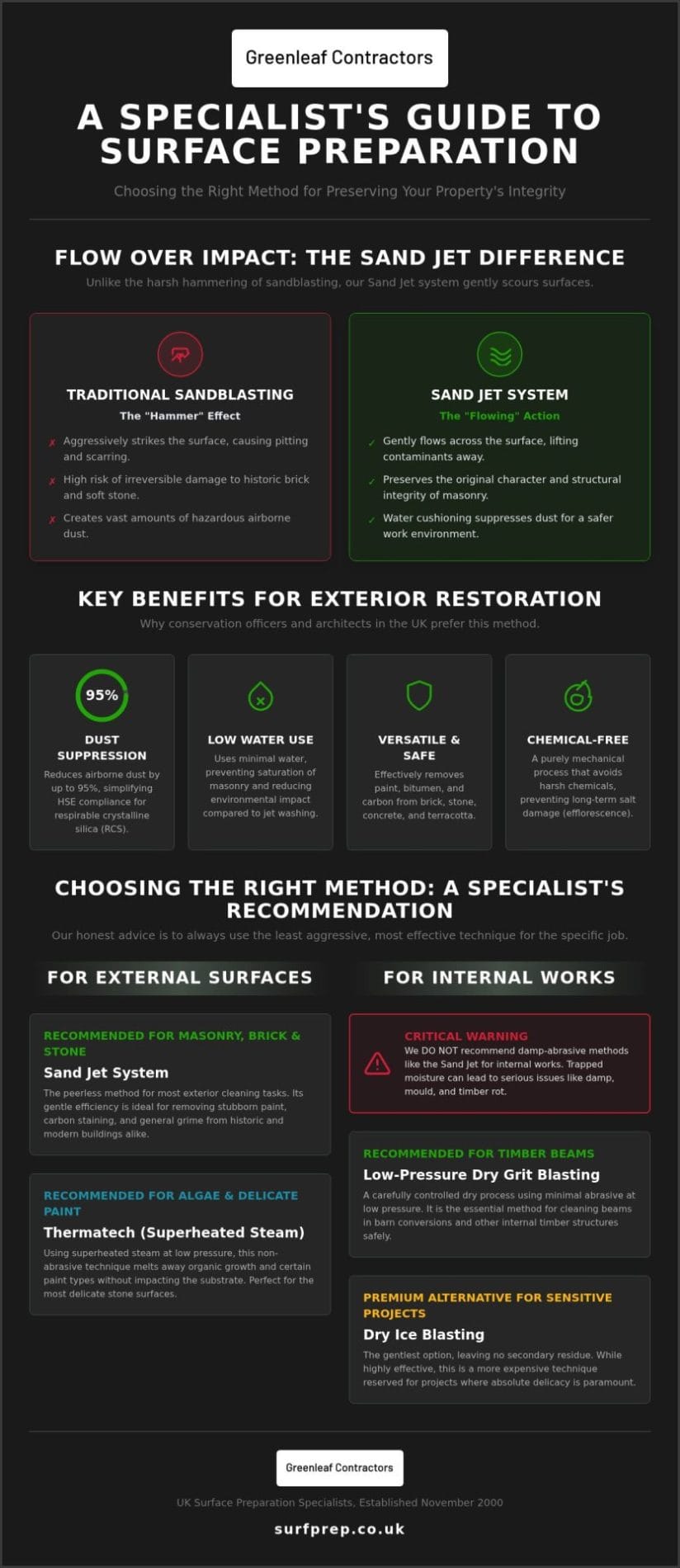
The true benefit of the sand jet system lies in its unique mechanical action, which prioritises “flow” over “impact”. Traditional dry sandblasting acts like a hammer, aggressively striking the surface and chipping away contaminants along with the underlying material. This often leads to irreversible pitting, scarring, and damage, particularly on softer substrates like historic Yorkshire stone or aged brickwork.
The sand jet works differently. By introducing a small amount of water and heat into the air stream, each abrasive particle is cushioned. This moisture wrap transforms the process from a harsh hammering into a gentle, consistent “lapping” or scouring action. The particles flow across the surface, lifting away grime, paint, or carbon staining without eroding the delicate masonry beneath. The result is a clean, restored surface that retains its original character and structural integrity.
This level of surface-safe precision is also highly effective in other industries, such as marine maintenance; for instance, you can discover Boat Valet Auckland to see how mobile marine grooming and antifouling benefit from similar gentle cleaning principles.
Key Benefits of the Sand Jet for Masonry and Heritage Restoration
For property owners, site managers, and architects in Northern England, the practical advantages of using the sand jet system for exterior cleaning are significant. It directly addresses the common pains associated with large-scale restoration projects in both urban and rural settings.
- Significant Dust Suppression: The damp nature of the process reduces airborne dust by up to 95% compared to dry blasting. This is a critical health and safety benefit, essential for minimising disruption and risk in busy city centres like Leeds and Manchester.
- Low Water Consumption: Unlike high-pressure jet washing, which can saturate masonry and create vast amounts of runoff, the sand jet uses a minimal amount of water. This reduces the environmental impact and simplifies site management.
- Versatility Across Substrates: This method is remarkably adaptable. It is highly effective for removing stubborn coatings like paint, bitumen, and years of carbon staining from a wide range of materials, including brick, stone, concrete, and even delicate terracotta.
- Chemical-Free Cleaning: The sand jet is a purely mechanical process. It avoids the use of harsh acidic or alkaline cleaners, which can cause long-term damage to masonry through efflorescence (salt crystallisation) and staining. It is a straightforward, environmentally responsible solution for restoring brickwork to its former glory.
Environmental Advantages for UK Property Developers
Modern construction and restoration sites in the UK must adhere to strict Health and Safety Executive (HSE) standards, particularly concerning respirable crystalline silica (RCS) dust. The sand jet’s ability to suppress dust makes compliance far easier to achieve, protecting both operatives and the general public.
Furthermore, the damp media used in the system is heavier than dry dust. This means it falls within the immediate work area instead of drifting across neighbouring properties or public spaces. This localisation simplifies cleanup, reduces the need for extensive containment measures, and ensures a cleaner, more professional site from start to finish.
Choosing the Right Method: When to Use the Sand Jet vs Other Techniques
As honest specialists with decades of experience, we believe in using the right tool for the job. Whilst the sand jet is peerless for most exterior masonry cleaning, its use of water makes it unsuitable for many internal projects.
The Expert Admission: We do not recommend the sand jet for internal use, especially on timber. Introducing moisture into an enclosed space like a barn conversion or a period home can lead to secondary problems such as damp, mould, or timber rot. This is a critical consideration that is often overlooked.
- Contrast with Thermatech: For removing organic growth like algae or certain types of delicate paint from stone, our Thermatech machine is often a better choice. It uses superheated steam at very low pressures to melt away coatings without any abrasive.
- Internal Alternatives: For cleaning internal wooden beams in a barn conversion, dry methods are essential. We typically recommend low-pressure dry grit blasting, which uses minimal abrasive, or dry ice blasting for particularly sensitive projects (though this is a more expensive option).
Ultimately, the best approach can only be determined after a thorough evaluation of the substrate, the contaminant, and the environment. A specialist site survey is the first step in creating a restoration plan that guarantees the “least aggressive, most effective” method is used, protecting your property for the long term.
External vs Internal Considerations
The distinction between external and internal work is crucial. Externally, the moisture from the sand jet can evaporate freely without causing harm. Internally, that same moisture becomes trapped, risking the integrity of timber frames, plaster, and insulation. This is why our advice is always to keep damp processes outside and use carefully controlled dry processes inside.
Maintaining Masonry Integrity in Northern Cities
The historic buildings in cities like Hull, Newcastle, and York face unique challenges from decades of industrial pollution and harsh weather. Their weathered brickwork and stone facades require a cleaning method that is both powerful enough to remove ingrained dirt and gentle enough to preserve the fragile surface. The sand jet provides this perfect balance. With over two decades of experience across the North, we can provide an honest, accurate assessment for your project. We invite you to contact Surfprep for a specialist site survey and benefit from our long-standing expertise.
Frequently Asked Questions
- Is the sand jet system truly dust-free?
- No system is 100% dust-free, but the sand jet suppresses up to 95% of airborne dust compared to dry sandblasting. This makes it one of the cleanest and safest methods for surface preparation in public or sensitive areas.
- Can the sand jet be used to remove paint from internal oak beams?
- We strongly advise against it. The sand jet is a damp system, and introducing water to internal timbers can lead to serious issues like rot and mould. For internal beams, we recommend dry methods like low-pressure grit blasting.
- How does the sand jet compare to traditional sandblasting in terms of cost?
- The initial project cost may be comparable, but the sand jet often proves more cost-effective in the long run. Reduced cleanup time, minimal need for dust containment, and the avoidance of costly surface damage mean better overall value and fewer risks.
- Is the sand jet safe for use on Grade II listed buildings?
- Yes, absolutely. Its gentle, controllable nature makes it a favoured method amongst conservation officers and heritage organisations for cleaning listed buildings without causing damage to historic masonry.
- What is the difference between the Farrow System and Thermatech steam cleaning?
- The Farrow System (which we call the sand jet) is a damp abrasive method that gently scours a surface clean. Thermatech uses superheated steam with no abrasive, melting away contaminants like paint or killing organic growth like algae. They are different tools for different tasks.
- Will the sand jet remove graffiti from sandstone without damaging the surface?
- Yes. The low pressure and fine media used in the sand jet system are ideal for lifting spray paint from porous surfaces like sandstone. The process can be finely tuned to remove the graffiti without etching or scarring the delicate stone underneath.
