
Cleaning the facade of a heritage building in the UK is not a simple maintenance task; it’s a regulated activity that carries significant legal weight. For property owners, architects, and facilities managers, navigating the complex web of heritage building cleaning regulations UK can be daunting. The fear of causing irreversible damage or facing prosecution for unauthorised work is a genuine concern.
The core challenge lies in balancing the desire to restore a building’s appearance with the absolute necessity of preserving its historic fabric. This guide provides a clear, comprehensive overview of the 2026 regulatory landscape, explaining the standards that Conservation Officers expect and the methodologies they approve, ensuring you protect both your property and your legal standing.
The Statutory Framework: Listed Building Consent and BS 7913
The foundation of all heritage work in the UK is the Planning (Listed Buildings and Conservation Areas) Act 1990. This legislation is designed to protect buildings of special architectural or historic interest. Any work that could affect a listed building’s character requires formal permission, known as Listed Building Consent (LBC).
- The Planning (Listed Buildings and Conservation Areas) Act 1990: This Act makes it a criminal offence to carry out unauthorised works to a listed building. The penalties can include unlimited fines and even imprisonment.
- Defining “Material Effect”: Many assume cleaning is simple upkeep, but regulators often disagree. If a cleaning process alters the appearance, texture, or material of the building’s fabric, it is considered to have a “material effect” on its character. Aggressive techniques that strip away the aged patina or damage the substrate fall squarely into this category.
- The Role of BS 7913:2013: This British Standard, the Guide to the Conservation of Historic Buildings, is the definitive document for best practice. Whilst not law itself, it is the benchmark that Conservation Officers and heritage bodies like Historic England use to assess proposed works. A method statement that aligns with BS 7913 is far more likely to gain approval.
- Expert Admission: Whilst cleaning undoubtedly improves a building’s aesthetics and can halt the damaging effects of pollutants, undertaking this work without the proper consent is a serious misstep. The principle is clear: always seek permission before acting.
When is Listed Building Consent (LBC) Mandatory?
LBC is mandatory for any work that affects the special character of a listed building. In the UK, buildings are listed in three categories: Grade I (exceptional interest), Grade II* (particularly important), and Grade II (special interest). All three grades are protected by the same legislation.
The key determinant for cleaning is the proposed method’s impact. A gentle removal of harmful atmospheric pollutants or biological growth is viewed more favourably than an aggressive “whitening” that aims to make the building look new. The latter fundamentally alters the building’s historic character. If you are unsure how your local authority in areas like York or Leeds interprets these thresholds, it is vital to seek professional advice before submitting an application.
The Role of the Conservation Officer
Your local council’s Conservation Officer is the gatekeeper for LBC. They are responsible for interpreting national policy at a local level, and their judgement on what constitutes a building’s “character” is paramount. Authorities across the North, from Hull to Manchester, may have slightly different priorities or interpretations based on local architectural styles and materials.
Engaging with the Conservation Officer early in your planning is the most effective way to ensure a smooth process. Presenting them with a well-considered plan, including proposed methodologies and potential contractors, demonstrates a commitment to conservation. This early consultation can prevent costly delays and the issuance of enforcement notices later on.
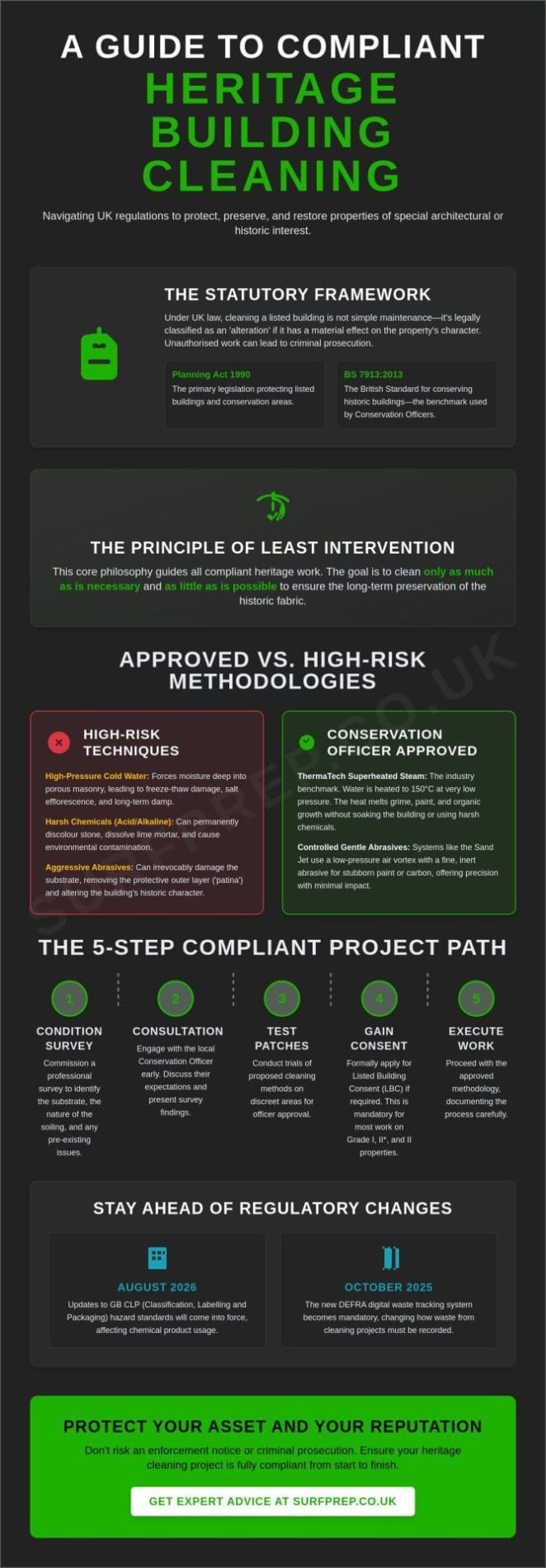
Approved Methodologies: Balancing Preservation with Effective Cleaning
When it comes to heritage cleaning, UK regulations are guided by the “principle of least intervention.” This means using the gentlest, most minimal method necessary to achieve the desired conservation outcome. For this reason, certain techniques are widely approved whilst others are strictly prohibited.
- The “Least Intervention” Principle: This philosophy prioritises the long-term health of the building’s fabric. Any proposed cleaning method will be judged on its potential to cause damage, such as abrasion, salt crystallisation, or water saturation.
- Superheated Steam: Systems that use superheated steam are the preferred choice for most historic masonry and brick cleaning projects. The combination of high temperature and low pressure effectively removes dirt and biological growth without damaging the underlying surface.
- Prohibited Methods: High-pressure cold water washing is almost universally rejected by conservation bodies. It can saturate porous stone and brick, leading to frost damage (spalling) and internal salt migration. Likewise, the use of non-approved, harsh chemicals is forbidden due to the risk of unpredictable reactions with historic materials.
- Managing Biological Growth: If biocides are required to treat algae, lichen, or moss, their use must be carefully justified. You will need to provide data on their chemical composition and prove they will not harm the masonry or the local environment.
Why Superheated Steam Cleaning Wins Approval
Superheated steam systems are favoured by Conservation Officers because they align perfectly with the principle of least intervention. These machines heat water to temperatures of up to 150°C but deliver it as a gentle vapour at very low pressure.
This “soft” approach is highly effective. The heat melts away grime, paint, and organic matter, while the low pressure ensures the substrate is not eroded or saturated. This prevents the mobilisation of damaging salts within the stone or brickwork, a common side effect of inferior methods. Whilst several systems exist, such as DOFF, at Surfprep we utilise the ThermaTech system for its precise control and proven results on delicate historic surfaces. For a detailed comparison, see our guide on Therma-Tech vs DOFF systems for heritage masonry.
Gentle Abrasives and the Sand Jet
In some cases, steam alone may not be sufficient to remove stubborn coatings like modern cement-based paints. For these situations, a low-pressure, gentle abrasive system may be approved. The Sand Jet system, for example, uses a fine, inert abrasive mixed with water in a swirling vortex.
This method provides more cleaning power than steam but is significantly gentler than traditional sandblasting. When expertly calibrated, it can remove tough coatings without profiling or damaging the delicate masonry beneath. The goal is to achieve a clean surface without stripping away the historic patina, a standard that requires deep technical expertise.
Executing a Compliant Heritage Project: Surveys and Trials
Gaining Listed Building Consent is not just about choosing the right machine; it’s about following a rigorous, documented process. A professional heritage contractor will guide you through three critical stages: the survey, the test patch, and the method statement.
- Pre-Cleaning Condition Survey: Before any work begins, a thorough survey is essential to identify fragile areas, previous repairs, and the specific nature of the soiling. This informs the entire project and prevents costly surprises.
- Conducting “Test Patches”: A Conservation Officer will almost always require a trial clean on a small, inconspicuous area of the building. This allows them to see the real-world results of the proposed method and confirm it will not cause damage before giving approval for the full project.
- Documenting the Process: All findings and proposals must be compiled into a formal “Method Statement.” This document details the equipment, pressures, temperatures, and safety measures that will be used, providing the local planning department with the assurance they need.
- Contractor Selection: Appointing a contractor with a proven track record in heritage restoration is non-negotiable. They will understand the nuances of working with Conservation Officers and possess the technical skill to execute the work safely and effectively.
Preparing Your Method Statement
Your Method Statement is a critical document that must be comprehensive and precise. It should include specific technical details, such as the exact pressure (in psi or bar) and temperature to be used on different substrates. It must also address practical considerations, especially for projects in busy city centres like Newcastle or Durham. This includes plans for water runoff management, public safety, and controlling environmental impact to satisfy all local authority requirements.
Post-Cleaning Inspection and Maintenance
Once the cleaning is complete, a final inspection is necessary to ensure the process hasn’t revealed any underlying defects, such as open or “blown” mortar joints that now require repointing. Cleaning is often the first step in a wider conservation project. This same principle of careful, approved restoration applies to a building’s interior, where features like historic beams may also require specialist attention, such as professional wooden beam cleaning.
When a post-cleaning inspection reveals deeper moisture issues, it is essential to consider professional waterproofing; for advanced solutions, you can explore Cuvelage to ensure the building’s fabric remains protected from the inside out.
Frequently Asked Questions (FAQs)
- Is it illegal to clean a listed building without permission in the UK?
Yes. If the cleaning method is deemed to “alter the character” of the listed building, carrying it out without Listed Building Consent is a criminal offence under the Planning (Listed Buildings and Conservation Areas) Act 1990. Always consult your local authority’s Conservation Officer first. - What is the best cleaning method for Grade II listed stone facades?
There is no single “best” method, as it depends on the type of stone and the nature of the soiling. However, low-pressure superheated steam cleaning (using systems like ThermaTech) is the most widely approved and recommended method by conservation bodies for its gentle yet effective action. - How much does a heritage building cleaning survey typically cost?
The cost of a pre-cleaning survey can vary significantly based on the building’s size, complexity, and location. A basic visual assessment might cost a few hundred pounds, whereas a project requiring detailed material analysis and multiple test patches could cost several thousand. This initial investment, however, prevents much costlier mistakes. - Can I use chemical cleaners on historic brickwork if they are biodegradable?
Not without specific approval. “Biodegradable” does not automatically mean “safe for heritage fabric.” Any chemical cleaner, regardless of its environmental credentials, must be tested and proven not to cause adverse reactions with the historic brick, mortar, or surrounding materials. The Conservation Officer will require detailed specifications and a successful test patch before granting consent.
