
Why does a quote for specialist masonry restoration often look so different from a standard pressure wash price, and could the “cheaper” option actually be the most expensive mistake you ever make for your property? We understand the difficulty in justifying cost of professional building cleaning to a board of directors or a cautious stakeholder, especially when the technical jargon feels like a minefield. You want a pristine finish, but you’re rightly terrified of aggressive contractors causing irreversible damage to delicate brickwork or historic stone. Since we established our business in November 2000, we’ve seen countless “budget” jobs end in structural heartbreak; and usually, those repair costs are far higher than doing it right the first time.
In this 2026 specialist guide, you’ll discover why investing in heritage-grade restoration is a strategic move that preserves material integrity far beyond the capabilities of general maintenance. We’ll show you the clear ROI of choosing the right methodology, from using Thermatech (the industry-recognised DOFF system) for outdoor steam cleaning to our gentle sand jet machine for delicate substrates. You’ll gain a transparent framework for evaluating quotes and the confidence to choose a process that respects your building’s requirements, whether you’re managing a commercial site in Manchester or a period property in York.
Key Takeaways
- Understand the fundamental difference between surface cleaning and material restoration, including why specialist Thermatech (DOFF) systems are essential for preserving delicate masonry.
- Learn how to navigate stakeholder concerns by justifying cost of professional building cleaning as a high-value investment that prevents structural decay and increases commercial lease rates.
- Discover our “Honest Specialist” approach to moisture management, including why we prefer dry grit blasting for interiors whilst using the damp sand jet machine for outdoor restoration.
- Gain a clear framework for evaluating professional quotes by understanding the technical setup and specialist equipment maintenance required for high-standard UK projects.
Specialist Restoration vs. General Cleaning: Why the Methods Matter
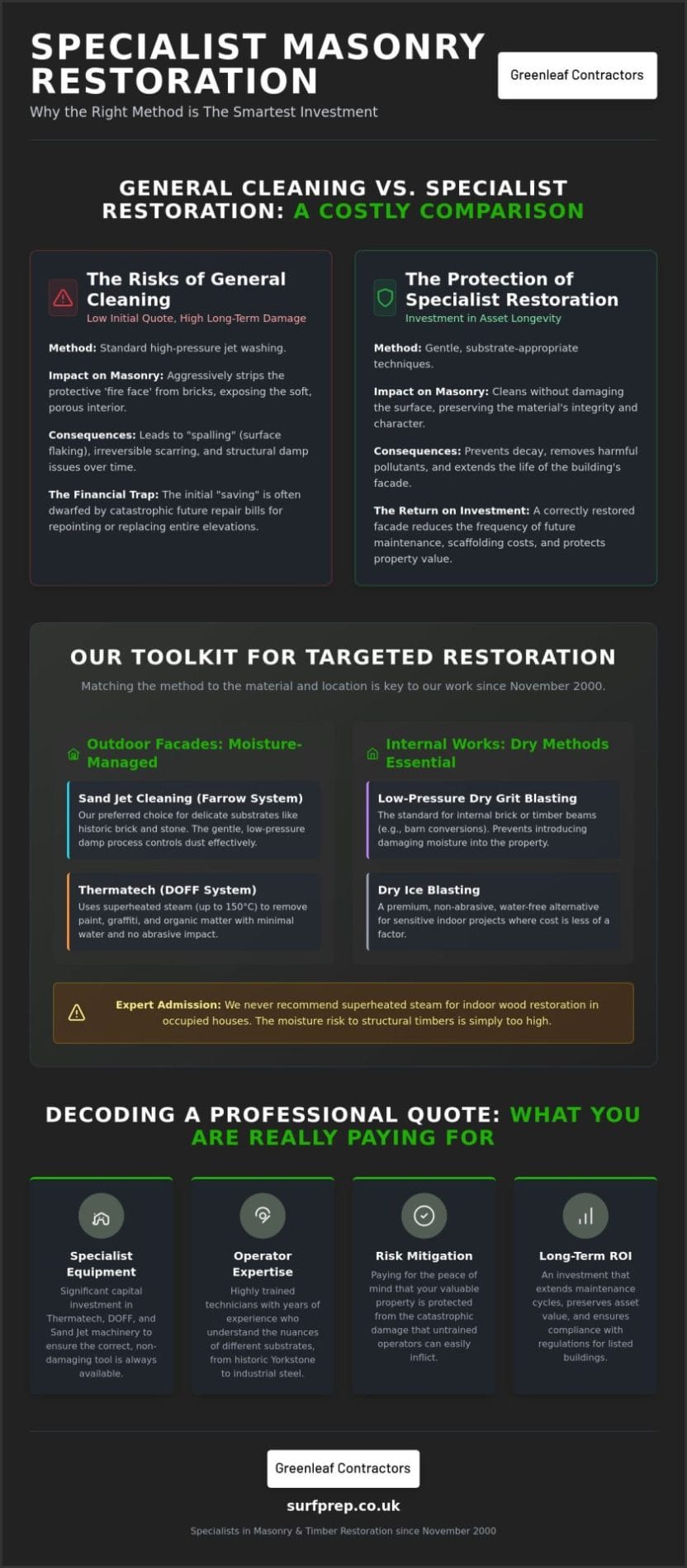
Distinguishing between basic maintenance and specialist restoration is the first step in justifying cost of professional building cleaning. Whilst standard Commercial cleaning services might focus on removing visible grime at a low hourly rate, we view our work as a structural preservation project. Since we started in November 2000, our focus has been on protecting the substrate; whether that is 200-year-old Yorkstone or industrial steel. Investing in Thermatech (DOFF) systems involves significant capital expenditure and specialist training. This is why a professional quote reflects more than just man-hours. It reflects the security of knowing your building’s surface won’t be ruined by an untrained operator with a standard pressure washer.
The Hidden Risks of High-Pressure Water
Standard jet washing is often the enemy of historic masonry. High-pressure water can easily strip the “fire face” from a brick, leaving the soft, porous interior exposed to the elements. This leads to spalling, where the brick surface literally flakes away; eventually causing structural damp issues. Our specialist brick cleaning service avoids these pitfalls. We use the sand jet cleaning method, originally known as the Farrow System, which provides a gentle, low-pressure alternative that cleans without scarring the material.
Indoor vs. Outdoor Moisture Management
Effective restoration requires a nuanced understanding of moisture. For outdoor facades, the damp process of the sand jet machine is our preferred choice to control dust and protect the public. However, for internal works like barn conversions or heritage pubs, we pivot to dry methods. We use traditional dry grit blasting at low pressures to prevent introducing litres of water into the property. Dry ice blasting is another water-free alternative; though it remains a significantly more expensive option due to the specialist media required. Here is our expert admission: we will never recommend superheated steam for indoor wood restoration in occupied houses. The moisture risk to structural timber is simply too high. Professionalism means prioritising the building’s health over the easiest setup, which is a key factor when justifying cost of professional building cleaning to stakeholders who value long-term structural integrity.
The ROI of Restoration: Calculating the Long-Term Savings
When justifying cost of professional building cleaning to a board or stakeholder, it’s vital to frame the project as an investment in asset longevity. Professional stone cleaning does more than improve aesthetics; it removes acidic pollutants and carbon crusts that actively eat away at masonry. If left untreated, these contaminants cause stone to “sugar” or crumble. This leads to structural failures that are far more expensive to remediate than a proactive cleaning schedule. By adhering to rigorous industry cleaning standards, we ensure the restoration process extends the life of the building’s facade by years compared to a basic surface-level wash.
The financial risk of hiring an unspecialised contractor is often underestimated. We’ve seen “cowboy” operators cause thousands of pounds in damage by using aggressive sandblasting on soft Victorian brickwork. The bill for replacing scarred bricks and repointing an entire elevation can dwarf the original cleaning quote. Choosing a specialist means you’re paying to avoid these catastrophic repair bills whilst ensuring the work lasts. It’s a strategic move. A correctly restored facade maintains its appearance for significantly longer maintenance cycles, reducing the frequency of site closures and scaffolding costs.
Preserving Heritage Assets and Listed Buildings
For those managing listed properties, the ROI is tied directly to legal compliance. UK conservation officers demand specific, non-destructive methods to maintain the historic record. We often find that cleaning structural timbers in a barn conversion requires a delicate touch to avoid introducing moisture that invites rot or woodworm. Using our dry grit blasting methods for internal beams protects the timber’s integrity. It ensures the property remains a high-value asset for decades.
Commercial Curb Appeal as a Revenue Driver
In competitive markets like Leeds, Manchester, and York, a building’s exterior is a direct reflection of brand integrity. A restored facade has a measurable impact on commercial lease rates and residential sale prices. Prospective tenants associate a well-maintained exterior with a well-managed property. You can explore how professional intervention boosts marketability in our commercial property restoration guide. If you’re ready to protect your investment, get in touch with our team for a technical assessment.
Decoding the Quote: What You Are Actually Paying For
When you receive a specialist quote, it encompasses far more than just the labour on the day. Much of the value in justifying cost of professional building cleaning lies in the technical setup and site preparation required to protect your property. This includes managing abrasive grit, controlling water runoff, and ensuring that surrounding areas (like neighbouring shopfronts or public footpaths) remain untouched. We also factor in the significant overheads of maintaining Thermatech and Farrow Systems to strict UK safety standards. These machines aren’t just pressure washers; they’re precision instruments that require regular, high-cost servicing to ensure they operate at the exact temperatures and pressures needed to save your masonry.
Our business was established in November 2000; that 25-year history is a silent component of every estimate. You’re paying for the veteran’s eye that identifies a failing substrate or a hidden repair before the first trigger is pulled. Specialist insurance is also a non-negotiable expense for us. Our public liability specifically covers heritage restoration and abrasive methods; something many general contractors lack. Whilst we align our internal processes with global benchmarks like OSHA safety standards to ensure operative protection, our primary focus remains the physical safety of your building’s fabric.
Transparency in Pricing: No-Nonsense Estimates
We don’t believe in “ballpark” hourly rates because every building in the North and Midlands has a unique history of soot, paint, or pollution. We provide detailed site assessments to ensure the quote is accurate from the start. When comparing specialist cleaning quotes, always ask if the contractor includes waste disposal and if their equipment is genuinely heritage-approved (like the DOFF system).
The Cost of Safety and Compliance
Adhering to environmental regulations for waste disposal is a legal requirement that we take seriously. This is particularly evident in our approach to graffiti removal. Whilst a “cheap” fix often involves simply painting over the tags, our professional service removes the ink entirely without ghosting or damaging the underlying brick. This thoroughness ensures you aren’t left with a patchy, unprofessional finish that devalues your commercial property; a result that justifies the initial spend through superior quality.
Securing Your Building’s Structural Future
Justifying cost of professional building cleaning becomes straightforward when you view it through the lens of long-term preservation rather than a simple maintenance task. By choosing heritage-safe methods like Thermatech (the DOFF system) for exteriors and prioritising dry grit blasting for internal timber, you are actively preventing the material decay that leads to astronomical repair bills. We don’t just remove surface dirt; we protect the structural integrity of your asset whilst ensuring compliance with UK conservation standards. Since November 2000, we’ve built our reputation on this no-nonsense, expert-led approach, serving clients across Leeds, York, Hull, and the wider Midlands. You’re paying for over two decades of technical experience and the peace of mind that comes from using a sand jet machine that respects the substrate. Your property is a significant investment; it deserves a cleaning strategy that treats it as one.
Request a transparent, specialist quote for your building restoration today and let our team provide the technical assessment your project requires. We look forward to helping you restore your property to its best possible condition.
Frequently Asked Questions
Why is specialist building cleaning more expensive than standard pressure washing?
Specialist cleaning involves high-capital equipment like Thermatech (the DOFF system) and the sand jet machine, which require significant investment and training to operate safely. Unlike a standard jet wash, our methods are designed to preserve the substrate rather than just removing surface dirt. When justifying cost of professional building cleaning, you’re paying for heritage-grade machinery and the expertise to ensure no irreversible damage occurs to your masonry.
Can I use a DOFF or Thermatech system for cleaning internal wooden beams?
We don’t recommend using superheated steam systems like Thermatech or DOFF for internal wooden beams in occupied properties. Introducing high volumes of moisture into an indoor environment can lead to structural rot or warping of the timber. For internal beams, we utilise dry grit blasting at low pressures; this removes contaminants effectively without the risks associated with introducing water into the building fabric.
What are the risks of choosing the cheapest quote for brick cleaning?
Choosing the cheapest quote often leads to aggressive cleaning methods that strip the protective “fire face” from bricks. This leaves the masonry porous and prone to spalling, where the brick surface flakes away due to frost and damp. The eventual repair costs for damaged brickwork usually far exceed the initial savings, which is a vital point when justifying cost of professional building cleaning to stakeholders.
Do I need to worry about water damage during the cleaning process?
Moisture management is a core part of our technical setup, so water damage isn’t a concern when the correct method is chosen. For outdoor work, we prefer the damp process of the sand jet machine to control dust. For internal works, we shift to dry methods like low-pressure grit blasting to avoid introducing water into your property’s structure. We’ll always advise on the safest method for your specific environment.
How long does a professional building restoration typically last?
A professional restoration can last for many years because we remove the deep-seated pollutants that cause structural decay. Standard cleaning often leaves acidic contaminants behind, which continue to eat into the stone or brick over time. By fully removing these substances, we extend your maintenance cycles and preserve the building’s aesthetic and structural health far longer than a surface-level wash would allow.
Is the sand jet machine the same as traditional sandblasting?
The sand jet machine, which we originally acquired as a Farrow System in 2000, is a much gentler alternative to traditional sandblasting. It uses a precise mix of low-pressure air, water, and a small amount of abrasive to “swirl” away dirt without scarring the surface. It’s specifically designed for delicate restoration work where traditional, aggressive blasting would be too destructive for the underlying material.
