
If you choose the wrong method for stripping your property, the damage isn’t just cosmetic; it’s permanent. We understand the deep-seated anxiety that comes with seeing historic masonry hidden under layers of suffocating, modern plastic paint. You want to restore the building’s original character, but the fear of “blown” brick faces or a rejection from a conservation officer is often enough to stall any project. Since we started in November 2000, we’ve helped many owners navigate the complexities of paint removal from listed building brickwork by prioritising the health of the substrate over a quick finish.
You’re right to be cautious, as the wrong chemical or mechanical choice can trap moisture and accelerate decay. This guide explains how to satisfy both the structural needs of your masonry and the strict requirements of Historic England (noting that whilst Listed Building Consent is essential, the application itself carries no fee). We’ll preview the best applications for our gentle Sand Jet system and Thermatech, which is often known as DOFF, for exterior work. We also explain why dry, low-pressure methods are the only professional choice for internal projects where moisture management is critical. With the 2026 National Planning Policy Framework placing even greater emphasis on the sustainable reuse of heritage assets, getting your restoration right is the best way to protect your investment.
Key Takeaways
- Learn why modern non-breathable paints trap moisture and how professional removal restores the natural vapour permeability of your historic bricks.
- Understand the regulatory requirements for paint removal from listed building brickwork, including why a consultation with a conservation officer is your first essential step.
- Discover the benefits of using Thermatech (often referred to as DOFF) and our gentle Sand Jet system as safe, conservation-approved alternatives to aggressive traditional sandblasting.
- Identify the crucial difference between indoor and outdoor projects, specifically why we prioritise dry grit blasting at low pressures for internal works to protect your property’s interior.
- See why mandatory test panels are the only way to guarantee a successful result without risking permanent damage to the delicate brick face.
Why Removing Paint from Historic Brickwork is a Delicate Operation
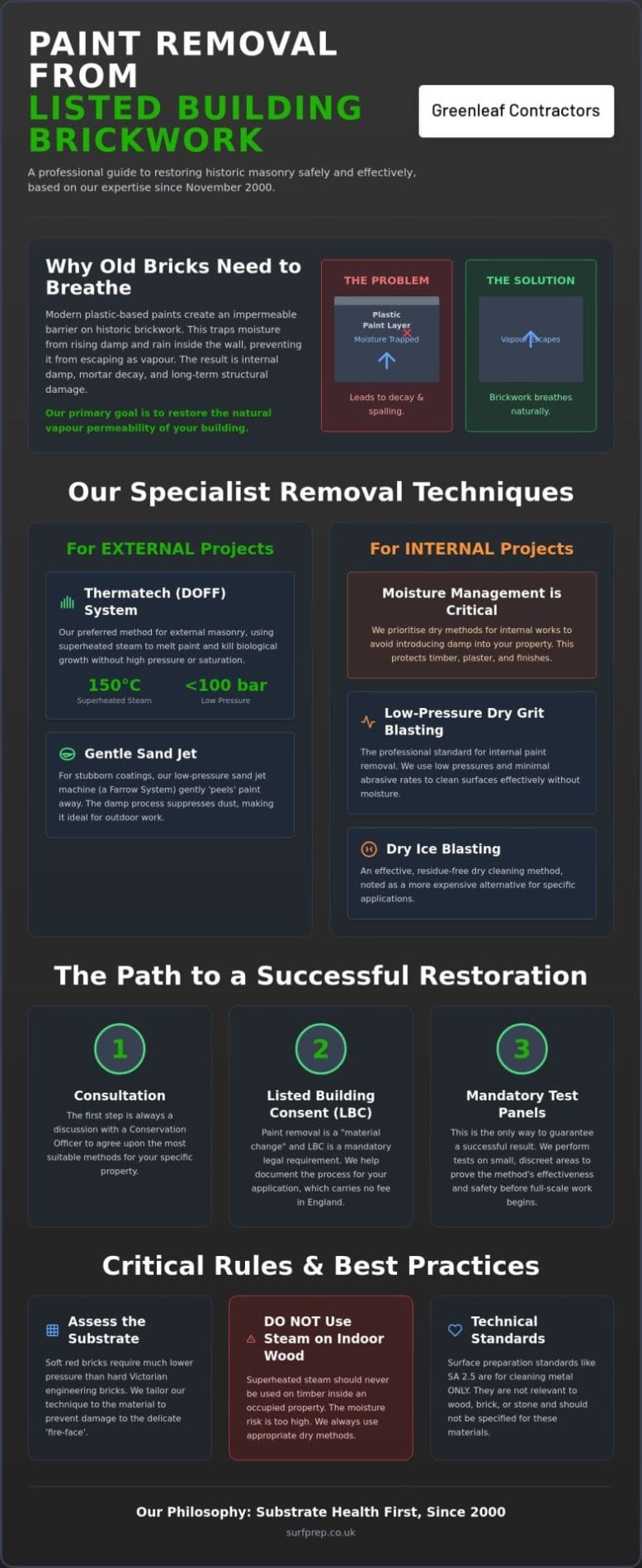
Old bricks need to breathe. When modern plastic-based masonry paints are applied over heritage surfaces, they create an impermeable barrier that traps rising damp and wind-driven rain within the wall. This moisture cannot escape as vapour, leading to internal damp issues and the slow decay of the mortar. Our expertise in brick cleaning since November 2000 has shown that the primary goal of any restoration must be to return the building to its natural state of vapour permeability.
The greatest risk during this process is damaging the “fire-face” of the brick. This is the hard, protective outer skin formed during the original kiln-firing process. If you use aggressive, traditional sandblasting, you’ll likely strip this skin away, leaving the soft, porous core of the brick exposed to the elements. We’ve seen countless properties where high-pressure methods have caused irreversible scarring. Instead, we utilise the sand jet machine, which is a gentle, low-pressure alternative that cleans without compromising the structural integrity of the substrate.
The Legal Framework: Listed Building Consent
You must remember that paint removal from listed building brickwork is almost always classified as a “material change” to the property’s character. Because of this, obtaining Listed Building Consent (LBC) is a mandatory requirement. It’s a criminal offence to proceed without it, though it’s helpful to know that there is currently no fee to apply for LBC in England. When we work on projects in heritage hubs like Leeds or York, we document our proposed methods clearly to satisfy local conservation officers. Whilst some might suggest using chemical paint removers to soften stubborn layers, these must be neutralised with extreme care to prevent salt deposits from forming later.
Assessing the Substrate: Soft Red Bricks vs Harder Clays
The success of the project depends on understanding what lies beneath the paint. Soft red rubbers or handmade Georgian bricks require a much lower operating pressure than harder, machine-made Victorian engineering bricks. Failing to adjust the technique can lead to rapid deterioration. Spalling is the physical breakdown of the brick surface caused by moisture expanding behind a non-breathable paint layer, particularly during freeze-thaw cycles. By choosing the right pressure and abrasive rate, we ensure the paint is lifted whilst the historic character of the clay remains untouched.
Specialist Removal Techniques: Thermatech, DOFF, and the Sand Jet
Successfully executing paint removal from listed building brickwork requires a nuanced understanding of both chemistry and physics. We often find that a single method isn’t a “silver bullet” for every project. In our professional experience (spanning over two decades), multi-layered oil paints often require a hybrid approach. This might involve softening the coating first with a targeted solution before using superheated steam to lift the residue. It’s about being an honest specialist; we won’t suggest a one-size-fits-all solution if the substrate requires a more complex, layered strategy.
When to Use Superheated Steam (Thermatech)
Thermatech, or DOFF as it’s widely recognised in the heritage sector, is our preferred choice for external masonry. It utilises superheated steam at 150°C to melt through paint layers and kill biological spores without saturating the brick. Because the pressure remains low (typically under 100 bar), there’s no risk of eroding fragile mortar joints or the brick face itself. This makes it an ideal tool for specialist brick cleaning services where preserving the original texture is paramount.
The Sand Jet Advantage for Stubborn Coatings
For more resilient coatings that steam alone cannot shift, our sand jet machine provides a gentle alternative to traditional sandblasting. Originally acquired as a Farrow System in November 2000, this technology uses a low-pressure vortex of air and a fine abrasive to “peel” paint from the surface. For outdoor work, we prefer the damp process to suppress dust and protect the surrounding environment. Learn more about our Sand Jet cleaning and how it differs from aggressive mechanical methods.
Our approach shifts significantly when moving from external facades to internal works. For indoor brickwork, moisture management is the priority to protect historic floorboards and structural timbers. We avoid superheated steam indoors to prevent introducing water into the property. Instead, we utilise traditional dry grit blasting at exceptionally low pressures and abrasive rates. Whilst dry ice blasting is a viable dry alternative for sensitive interiors, it’s important to be transparent: it remains a considerably more expensive option for most domestic or commercial budgets. If you’re unsure which method fits your property, our team can provide a technical assessment of your specific substrate.
Planning Your Restoration: Test Panels and Professional Standards
Before a single square metre of paint is stripped, we always conduct a mandatory test panel in a discreet area of the property. This isn’t just a recommendation; it’s a technical necessity that most conservation officers in heritage hubs like York and Leeds will insist upon. These trials allow us to calibrate our equipment to the specific hardness of your brickwork. A successful test means the paint is fully lifted whilst the brick’s “fire-face” remains untouched. We also look for “ghosting”—the faint, stubborn staining left behind by certain pigments—to decide if a secondary, gentle steam pass is required to achieve a uniform finish.
Logistics play a significant role in the success of paint removal from listed building brickwork, particularly in Northern England. We generally advise scheduling outdoor restoration for the spring or summer months. This timing allows the masonry to dry out naturally after the cleaning process. If work is carried out too late in the year, moisture trapped within the porous bricks can freeze and expand during winter, leading to the very spalling and face-damage we are trying to prevent. Once the bricks are clean and dry, the logical next step is re-pointing with a traditional lime mortar to ensure the entire wall remains vapour-permeable.
Working with a Heritage Specialist
Choosing a contractor with the right toolkit is vital for protecting your property’s value. You should look for a team that has long-term experience with both Thermatech (DOFF) and Farrow Systems (the Sand Jet). It’s important to differentiate heritage cleaning from industrial preparation. We’ve seen industrial firms mistakenly apply SA 2.5 standards to masonry; it’s a mistake we never make. SA 2.5 is a specific grit-blasting standard for steel and metalwork only; it’s far too aggressive for clay or stone. For more detailed advice on selecting a local partner, see our Professional Brick Cleaning in Leeds: A Specialist Buying Guide.
Aftercare and Maintenance
After the cleaning is complete, the best thing you can do for your building is to let it breathe. We strongly advise against the application of modern “waterproof” sealants or silicone-based coatings. These products often act exactly like the plastic paints we’ve just removed, trapping moisture within the substrate and causing long-term structural decay. By allowing the brickwork to remain in its natural, uncoated state, you’re ensuring the building stays healthy and damp-free for decades to come.
Restoring the Character of Your Heritage Property
Successful paint removal from listed building brickwork is about more than just aesthetics; it’s a vital preservation step to restore breathability and prevent long-term damp. We’ve discussed how choosing the correct technology, whether that’s the superheated steam of Thermatech (DOFF) for exteriors or low-pressure dry methods for internal works, protects the delicate fire-face of the brick whilst satisfying strict conservation requirements. By prioritising a “substrate-first” approach and conducting thorough test panels, you can avoid the permanent damage often caused by aggressive, traditional sandblasting.
Since November 2000, we’ve focused on delivering these specialist services with transparency and technical precision. We’re proud to be trusted by heritage property owners across Leeds, York, and Manchester who value an honest advisor over a quick fix. If you’re ready to uncover the original beauty of your masonry, request a professional brick restoration survey from our expert team. Your property has stood for generations; we’re here to help it stand for many more.
Frequently Asked Questions
Do I need Listed Building Consent to remove paint from my brickwork?
Yes, you almost certainly need Listed Building Consent before starting any paint removal from listed building brickwork. Because removing a permanent coating changes the external appearance and character of the property, local planning authorities in areas like Leeds or York view it as a material alteration. It’s worth remembering that whilst the application for consent is free in England, carrying out the work without it is a criminal offence.
Will removing the paint damage the original face of the bricks?
No, the brick face should remain intact if you avoid traditional, aggressive sandblasting. Our approach centres on preserving the “fire-face” of the brick, which is why we prioritise the gentle Sand Jet machine or Thermatech systems. These methods peel or melt the paint away at low pressures, ensuring the protective outer skin of the masonry isn’t scarred or pitted during the process.
How long does the paint removal process usually take for a terraced house?
Most standard terraced house facades can be completed within three to five working days. This timeframe includes the initial setup, the cleaning process itself, and the final rinse-down. However, the exact duration depends heavily on the number of paint layers present and the underlying brick condition, which is why we always recommend an initial site assessment to provide a realistic schedule.
Can you remove paint from internal brickwork without creating a mess?
We manage internal projects by shifting to dry, low-pressure grit blasting to avoid introducing water into your home. Unlike outdoor work where a damp process is preferred, internal paint removal from listed building brickwork requires strict moisture control to protect floorboards and joinery. Dry ice blasting is another “clean” option we can provide, though it’s important to note that it is generally a more expensive choice for most homeowners.
Is steam cleaning better than chemical stripping for historic masonry?
Superheated steam is generally superior because it doesn’t introduce harsh chemicals into the porous brickwork. Whilst chemical strippers can be effective for certain oil-based paints, they often require extensive neutralisation to prevent salt efflorescence from appearing later. Thermatech (DOFF) provides a cleaner result by using heat rather than chemicals to break the bond between the paint and the brick.
What is the difference between DOFF and Thermatech systems?
There is very little technical difference as both systems utilise superheated water at temperatures up to 150°C. Thermatech is the specific equipment we have used since our early years in business, whilst DOFF is a widely recognised brand name for the same process. Both are approved by conservation officers across the UK for use on sensitive heritage masonry because they offer high-temperature cleaning at exceptionally low pressures.
