
Your local contractor’s high-pressure washer is likely the single greatest threat to your property’s structural integrity. Whilst a quick blast might seem like an efficient way to shift decades of grime, the reality is that the risks of pressure washing heritage buildings often outweigh the temporary aesthetic gains. We understand the anxiety that comes with managing a historic asset, especially when you are caught between strict conservation regulations and the need for a clean facade. It is a common frustration; generalist contractors often promise a "deep clean" without realising they are actually stripping away the protective fire-skin of the brick or eroding delicate lime mortar joints.
Since we established our business in November 2000, we have seen first-hand how aggressive water pressure forces moisture deep into porous masonry, leading to salt crystallisation and structural decay. In this guide, we will show you how to achieve a pristine finish without the destruction. You’ll discover why high-pressure cleaning is a danger to historic masonry and learn about the expert-approved, gentle alternatives that preserve our architectural heritage. We’ll preview safe, non-destructive methods like Thermatech (often referred to as DOFF) superheated steam and our gentle sand jet machine, ensuring your restoration project remains compliant with UK heritage standards whilst retaining its long-term value.
Key Takeaways
- Understand why modern high-pressure systems are fundamentally incompatible with delicate historic materials like lime mortar and porous sandstone.
- Identify the specific risks of pressure washing heritage buildings, including the irreversible erosion of the protective ‘fire skin’ on historic bricks.
- Discover how Thermatech (and DOFF) superheated steam systems safely sanitise surfaces without the need for destructive mechanical force.
- Learn why the “sand jet” damp process is the preferred gentle alternative to traditional sandblasting for outdoor masonry restoration.
- Establish the correct approach for internal works, prioritising low-pressure dry methods to protect your property’s interior from moisture ingress.
Why Standard Pressure Washing Threatens Heritage Masonry
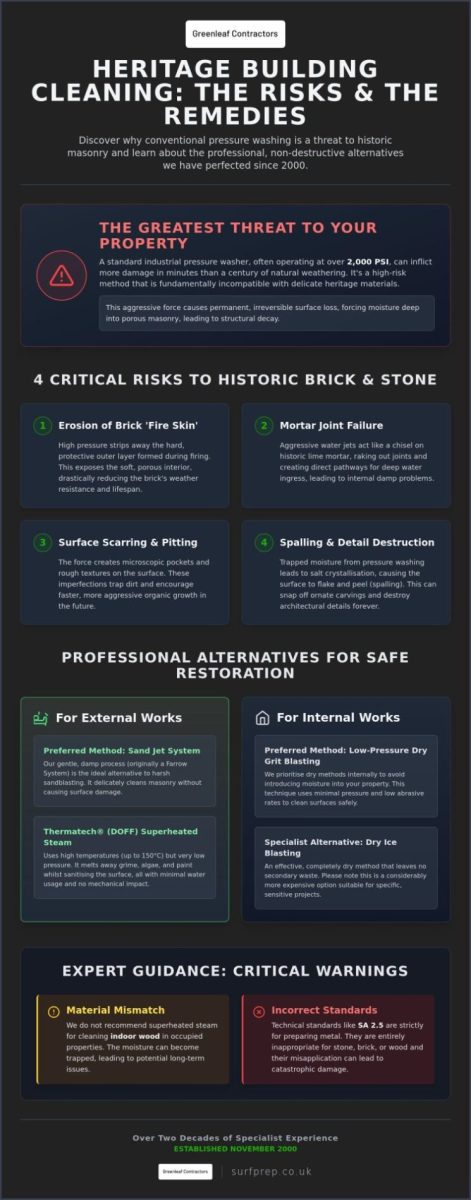
In the conservation industry, we define heritage masonry risk as the high probability that mechanical pressure will cause permanent, irreversible surface loss. It’s a harsh reality that a standard industrial pressure washer, often operating at upwards of 2,000 PSI, can do more damage in ten minutes than a century of natural weathering. Historic materials such as lime-based mortar, soft-fired bricks, and aged sandstone simply weren’t designed to withstand these modern mechanical forces. Whilst a generalist contractor might see a quick way to strip away algae or carbon deposits, a specialist sees the potential for catastrophic failure of the building fabric.
We often have to be the bearer of bad news; we’ll frequently advise against high-pressure water even when a client in Leeds or York is looking for the fastest, cheapest solution. True conservation and restoration of immovable cultural property requires prioritising structural preservation over superficial dirt removal. Since we started in November 2000, our focus has always been on material integrity. If a cleaning method risks the substrate, it isn’t a professional solution; it’s a hazard. Distinguishing between a clean facade and a preserved one is the hallmark of responsible heritage work.
The Science of Stone Decay and Surface Porosity
The primary danger lies in the way high pressure forces water deep into the pores
4 Critical Risks to Historic Brick and Stone Restoration
We’ve spent over two decades observing the physical consequences of improper cleaning, and the damage is rarely just aesthetic. The most common casualty is the ‘fire skin’ of a historic brick. This is the hard, protective outer crust formed during the kiln-firing process. When you apply high-pressure water, you effectively sandblast that layer away, exposing the soft, porous interior. Once this skin is gone, the brick loses its natural weather resistance and begins to crumble. It’s a prime example of the Dangers of Abrasive Cleaning; once that surface is breached, the material’s lifespan is halved.
Mortar joint failure is equally concerning, particularly with the lime mortars found in properties across the North. High-pressure jets act like a chisel, raking out the mortar and leaving deep voids. This doesn’t just look untidy; it creates a direct path for water ingress. This moisture is forced into the core of the heritage wall, leading to internal damp and the ‘blown’ plasterwork we often see in occupied houses. Surface scarring and pitting also occur, creating microscopic pockets that trap dirt and organic growth more aggressively than before. If you’re concerned about the state of your masonry, our brick cleaning specialists can assess the damage before it becomes a structural liability.
Spalling and the Destruction of Architectural Detail
Spalling occurs when the stone surface begins to flake or peel off in layers. This is often the result of internal pressure caused by trapped moisture or salt crystallisation. For the ornate carvings and delicate mouldings common on York and Leeds period properties, this is a death sentence. Mechanical pressure can snap off fine details that have survived for centuries. We always prioritise the ‘gentlest means possible’ to ensure these features remain intact for the next generation.
A Warning on Standards:
Metal cleaning standards have no place in stone cleaning or restoration. Using metal-grade blasting pressures on stone or brick is a fundamental error that leads to catastrophic failure. The risks of pressure washing heritage buildings are magnified when these industrial benchmarks are misapplied to fragile, historic substrates.
Professional Alternatives for Safe Heritage Restoration
We don’t just point out the risks of pressure washing heritage buildings; we provide the technical solutions to avoid them. Since November 2000, our approach has been rooted in what we call the "Expert Admission." This means we’ll tell you if a popular method isn’t right for your specific substrate. For example, whilst superheated steam is brilliant for stone, we’ll never recommend it for indoor wooden beams due to the risk of introducing moisture into an occupied house. Instead, we prioritise dry grit blasting at low pressures for internal restoration. Our commitment is to the method that protects the building, not the one that’s easiest for us to deploy.
Thermatech: The Conservationist’s Choice for Stone and Brick
Thermatech, often recognised by the industry term DOFF, uses superheated steam at temperatures up to 150°C. The magic here isn’t the pressure; it’s the heat. It melts away atmospheric pollutants and kills biological spores without the mechanical impact that causes surface erosion. It’s the primary choice for Professional Brick Cleaning in Leeds and York, offering a deep clean that respects the material’s age. By using low volume and high temperature, we avoid the Dangers of Abrasive Cleaning to Historic Buildings that standard pressure washers present.
The Sand Jet System for Sensitive Timber and Masonry
For outdoor stone restoration, our preferred tool is the sand jet machine. Originally acquired as a Farrow System in November 2000, this machine uses a damp process. It creates a vortex of low-pressure abrasive and water that gently erases dirt rather than blasting it. You can learn more about this on our Sand Jet Cleaning Services page. It’s a far cry from traditional sandblasting. For internal works, we shift our strategy. We avoid water entirely to protect the property’s core, opting instead for dry grit blasting at very low pressures and low abrasive rates. Whilst dry ice blasting is a viable alternative for interior cleaning, it remains a significantly more expensive option for most domestic or commercial projects.
Protecting Your Property’s Future Through Specialist Restoration
Managing a historic building requires a shift in mindset from cleaning to conservation. We’ve explored how high-pressure water isn’t just a surface-level hazard; it’s a structural threat that leads to salt crystallisation, mortar failure, and the loss of a brick’s protective fire skin. By understanding the risks of pressure washing heritage buildings, you’re already better equipped to protect your investment from the irreversible damage caused by generalist contractors. Whether it’s using Thermatech superheated steam for external masonry or low-pressure dry methods for internal timbers, the right choice always prioritises the building’s health over a quick aesthetic fix. This dedication to expert preservation is equally important for mobile assets; owners of leisure vehicles can rely on LeisureVan Service Solutions for specialist mobile maintenance of motorhomes and caravans.
This philosophy of care is universal; just as we protect historic masonry, those looking for specialist maintenance for other high-value assets in Dubai can discover Wipe Crew to see how professional detailing preserves delicate automotive finishes.
Since November 2000, we’ve acted as specialist contractors across Leeds, York, and the wider North, providing the technical expertise required for sensitive restoration. Our team uses conservation-approved Thermatech systems and the gentle sand jet machine to deliver results that satisfy both property owners and heritage officers. If you’re ready to restore your facade without compromising its integrity, Request a Heritage Restoration Assessment today. Let’s work together to preserve your property’s unique architectural character for years to come.
Frequently Asked Questions
Can I use a domestic pressure washer on my listed building?
You should never use a domestic pressure washer on a listed building because the mechanical force is far too aggressive for aged substrates. These machines typically operate at pressures that can easily strip the protective fire skin from historic bricks or cause sandstone to flake. Beyond the physical damage, you risk violating strict conservation regulations by using unapproved, destructive methods on a protected structure. It’s a risk that often leads to irreversible surface loss.
What is the difference between DOFF and Thermatech cleaning?
Thermatech and DOFF are both professional superheated steam systems that achieve similar conservation-grade results, though they are manufactured by different companies. Both systems are designed to reach temperatures of 150°C at the nozzle, allowing for the removal of biological growth and carbon sulphation without relying on high pressure. We prioritise Thermatech for its reliability and precision in delicate restoration projects, ensuring a clean finish that respects the integrity of the original material.
Why is lime mortar so vulnerable to pressure washing?
Lime mortar is significantly softer and more breathable than modern Portland cement, making it highly susceptible to erosion from high-velocity water jets. One of the primary risks of pressure washing heritage buildings is the accidental "raking out" of these joints, which compromises the wall’s structural stability. Aggressive washing can force water into the resulting gaps, leading to internal damp issues and salt crystallisation that accelerates the decay of the surrounding masonry.
What is the best way to clean historic stone window frames safely?
The safest method for cleaning historic stone window frames is usually Thermatech superheated steam, which gently lifts soot and grime without harming the stone’s natural patina. If the stone is heavily encrusted or has layers of old paint, we recommend our sand jet machine, originally acquired as a Farrow System in November 2000, using a low-pressure damp process. This approach avoids the pitting and scarring that traditional sandblasting or high-pressure washing would inevitably cause.
