
Most property owners believe that high-pressure blasting is the only way to shift stubborn spray paint, but excessive force is often the quickest way to permanently scar a building’s masonry. When you’re facing the stress of fresh vandalism, the fear of “ghosting” shadows or potential legal notices from the council can lead to rushed decisions. However, using steam to remove graffiti is actually the superior choice because it relies on temperature rather than brute impact. At Surfprep, we’ve been refining these restoration techniques since November 2000; we understand that the goal is to protect the stone whilst the paint simply melts away.
You deserve a clean facade that doesn’t look like it’s been through a war zone. In this guide, you’ll discover why superheated steam, specifically via the Thermatech system, is the most effective and gentle method for removing graffiti without damaging the underlying surface. We’ll also discuss when a damp, gentle sand jet is appropriate for external restoration and why certain moisture-heavy methods should be avoided for internal work. By the end, you’ll have a clear plan for a fast, professional solution that restores your property’s original patina and helps deter future vandals.
Key Takeaways
- Understand why using steam to remove graffiti at 150°C is the safest method for melting paint bonds without damaging the delicate “fire skin” of your brickwork.
- Learn how to assess surface porosity to ensure that softer stones, such as sandstone and limestone, are treated with the specialised care they require to prevent permanent scarring.
- Discover why the Thermatech system is the preferred choice for professional masonry restoration and how it effectively prevents the common problem of “ghosting” shadows.
- Find out why rapid removal within 24 to 48 hours is the most effective way to deter future vandals and maintain your building’s long-term kerb appeal.
- Explore how a professional pre-assessment helps identify specific paint types to ensure the most effective cleaning method is selected for your specific property.
Why Superheated Steam is the Gold Standard for Graffiti Removal
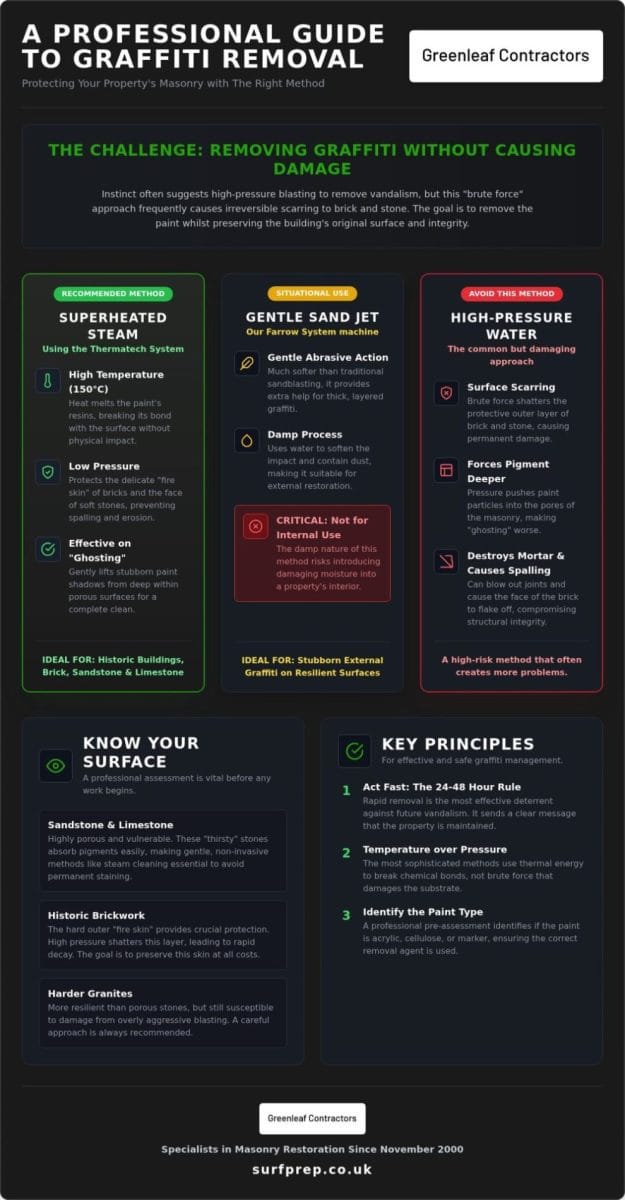
When vandalism strikes, the instinctive reaction is often to blast it away with as much force as possible. However, high-pressure cold water usually does more harm than good, forcing pigment deeper into the pores of the masonry and potentially shattering the surface of older materials. We’ve found that using steam to remove graffiti is a far more sophisticated approach. By heating water to 150°C, we transform it into a superheated vapour delivered at a remarkably low pressure. This isn’t about brute force; it’s about thermal energy. Whilst various Graffiti removal methods exist, superheated steam stands out for its ability to protect the “fire skin” (the hard, protective outer layer) of bricks and the delicate face of natural stone.
The Science of Thermatech: Breaking the Bond
We utilise the Thermatech system because it offers precise control over temperature. At 150°C, steam liquifies the resins in spray paints, such as acrylic or cellulose, without the need for aggressive scrubbing. The heat breaks the bond between paint and masonry, allowing the residue to be rinsed away gently. This process is vital for removing “ghosting” shadows; those stubborn stains that remain when chemicals fail to reach deep into the stone’s pores.
Protecting the Substrate: Why Pressure Isn’t the Answer
High pressure can easily blow out mortar joints or cause “spalling,” where the brick face flakes off. Since November 2000, we’ve focused on surface-active cleaning. Because steam melts the paint on contact, we keep pressures low to protect the building’s structural integrity. It’s a methodical process that leaves the underlying stone intact whilst ensuring the graffiti is completely eradicated, preserving the masonry for the long term.
Assessing Your Surface: From Historic Brick to Modern Stone
Before we even turn on the Thermatech machine, we have to understand the canvas. Different stones react uniquely to treatment. Harder granites are relatively resilient, but porous materials like sandstone and limestone require a far more cautious hand. If you use the wrong method on these “thirsty” stones, you risk driving the pigment so deep that it becomes a permanent part of the facade. Since we established Surfprep in November 2000, our priority has always been the long-term preservation of the building’s aesthetic. This often starts with a thorough pre-assessment to identify whether we’re dealing with acrylic spray, cellulose paint, or even permanent marker. For those managing larger properties, this assessment often forms part of a wider strategy for professional brick cleaning in Leeds or across West Yorkshire.
When Steam Meets Sandstone and Limestone
Heritage masonry is particularly vulnerable. In historic centres like York or Beverley, the light-coloured stone is easily stained by harsh chemical strippers, which can leave behind unsightly orange or blue tints. According to best practices for Removing Graffiti from Historic Masonry, avoiding abrasive force is essential. This is why using steam to remove graffiti is the preferred conservation-approved method. Using steam to remove graffiti is often the only way to ensure a shadow-free finish on delicate limestone without introducing aggressive chemicals that might react with the mineral composition of the stone.
The Sand Jet Alternative: When Steam Needs a Helping Hand
Sometimes, particularly with older, layered graffiti or exceptionally thick paint, steam alone isn’t enough. In these stubborn cases, we utilise our sand jet cleaning equipment. Originally acquired as a Farrow System in November 2000, this machine provides a gentle, damp abrasive action. It’s much softer than traditional sandblasting, making it ideal for external restoration. However, we’re always honest about its limitations. Because it’s a damp process, we never recommend it for indoor use to avoid introducing moisture into your property’s structure. If you’re unsure which method fits your building, we can provide a specialist surface assessment to find the safest path forward.
Organising a Graffiti Management Plan for Your Property
A proactive stance is always more effective than a reactive one. The “broken windows” theory suggests that leaving vandalism in place sends a signal of neglect, which often invites further damage. In the UK, where graffiti removal costs an estimated £1 billion annually, rapid removal within 24 to 48 hours is the most proven deterrent. Integrating this response into a broader commercial kerb appeal strategy doesn’t just protect your building; it maintains the professional image of your business. Under the Anti-Social Behaviour, Crime and Policing Act 2014, local authorities can issue notices to private owners to remove graffiti that affects local amenity, so staying ahead of the problem is a legal necessity as much as an aesthetic one.
High-street restoration requires a level of oversight that DIY methods simply can’t provide. Professional contractors offer the necessary health and safety RAMS (Risk Assessment and Method Statements) and insurance required for working in public spaces. Since November 2000, we’ve focused on delivering these high standards across the North of England. We ensure that using steam to remove graffiti is carried out with minimal disruption to pedestrians whilst guaranteeing a finish that meets heritage requirements.
Professional Removal vs DIY Risks
We strongly advise against using “off-the-shelf” chemical removers found in hardware shops. These products are often too aggressive for porous UK masonry and can permanently bleach stone or burn the delicate face of a brick. Amateurs often struggle with “ghosting,” which is the faint, stubborn shadow left behind when paint isn’t fully extracted. By using the Thermatech system’s superheated vapour, we lift the pigment out of the pores entirely, avoiding the need for the harsh scrubbing that causes surface scarring.
Long-Term Protection and Anti-Graffiti Coatings
Once the masonry is clean, applying a protective coating can make future incidents much easier to manage. Sacrificial coatings are designed to be washed away along with the graffiti during the next clean, whilst permanent coatings provide a long-term barrier. However, the initial restoration must be flawless. If a coating is applied over a “ghost” shadow, that stain is effectively sealed into the stone forever. We always ensure the substrate is perfectly prepared before suggesting any preventative measures.
Restoring Your Building’s Professional Facade
Effective restoration is about choosing the right tool for the specific material of your building. We’ve seen that using steam to remove graffiti at 150°C provides a clean finish without the scarring risks of high pressure or the staining risks of harsh chemicals. It’s a precise science. Whether you’re dealing with delicate Yorkstone or modern brickwork, the priority is always to lift the pigment whilst leaving the substrate perfectly intact. This ensures your property maintains its original character and value for years to come.
Rapid removal is your best defence against repeat vandalism, but it shouldn’t come at the cost of your property’s structural integrity. Since establishing Surfprep in November 2000, we’ve spent over two decades refining our approach across Leeds, York, Hull, and the wider North of England. As specialists in Thermatech superheated steam systems, we provide the technical expertise and logistical reliability needed for complex high-street or heritage projects. If you’re facing fresh vandalism or need a long-term management plan, contact our specialist team for a graffiti removal quote today. We’ll help you restore your property’s kerb appeal with the care and precision it deserves.
Frequently Asked Questions
Is steam cleaning safe for listed buildings and heritage masonry?
Superheated steam is widely considered the safest method for heritage masonry and listed buildings. Because our Thermatech system operates at very low pressure, it doesn’t risk the structural damage associated with traditional power washing. It effectively removes paint whilst preserving the stone’s original patina and mineral integrity, making it a favourite for conservation officers across the UK.
Will using steam leave a ‘ghost’ image of the graffiti behind?
Using steam to remove graffiti significantly reduces the risk of “ghosting” or shadows. The high temperature of 150°C liquifies the paint resins, allowing the pigment to be lifted out of the stone’s pores rather than being driven deeper into the substrate. This methodical process ensures a clean finish that cold-water methods simply can’t match.
Can I use superheated steam to remove graffiti from wooden beams inside my house?
We don’t recommend using superheated steam for wooden beams inside a property, particularly in occupied houses. The moisture introduced can cause timber to swell or warp, creating long-term structural issues. For internal timber restoration, we suggest traditional dry grit blasting at low pressures or dry ice blasting, though you should be aware that dry ice is a significantly more expensive option.
How much does professional graffiti removal cost in the UK?
Professional removal costs in the UK depend on several factors, including the type of masonry, the height of the work, and the specific paint used. Every project is unique. We provide bespoke quotes after a thorough assessment to ensure the most cost-effective and safe method is chosen for your specific building material and location.
Is steam cleaning more environmentally friendly than chemical removal?
Steam cleaning is an exceptionally eco-friendly choice compared to traditional chemical strippers. It relies entirely on thermal energy and water, meaning there’s no toxic runoff or harsh solvent odour left behind. This makes it ideal for public spaces and high-street environments where environmental safety and public health are primary concerns for local councils.
How quickly can Surfprep respond to a graffiti incident in Leeds or Hull?
We prioritise rapid response for clients in Leeds, Hull, York, and across the North of England. Since our establishment in November 2000, we’ve built the logistical capacity to handle urgent requests quickly. Aiming for removal within 24 to 48 hours is our standard recommendation to prevent your property from becoming a repeat target for vandals.
