
What if the weekend project you planned to restore your home’s character ends up stripping away its history forever? It’s natural to feel tempted by the cost savings of manual sanding, yet the reality often involves endless mess and the genuine risk of damaging delicate grain with harsh chemicals. You’re right to worry about hidden lead paint or the physical toll of the work. This guide explores the critical differences in DIY vs professional wooden beam restoration to ensure your historic timbers are preserved safely and beautifully. Since establishing our specialist service in November 2000, we’ve focused on methods that avoid introducing moisture into your property. We will compare DIY efforts against professional low-pressure dry grit blasting, providing the expert advice you need to choose the right path for your specific barn or cottage restoration.
Key Takeaways
- Identify the hidden risks of DIY methods, including how chemical strippers can leave residues that prevent future oils and waxes from bonding correctly to the timber.
- Understand the critical role of moisture control in the DIY vs professional wooden beam restoration decision, particularly why dry grit blasting is preferred over steam for internal works.
- Learn why low-pressure techniques are vital for preserving delicate historic grain, preventing the aggressive pitting often caused by standard industrial sandblasting.
- Evaluate the complexity of your property’s timbers to determine when specialist expertise is required to safely manage lead paint risks and structural preservation.
The Appeal and Practical Risks of DIY Wooden Beam Restoration
Many homeowners across Leeds and York feel the pull of a weekend project when they first look at the darkened timbers in their cottages. Since establishing our business in November 2000, we’ve seen many people start with a heat gun, thinking the job is simply elbow grease. For larger projects, professional wooden beam cleaning is often the safer route. However, the debate over DIY vs professional wooden beam restoration often ignores the physical toll. Manual sanding is messy and time-consuming. Heat guns can also easily scorch old oak if held a second too long.
Then there is the issue of chemical strippers. These products might promise a clean finish, but they often leave behind alkaline or acidic residues deep within the timber fibres. These leftovers can react poorly with future treatments, causing patches or peeling when you try to apply a final coat. If you want to understand the complexities of these layers, consult this comprehensive guide to wood finishing.
Common DIY Mistakes: Chemical Residues and Grain Damage
One frequent error is “blinding” the grain. Excessive sanding smooths over pores, creating a flat, plastic-like appearance rather than the rich texture of original oak. Our Expert Admission: whilst a single mantelpiece is a reasonable DIY task, a full barn conversion is impractical. Houses built before the 1960s carry a significant risk of containing lead-based paint, which is hazardous when disturbed. The DIY vs professional wooden beam restoration choice ensures these hazards are managed correctly from the start.
Professional Restoration: Low-Pressure Grit Blasting and Modern Alternatives
Professional restoration isn’t just about speed; it’s about control. Traditional sandblasting is often far too aggressive for aged timber, as high pressures can tear through the soft summerwood and leave deep pits. We focus on low-pressure dry grit blasting, which uses a delicate abrasive rate to lift paint and grime without gouging the oak. This precision is a key factor in the DIY vs professional wooden beam restoration debate, as it preserves the historical integrity of the wood. For those managing sensitive projects, Historic building preservation briefs often highlight the importance of using the least impactful method possible.
Why We Avoid Superheated Steam for Internal Timber
Whilst we utilise our Thermatech machine for superheated steam cleaning on external brickwork, we never recommend it for internal wood. Moisture is the enemy of structural timbers, especially in occupied homes where trapped water can lead to rot or damp issues. For external surfaces or masonry, the sand jet cleaning process, originally acquired as the Farrow System in November 2000, provides a gentle, damp alternative that keeps dust to a minimum. It’s a reliable choice for barns or cottages where external timbers require a sympathetic touch.
For internal work, dry grit blasting remains the industry standard for efficiency and cost-effectiveness. Expert Admission: dry ice blasting is a superb, residue-free option for premium projects, but it is often significantly more expensive than traditional low-pressure methods. If you are unsure which approach suits your property, you can always speak with our specialists for an honest assessment. Our team has refined these processes over two decades, ensuring we deliver a clean, natural finish that highlights the grain without compromising the timber’s strength. Deciding between DIY vs professional wooden beam restoration often comes down to this level of technical safety and finish quality.
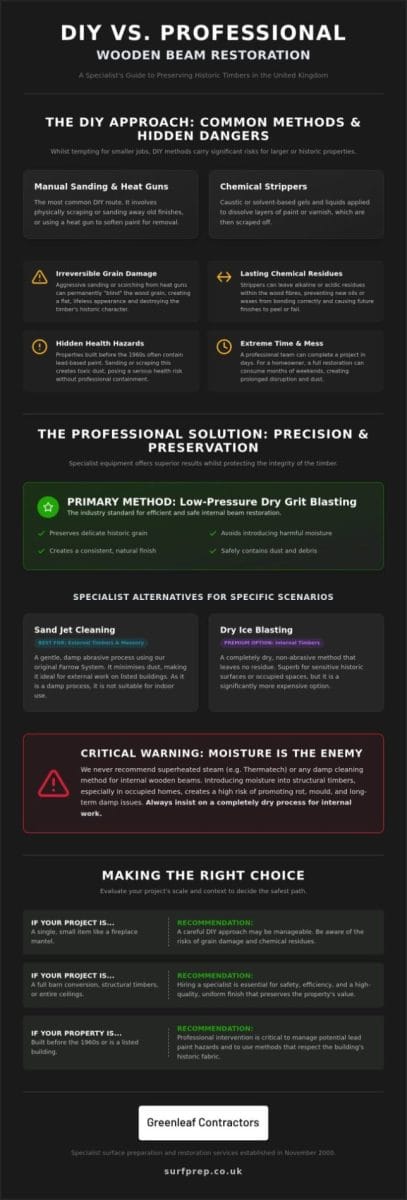
Making the Choice: When to Hire a Specialist for Your Property
Choosing the right path for your home often depends on the scale of the project. If you’re tackling a single fireplace mantel, the manual approach might be manageable. However, when you’re faced with a full ceiling of structural timbers, the mess and physical exhaustion can quickly become overwhelming. This is where the DIY vs professional wooden beam restoration debate shifts from cost to practical value. A professional team can often complete in three days what might take a homeowner months of dedicated weekends.
Evaluating Your Project: Safety, Speed, and the Final Aesthetic
Since we began our work in November 2000, we’ve helped countless owners of barn conversions and listed cottages navigate these choices. Large-scale projects require a level of consistency that’s hard to achieve by hand. Our low-pressure dry grit blasting ensures a uniform, lightened aesthetic (what we call the “Surfprep Finish”) across every square inch of timber. Unlike the patchy results often seen with manual sanding, our method reveals the natural grain whilst keeping the surface perfectly dry.
A clean, dry surface is essential before you apply any final oils or waxes. If you use chemical strippers or introduce moisture (as discussed in previous sections), you risk trapping contaminants that ruin the final look. We pride ourselves on being honest advisors; if we think a DIY approach is suitable for your specific beam, we’ll tell you. For a transparent appraisal of your home’s needs, we encourage you to contact our specialists today. Balancing DIY vs professional wooden beam restoration is ultimately about ensuring your historic property remains a safe, beautiful investment for years to come.
Restore Your Timbers with Confidence
Deciding on DIY vs professional wooden beam restoration ultimately comes down to the balance between personal effort and the long-term health of your property. We’ve seen that while minor repairs are possible for homeowners, larger projects like barn conversions require the precision of low-pressure dry grit blasting to avoid grain damage and moisture ingress. Since November 2000, we’ve helped owners across Leeds, York, and Manchester reveal the hidden beauty of their historic timbers without the mess of manual sanding. Our specialists ensure a clean, natural finish whilst managing hidden risks such as lead paint. If you want to transform your home safely, it’s time to seek an honest appraisal from a reliable veteran in the field. Request a Professional Timber Restoration Quote today to see how we can bring your original features back to life. Your historic timbers deserve a finish that lasts for generations.
Frequently Asked Questions
Is DIY wooden beam restoration cheaper than hiring a professional?
DIY methods often appear cheaper because you only pay for materials like sandpaper or chemical strippers. However, when evaluating DIY vs professional wooden beam restoration, you must consider the value of your time and the risk of permanent timber damage. A specialist ensures the job is done correctly the first time, preventing the need for costly repairs to “blinded” or chemically stained grain.
Can I use a heat gun to remove paint from my ceiling beams?
You can use a heat gun, but we strongly advise against it for structural timbers. The high heat required to lift old paint can easily scorch the oak, leaving unsightly black marks that are difficult to remove. Additionally, many period properties in the UK contain lead-based paint. This releases toxic fumes when heated, which poses a significant health risk to your family and pets.
Will professional grit blasting create a lot of dust in my home?
Any dry restoration process will generate dust, but we take extensive measures to manage it. We use heavy-duty sheeting and industrial extraction systems to contain the debris within the work area. Whilst it’s a messy process, our team handles the heavy lifting and cleanup. We complete in days what would take a DIYer weeks of uncontained, exhausting manual sanding.
What is the best way to lighten dark, stained wooden beams safely?
Low-pressure dry grit blasting is the most effective way to remove years of dark stain and reveal the natural timber underneath. This method gently lifts the surface layers without introducing moisture or harmful chemicals. It provides a uniform, lightened aesthetic that highlights the original grain. This result is incredibly difficult to achieve with patchy hand-sanding or liquid chemical strippers.
Can I use a pressure washer or steam cleaner on my internal beams?
We never recommend using pressure washers or superheated steam cleaners, such as the Thermatech, on internal wood. Introducing water into structural timbers can lead to rot, mould, and moisture ingress within your property walls. For internal work, we always utilise dry methods to keep your home safe. We only use the damp sand jet system for external masonry or timber surfaces.
How long does professional wooden beam restoration typically take?
Most domestic projects, including barn conversions, are completed within two to four days. The speed of a professional team is a major factor in the DIY vs professional wooden beam restoration choice. Expert admission: whilst dry ice blasting is a faster, residue-free alternative, it is often too expensive for domestic budgets. This makes low-pressure dry grit blasting the most practical and efficient choice for homes.
