
The true cost of surface restoration isn’t just the initial quote; it’s the invisible price of silica dust drifting into every crevice of a heritage property or industrial facility. We’ve seen many projects where the post-work clean-up ends up costing more than the preparation itself, not to mention the significant health risks involved. Adopting the right dust-free surface preparation methods is no longer just a preference for the tidy-minded; it’s a necessity for meeting 2026 UK health and safety standards whilst ensuring that delicate stone or timber isn’t scarred by aggressive, outdated techniques.
We understand that finding the balance between a deep clean and a safe site is a constant challenge for UK contractors and property owners alike. This guide explores the most effective, mess-free techniques available today, focusing on UK-compliant methods that prioritise substrate integrity and operator safety. You’ll discover how to achieve a high-standard, coating-ready finish without the risk of secondary damage. We’ll walk through specific applications for superheated steam, the sand jet system, and industrial preparation, providing an honest look at which technology fits your specific restoration needs.
Key Takeaways
- Learn why eliminating airborne particulates is the essential foundation for ensuring long-term coating adhesion and operator safety.
- Discover how superheated steam at 150°C provides a chemical-free solution for removing paint and biological growth from masonry.
- Master the use of dust-free surface preparation methods like the sand jet system to safely clean and restore delicate heritage substrates.
- Gain a clear framework for selecting the right restoration technique based on your specific material, from industrial steel to timber beams.
- Understand the practical distinctions between total dust containment and low-dust alternatives for large-scale commercial and industrial projects.
Understanding Dust-Free Surface Preparation: Standards and Benefits
True dust-free surface preparation methods are defined by their ability to control the environment as much as the substrate. In practical terms, this means using specialised equipment that either suppresses particulates with a fine water mist or captures them immediately through high-efficiency vacuum systems. This level of control is essential for modern restoration projects; it ensures that old coatings, carbon sulphation, and contaminants are removed without creating a secondary cleaning crisis for the client or a health hazard for the public.
Surface cleanliness serves as the absolute foundation for any successful coating application. If a substrate isn’t cleared of microscopic dust and salts, the new paint or sealant is essentially bonding to a loose film rather than the material itself. This inevitably leads to premature peeling or flaking, often within the first year of application. By adhering to rigorous surface preparation standards (Sa 2.5), we can achieve a “near-white” finish that provides the perfect mechanical key for modern coatings whilst maintaining a pristine site environment. This principle is especially critical when considering surface preparation for non-slip coatings, where the correct mechanical profile directly determines whether a safety-critical system will bond and perform over the long term.
The Problem with Traditional Grit Blasting
Standard open-air Abrasive blasting methods present significant logistical and environmental headaches, particularly in densely populated urban centres like Manchester or Leeds. Beyond the obvious mess, there is a constant risk of “secondary damage” to historic structures. Aggressive, dry grit can easily strip away the “fire” (the protective, vitrified outer skin) of a Victorian brick, leaving the porous interior exposed to frost and moisture. This is why we prioritise gentler, contained alternatives that preserve the building’s structural integrity.
UK Regulatory Standards for Dust Control
In the UK, the Health and Safety Executive (HSE) remains strictly focused on the dangers of Respirable Crystalline Silica (RCS) and wood dust. All contractors must operate within specific Workplace Exposure Limits (WELs) to protect both the workforce and anyone in the vicinity of the site. We align our processes with British Standards Institution (BSI) norms for surface cleanliness and particle containment. This ensures that every project isn’t just visually impressive, but fully compliant with current UK safety legislation.
Leading Dust-Free and Low-Dust Methods for Masonry and Timber
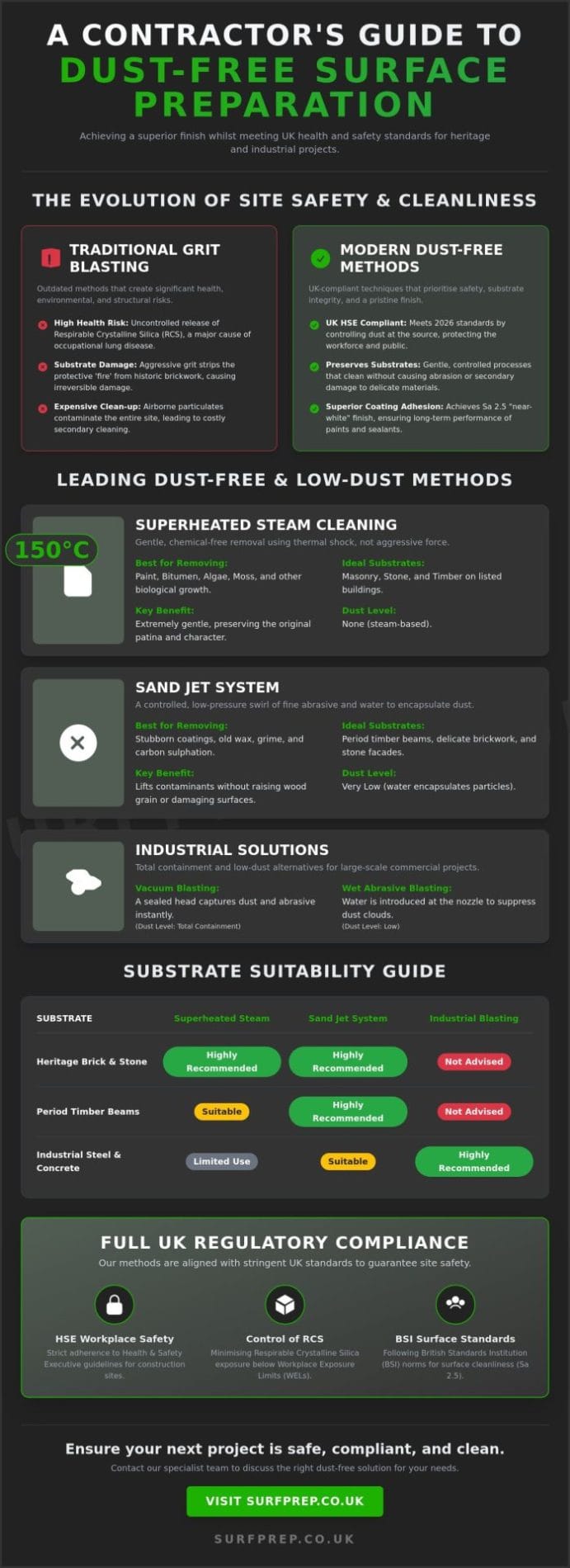
Selecting the most appropriate dust-free surface preparation methods depends entirely on the substrate’s fragility and the immediate environment. For masonry and timber, superheated steam cleaning is a primary choice. By utilising steam at 150°C, the Doff system melts away paint, bitumen, and biological growth without the need for harsh chemicals or high-pressure impact. It’s an exceptionally gentle process that relies on thermal shock rather than mechanical force, which prevents the clouds of debris associated with dry methods.
When a project requires a more abrasive touch to remove stubborn coatings, Sand Jet Cleaning provides a controlled, low-volume solution. This method uses a low-pressure swirl of fine abrasive and water to encapsulate particles at the point of impact. For industrial applications, vacuum blasting uses a sealed head to capture dust instantly, whilst wet abrasive blasting methods introduce water at the nozzle to weight particles. These techniques ensure strict compliance with UK Health and Safety Executive (HSE) guidelines regarding respirable crystalline silica (RCS), protecting both the workforce and the public on confined UK sites.
Restoring Period Timber and Beams
Barn conversions in regions like York or Derby often feature historic oak that simply cannot withstand aggressive mechanical sanding. Traditional dry methods create a pervasive sawdust storm that settles into every joint and crevice. We specialise in cleaning wooden beams using the sand jet method, which lifts old wax and grime without raising the grain or saturating the timber. It’s a precise, methodical alternative to traditional sanding, maintaining the wood’s character whilst keeping the interior workspace clean.
Specialist Brick and Stone Cleaning
For listed buildings, brick restoration must be handled with extreme care to preserve the original patina and the “fire” of the brick. We often employ the Farrow System or similar low-pressure technologies for soft British sandstone and limestone. These systems allow for fine-tuned control over the cleaning intensity, ensuring the substrate remains undamaged by the process. If you’re managing a heritage project and need to avoid the mess of traditional blasting, you might want to speak with a specialist about our tailored containment solutions.
Implementing Dust-Free Solutions: Compliance, Costs, and Selection
Selecting from various dust-free surface preparation methods requires a clear-eyed look at your substrate and site constraints. For industrial steel, vacuum blasting or wet abrasive techniques are often the standard, providing a rigorous clean whilst containing debris. Conversely, porous materials like stone or timber demand the gentler touch of superheated steam or low-pressure sand jets to avoid irreversible surface etching. Matching the kinetic energy of the cleaning media to the fragility of the material is the only way to ensure a successful restoration. Where the finished surface will carry a functional coating, understanding the specific requirements of professional surface preparation for non-slip coatings ensures the chosen method delivers the precise mechanical profile needed for maximum adhesion and long-term durability.
Whilst “100% dust-free” is always our target, we believe in being transparent with our clients. On massive industrial projects, achieving a laboratory-clean atmosphere is rarely possible. In these cases, “low-dust” methods like wet abrasive blasting are the most pragmatic choice. They don’t eliminate every single particle, but they do “weight” the dust, causing it to drop safely to the floor. This still offers massive logistical benefits; it allows other trades, such as electricians or joiners, to continue their work nearby without the need for total site evacuation. This overlap can significantly reduce overall project timelines.
From a financial perspective, specialised equipment often carries a higher daily rate. However, the total project cost is frequently lower. When you factor in the savings from not needing complex scaffolding encapsulation or the days of intensive site-wide clean-up required after dry blasting, the “expensive” method often becomes the most economical route. It’s a matter of looking at the bottom line rather than just the initial quote.
Preparing for an Industrial Project
Successful execution on a large scale requires meticulous planning. Site managers should consider this brief checklist before work begins:
- Scaffolding: Ensure it’s rated for the weight of specialised machinery and provides adequate access for hoses.
- Water Access: A consistent, high-pressure water supply is essential for steam and wet-prep methods.
- Waste Disposal: Plan for the containment and filtration of runoff or slurry to meet UK environmental regulations.
Choosing a contractor with a proven track record in specialist stone cleaning is vital. Experience ensures they can navigate these logistical hurdles without delaying the rest of your build. For projects involving high-level exterior surfaces, our detailed guide on industrial building facade cleaning in York covers the specialist methods and heritage considerations that apply to complex facade restoration work.
Environmental and Community Impact
In sensitive urban locations, such as Newcastle city centre or residential areas in Hull, traditional grit blasting is rarely an option due to noise and air quality concerns. Dust-free methods allow for restoration work to proceed with minimal disruption to the public or neighbouring businesses. Ultimately, “Dust-Free” is a commitment to both technical excellence and public health.
Achieving a Cleaner Standard for Your Next Restoration
Adopting modern dust-free surface preparation methods represents a significant step forward in site safety and operational efficiency. By prioritising the kinetic balance of systems like Doff superheated steam and the Sand Jet, you ensure that delicate heritage brickwork and industrial steel alike receive the exact treatment they require. This methodical approach doesn’t just satisfy HSE requirements; it protects your bottom line by eliminating the hidden costs of extensive site-wide clean-up and trade delays.
Our team brings years of practical expertise in Sa 2.5 industrial standards and sensitive heritage restoration to every project we undertake. From barn conversions in the Midlands to industrial building facade cleaning in York and commercial refurbishments across the North of England, we focus on delivering a high-standard finish that respects both the substrate and the surrounding environment. We’re here to provide the honest advice and technical capability needed to get the job done right the first time.
Contact Surfprep today for a professional site assessment and dust-free preparation quote. We look forward to helping you transform your surfaces with precision and care.
Frequently Asked Questions
Is dust-free surface preparation truly 100% dust-free?
Whilst the term implies total elimination, achieving a 100% dust-free environment in an industrial setting is rarely possible. Most dust-free surface preparation methods are more accurately described as dust-controlled or low-dust processes. Techniques like vacuum blasting come closest to total containment by sealing the blast head, whereas wet methods focus on suppressing particles so they don’t become airborne. It’s about mitigation and safety rather than absolute perfection in every scenario.
Can I use these methods on listed buildings in the UK?
These methods are frequently the preferred choice for listed buildings and heritage structures across the UK. Superheated steam and low-pressure sand jet systems are often specifically requested by conservation officers because they clean without the aggressive impact of traditional grit. These techniques allow for the removal of paint and carbon whilst preserving the delicate patina of the original stone or brickwork. They provide a sympathetic restoration that meets strict historical standards.
How much more expensive is dust-free blasting compared to traditional methods?
The upfront cost of hiring specialised machinery is generally higher than traditional dry blasting due to the complexity of the equipment. However, you’ll usually find that the total project expenditure is lower. By using dust-free surface preparation methods, you eliminate the need for expensive scaffolding encapsulation and reduce the days required for site-wide clean-up. It also prevents costly downtime for other trades working in the immediate vicinity of the site.
What happens to the waste material when using wet or steam-based cleaning?
Using water or steam converts what would have been airborne dust into a manageable liquid runoff or slurry. This waste material must be contained and filtered on-site to comply with UK environmental and water authority regulations. We typically use bunding or filtration mats to capture solids, ensuring that only clean water enters the drainage system. This responsible approach prevents local contamination and simplifies the final site clearance once the preparation is complete.
